A home warranty covers breakdowns; home insurance covers disasters — most homeowners need one, and some benefit from having both. If you own a home, understanding the difference can prevent a costly mistake: filing a warranty claim for storm damage (denied), or assuming your homeowners policy covers a broken HVAC (it won't).
Feature
Home Insurance
Home Warranty
What it covers
Damage from fire, storms, theft, liability
Breakdown of HVAC, appliances, and home systems
What it doesn't cover
Wear and tear, mechanical failure
Sudden/accidental damage, structural damage
Avg. annual cost
$1,400–$2,300
$350–$600
Required by lender?
Yes — for financed homes
No — optional
Claim trigger
Covered peril (fire, theft, windstorm)
System or appliance breakdown from age or wear
Your cost per claim
Deductible ($500–$2,500 typical)
Service fee per visit ($75–$150)
What Is Home Insurance?
Home insurance (also called homeowners insurance) is a contract with an insurer that pays to repair or replace your home and belongings when a covered event — called a peril — causes damage. It also protects you financially if someone is injured on your property or you accidentally damage someone else's property.
Standard HO-3 home insurance policies cover four main areas:
Dwelling coverage: Pays to repair or rebuild the structure of your home — walls, roof, foundation — after fire, windstorm, hail, or other covered perils.
Personal property coverage: Replaces your belongings — furniture, electronics, clothing — if they're damaged or stolen.
Liability coverage: Pays medical bills and legal costs if someone is injured at your home or you accidentally damage someone else's property.
Additional living expenses (ALE): Covers hotel and food costs if your home becomes uninhabitable while repairs are made.
If you have a mortgage, your lender requires you to carry home insurance as a condition of the loan. The national average premium runs approximately $1,400–$2,300 per year, varying by location, home value, and coverage levels.
What Is a Home Warranty?
A home warranty is a service contract — not an insurance policy — that covers repair or replacement of major home systems and appliances when they break down from normal wear and tear. Unlike home insurance, a home warranty is entirely optional and has nothing to do with your mortgage lender.
When a covered item breaks — say, your air conditioner stops cooling in August — you call your home warranty provider. They dispatch a contractor from their network, you pay a service fee ($75–$150 per visit), and the contractor repairs or replaces the item. If replacement is required, your warranty covers it up to a per-item cap, typically $1,500–$3,000.
Standard home warranty plans typically cover:
HVAC systems (heating and air conditioning)
Water heater
Plumbing and plumbing stoppages
Electrical systems
Refrigerator, dishwasher, oven/range, microwave, and garbage disposal
Annual premiums run $350–$600 for basic plans, rising to $800–$1,200 for comprehensive coverage. Most plans have a 30-day waiting period after signup before coverage activates — something to keep in mind if you're buying immediately after closing on a home.
What Each One Covers: A Detailed Breakdown
Here's how common homeownership scenarios map to each product:
Situation
Home Insurance
Home Warranty
Fire or smoke damages your home
Covered
Not covered
Windstorm or hail damages roof
Covered
Not covered
Theft of personal belongings
Covered
Not covered
Guest slips and falls at your home
Covered (liability)
Not covered
Pipe bursts suddenly from a freeze
Covered (sudden/accidental)
Not covered
HVAC stops working after 12 years
Not covered
Covered
Water heater fails from old age
Not covered
Covered
Dishwasher motor burns out
Not covered
Covered
Plumbing clog from normal use
Not covered
Covered
Pipe slowly corrodes over time
Not covered
Covered
Flood (storm surge, river overflow)
Not covered
Not covered
Earthquake
Not covered
Not covered
Termite or pest damage
Not covered
Not covered
Pre-existing conditions
Not covered
Not covered
Flood and earthquake coverage each require separate policies. Standard home insurance explicitly excludes both. Neither home insurance nor a home warranty covers conditions that existed before the policy start date.
The Cost Math: A Worked Example
Here's how the numbers break down for a typical 2,000-square-foot home at national average pricing:
Cost Item
Annual
Notes
Home insurance
~$1,800
National average for a 2,000 sq ft home, HO-3 policy
Home warranty (basic plan)
~$500
Covers HVAC, appliances, plumbing, electrical
Service fees (2 claims/yr)
~$200
$100/call × 2 service visits
Total — insurance only
$1,800
Plus your deductible when you file a claim
Total — both products, 2 claims
~$2,500
Before any deductible on the insurance side
When a home warranty pays off: A single HVAC repair runs $500–$2,500; a full replacement costs $7,000–$15,000. A warranty with a $2,000 HVAC cap won't make you whole on a full replacement, but for smaller covered repairs — water heater failure ($1,000–$1,500), dishwasher motor ($300–$500) — the math works in your favor within the first year.
When home insurance pays off: A kitchen fire causing $40,000 in structural damage, or a liability claim after a guest breaks their arm on your property, is exactly what home insurance is for. No home warranty touches these scenarios.
You Always Need Home Insurance
If you carry a mortgage, home insurance is non-negotiable. Your lender requires it as a condition of the loan. If coverage lapses, your lender can force-place insurance at your expense — typically at 2–3× market rates, with a policy that only protects the lender's interest, not yours.
A home warranty adds the most value in these situations:
First-time homebuyer with limited reserves: If you've stretched your budget on the purchase and have limited cash for repairs, a warranty creates predictable costs — you pay the service fee; they handle the work.
Older home (10+ years): HVAC units, water heaters, and appliances fail far more frequently after the 10-year mark. A home built in 2014 or earlier is a strong warranty candidate.
Unknown system condition: If you inherited a home or bought one without a recent inspection of mechanical systems, a warranty limits your exposure to unknown defects — subject to pre-existing condition rules.
Rental property owners: Home warranties simplify maintenance management. One call handles service dispatch instead of you coordinating contractors across multiple properties or tenants.
Remote or non-handy homeowners: If you're not local or don't have trusted contractors on speed dial, a warranty provides a pre-vetted service network on demand.
When a Home Warranty Is Probably Not Worth It
New construction: Most builders provide a 1-year workmanship warranty, 2-year mechanical systems warranty, and 10-year structural warranty. This builder warranty overlaps almost entirely with home warranty coverage — don't pay for duplicate protection.
Recently replaced systems: If your HVAC is 3 years old and your appliances were replaced after purchase, manufacturer warranties likely cover the same failures a home warranty would.
Handy homeowners: If you can diagnose and fix most household issues yourself, you're paying annual premiums for a service you'll rarely use.
Homeowners with a strong emergency fund: $15,000–$20,000 in liquid savings earmarked for home repairs is often cheaper over a 10-year horizon than a decade of premiums plus service fees.
Should You Get Both? A Decision Framework
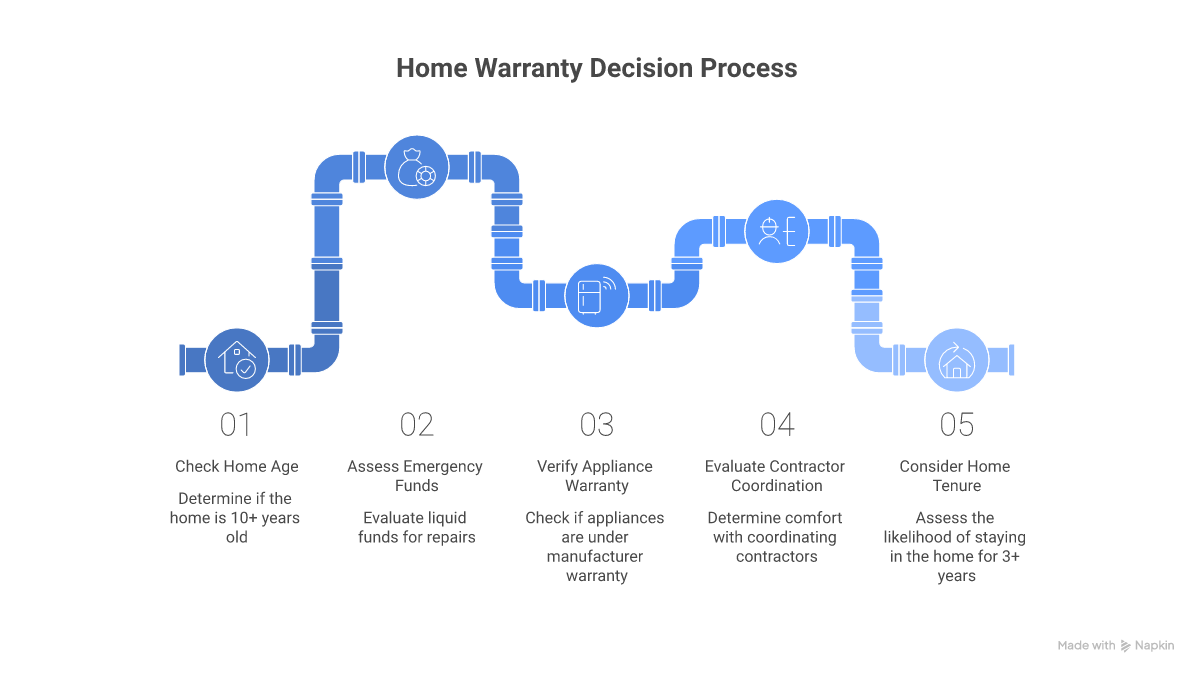
Should you add a home warranty? A 5-question flowchart
Home insurance is non-negotiable if you have a mortgage. The real question is whether to add a home warranty on top. Work through these five questions:
Is my home 10+ years old? If yes, warranty value increases significantly as systems near end-of-life.
Do I have $5,000–$15,000 liquid for emergency repairs? If no, a warranty reduces financial risk at a predictable price.
Are my appliances still under manufacturer warranty? If yes, a basic home warranty may double-cover items already protected.
Am I comfortable coordinating my own contractors? If no, the warranty's service network has real convenience value beyond just cost.
Will I be in this home for 3+ more years? Short-term owners rarely recoup warranty costs; sellers can offer a 1-year warranty as a buyer incentive instead.
Verdict: Most homeowners benefit from home insurance always. A home warranty adds meaningful value for owners of homes 10+ years old with limited repair reserves. Carrying both costs roughly $2,300–$3,000 per year — compare that against a single HVAC replacement at $7,000–$15,000, which a warranty partially offsets.
Common Home Warranty Pitfalls
Pre-Existing Condition Denials
The most common home warranty complaint is claim denial for pre-existing conditions. Most policies exclude any defect that existed before your start date — and the determination is made by the warranty company's own contractor. Protect yourself: get a home inspection before activating your warranty and document that all covered systems are currently operational. Keep that inspection report on file.
Maintenance-Requirement Clauses
Home warranties require you to maintain covered systems properly. If your HVAC filter hasn't been changed in years when the unit fails, the warranty company may deny the claim citing lack of maintenance. Keep records of annual HVAC service, water heater flushes, and drain cleaning — documentation protects your claims.
Coverage Caps
Per-item caps are often lower than actual replacement costs. A standard plan may cap HVAC at $1,500–$2,000, but a full system replacement can run $7,000–$15,000. Always verify the per-item cap for your highest-risk systems before purchasing. Premium plans sometimes offer higher caps or unlimited coverage on specific items — compare them side by side.
Contractor Quality
Home warranty companies dispatch their own contractors — you don't choose the technician. Service quality varies widely by provider and region. Before purchasing, check BBB ratings, Trustpilot reviews, and your state attorney general's complaint database for the specific company. A warranty backed by poor contractor networks can be worse than no warranty at all.
How to File a Claim on Each
Filing a Home Insurance Claim
1. Document damage immediately with photos and video. 2. Contact your insurer within 24–72 hours of discovering damage — check your policy's reporting window. 3. The insurer assigns an adjuster who inspects the damage and estimates repair costs. 4. You receive a settlement offer covering repairs minus your deductible. Typical resolution: 2–4 weeks for standard claims, 60–90 days for major losses.
Filing a Home Warranty Claim
1. Call your warranty provider's service line (most offer 24/7 submission) or submit online. 2. A contractor from their network contacts you within 24–48 hours to schedule a visit. 3. You pay the service fee at the time of service. 4. The contractor diagnoses and repairs the issue, typically within 2–5 business days. For replacements requiring warranty approval, add 5–10 business days. Resolution times vary by provider and region.
Ready to Compare?
Start with these resources to find the right coverage for your home:
Explore HELOC options — if a major repair is already needed, a home equity line of credit can be a smarter funding option than financing through a warranty claim
See what you could be paying
Get auto insurance quotes from top carriers in a couple of minutes.
Compare pet insurance plans that cover dental cleanings, extractions, and periodontal disease. See which top insurers include dental — and which exclude it.
Young drivers pay 2-3x more for car insurance. We compared the best and cheapest options for 18-25-year-olds — including discounts that can cut your rate by 30%.
SR-22 is not insurance — it's a certificate your insurer files with the state. Learn who needs it, how much it costs, how long you need it, and where to get it cheap.