Best Car Insurance for New and Young Drivers in 2026: Rates Compared
If you're between 16 and 25, you already know car insurance is expensive. The average 18-year-old pays around $514 per month for full-coverage auto insurance on their own policy — more than triple the national average of $167 per month. The gap narrows as you age: by 22, full coverage averages about $301–$327 per month. But the right insurer, the right discounts, and the right coverage setup can cut those numbers significantly. Here's what you need to know to find the best auto insurance rate as a young driver.
Best Auto Insurance Companies for Young Drivers in 2026
Not every insurer prices young driver risk the same way. After comparing rates, discounts, telematics programs, and customer satisfaction data, these five companies stand out:
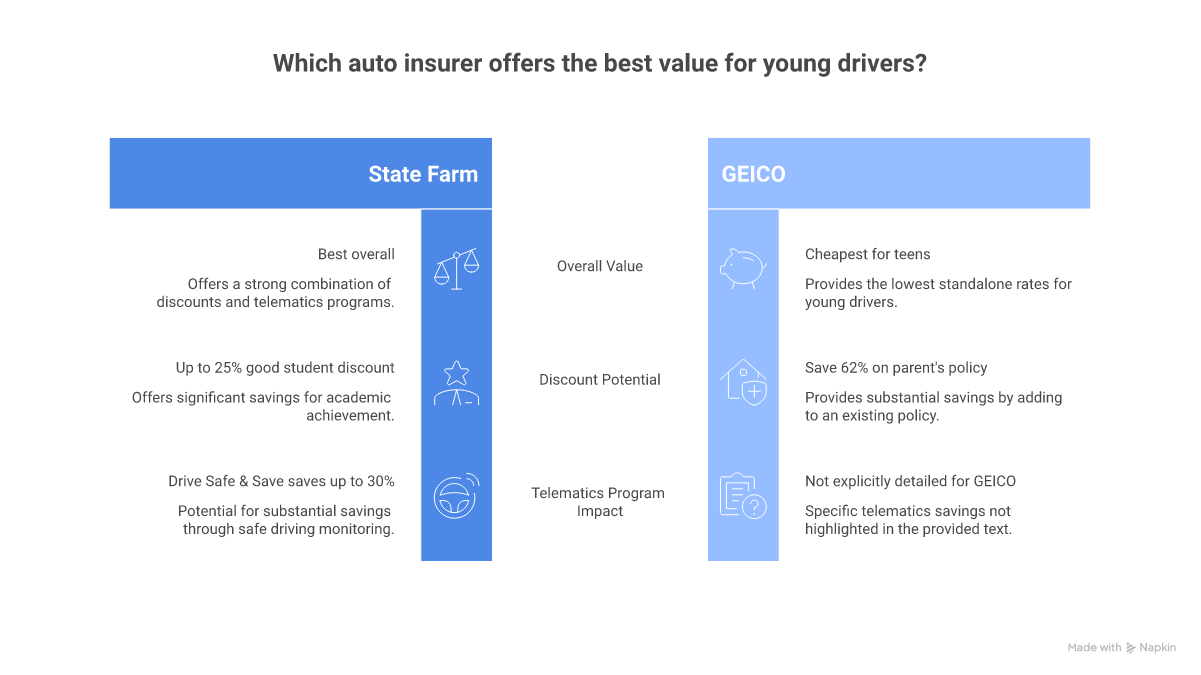
State Farm — Best overall. Average full-coverage rate around $327/month for a 22-year-old male. Drive Safe & Save telematics (up to 30% off), good student discount (up to 25%).
GEICO — Cheapest for 18-year-olds. Averages around $488/month for full coverage on a standalone policy. Strong student discounts available.
Progressive — Best usage-based program. Snapshot telematics saves qualified drivers an average of $322/year. Strong option for careful young drivers with low mileage.
Erie Insurance — Best for college students who leave their car at home. Student away at school discount available when you live 100+ miles away (12 states + D.C.).
Nationwide — Best for young drivers staying on a parent's policy. SmartRide telematics (up to 40% off) and strong multi-policy discounts benefit the whole family plan.
Best auto insurance picks for young drivers: rates and discounts compared
Best Overall for Young Drivers: State Farm
State Farm is the largest auto insurer in the U.S. and consistently ranks as the top option for young drivers who want competitive rates, a strong discount stack, and reliable customer service. Its Drive Safe & Save program tracks your driving through a mobile app and can reduce your premium by up to 30% based on your actual driving behavior — a powerful discount for a young driver willing to prove they're careful behind the wheel.
State Farm also offers one of the best good student discounts in the industry: up to 25% off for drivers under 25 who maintain a 3.0 GPA or better. Its Steer Clear program provides additional savings for drivers under 25 with a clean record who complete a driver training module. Whether you're on your parents' policy or managing your own, State Farm is flexible and easy to work with across different life stages.
Cheapest for 18-Year-Olds: GEICO
GEICO is consistently the cheapest major insurer for 18-year-old drivers on a standalone policy, averaging approximately $488 per month for full coverage — lower than most large national competitors. If you're added to a parent's existing GEICO policy, costs drop even further: young drivers save an average of 62% by being on a family plan versus their own policy.
GEICO offers a good student discount (B average required), a student away at school discount for those living 100+ miles from their car, and a driver's education discount. While GEICO's customer satisfaction scores are more middling than State Farm's, it consistently wins on price — which is often the top priority for first-time policyholders paying their own premiums.
Best Usage-Based Insurance: Progressive Snapshot
Progressive's Snapshot program is the most widely used telematics program in the country. Drivers who qualify for savings with Snapshot save an average of $322 per year. Progressive also offers a discount just for signing up — $169 on average — even before any driving data is collected. Snapshot tracks speed, hard braking, time of day, and phone usage during trips.
One important caveat: unlike State Farm's Drive Safe & Save, Progressive Snapshot can raise your rate if it identifies risky driving patterns — about 20% of Snapshot users see a rate increase. It's best suited for young drivers who commute during daytime hours, drive fewer miles than average, and consistently avoid hard braking and fast acceleration. Progressive also offers a good student discount and a student away at school discount for college students.
Best for College Students Away at School: Erie Insurance
Erie Insurance's college student discount is among the most valuable in the industry for families with a student heading off to school. To qualify, the student must be unmarried, enrolled full-time, living more than 100 miles from where the car is parked, and the car must stay home during the school year. Under those conditions, Erie significantly reduces the premium — because the car is effectively unused for much of the year.
Erie is only available in 12 states and Washington, D.C. (including Illinois, Indiana, Kentucky, Maryland, New York, North Carolina, Ohio, Pennsylvania, Tennessee, Virginia, West Virginia, and Wisconsin). If Erie operates in your state and you have a college-bound student who's leaving their car at home, it's one of the first quotes you should request.
Best if on Your Parents' Policy: Nationwide
Staying on your parents' policy is almost always the cheaper option for young drivers, and Nationwide is a strong choice for families looking to maximize savings across the whole household policy. Nationwide's SmartRide telematics program offers up to 40% off for safe driving — one of the highest potential discounts of any major insurer's usage-based program. Because the discount applies at the policy level, a young safe driver can directly lower the family's premium.
Nationwide also offers competitive multi-policy discounts when home and auto are bundled together. The company carries strong financial stability ratings, meaning claims are paid reliably. It's a solid pick for families who want one carrier handling all their coverage needs.
Why Do Young Drivers Pay So Much for Car Insurance?
Insurers set premiums based on statistical risk, and young drivers represent the highest-risk group on the road. According to the Insurance Institute for Highway Safety (IIHS), drivers aged 16–19 are nearly three times more likely to be in a fatal crash than drivers aged 20 and older. Drivers aged 20–24 continue to have elevated crash rates relative to more experienced adults.
The key factors that drive up young driver premiums: higher accident frequency, no driving history for insurers to price against, more severe claims when accidents do occur, and a greater likelihood of driving late at night and on weekends, statistically the riskiest times on the road. These factors explain why an 18-year-old pays over $500/month while the average U.S. driver pays about $167/month. The good news: rates drop consistently each year from 18 to 25 as you build a clean record, and most major young-driver surcharges phase out by age 25.
Average Car Insurance Cost by Age
Age is the single biggest lever on a young driver's premium. Rates fall hardest at 18, 21, and 25, the points where insurers re-price the risk. The figures below are national averages for full coverage on the driver's own policy; your real rate shifts with state, vehicle, and driving record.
Driver age
Avg. monthly full-coverage premium (own policy)
16
~$820
18
~$510–625
21
~$300–340
25
~$200–250
Adult average (35–55)
~$167
Car Insurance Discounts That Actually Move the Needle
Good Student Discount (Save 10–25%)
Most major insurers — including State Farm, GEICO, Progressive, Allstate, and Nationwide — offer a good student discount for full-time students under 25 who maintain a B average (3.0 GPA) or better. State Farm offers the highest discount at up to 25%. Allstate accepts a slightly lower GPA threshold of 2.7. To maintain the discount, you'll typically submit a transcript or grade report each semester. If your grades qualify, make sure every insurer you quote knows about it — it's one of the most consistent savings available to young drivers.
Telematics / Usage-Based Programs (Save 10–40%)
Telematics programs track your actual driving behavior — braking, speed, phone use, and time of day — and reward safe habits with premium discounts. State Farm's Drive Safe & Save can save up to 30%. Progressive Snapshot saves careful drivers an average of $322/year. Nationwide SmartRide can reduce premiums by up to 40% for excellent drivers. These programs are especially valuable for young drivers who can demonstrate that their driving habits are safer than their age group's statistics suggest. Note: Progressive Snapshot is the only major program that can raise your rate for unfavorable driving data — the others only lower it.
Student Away at School Discount (Save 10–25%)
If you're a college student attending school more than 100 miles from where your car is garaged and you leave the car at home, you likely qualify for a student away at school discount. GEICO, Erie, State Farm, and Progressive all offer this discount. It reflects the reduced mileage and lower daily driving risk during the school year. This is one of the easiest discounts to qualify for if your situation fits — and requires nothing other than verifying the distance with your insurer.
Defensive Driving Course (Save 5–15%)
Completing an approved defensive driving or driver's education course can earn a 5–15% discount with most insurers. Some states require insurers to honor approved courses; others leave it discretionary. Before enrolling, confirm with your insurer which courses qualify — not every program counts. The discount is typically available to drivers under 25 and is usually a one-time filing. It's a modest savings, but the course also builds actual driving skills that reduce your long-term accident risk.
Multi-Policy Bundle (Save 5–15%)
If you rent an apartment, bundling renters insurance with your auto policy can unlock a 5–15% discount on both policies. Renters insurance typically runs $15–30 per month, making it an affordable add-on that also protects your personal belongings. Most major insurers — including State Farm, Nationwide, Progressive, and Allstate — offer a multi-policy discount for auto and renters together. For 22–25 year olds who have moved out on their own, this is a straightforward way to stack a discount with minimal additional cost.
Should You Stay on Your Parents' Policy or Get Your Own?
For most young drivers, staying on your parents' policy is significantly cheaper than a standalone policy. Adding a 22-year-old to an existing parent policy typically adds $150–250 per month to the family premium. A standalone full-coverage policy for the same driver can run $300–400 per month or more. If you share the same primary address, the math almost always favors staying on the family plan.
Getting your own policy makes sense when: you move to a separate address (most insurers require all licensed household drivers on the same policy), your car is registered in your name at a different address, your driving record has violations that could raise your parents' rates significantly, or you're past 25 and rates have moderated enough that a standalone policy is no longer substantially more expensive.
Staying on a Parent's Policy: Pros and Cons
Pros
Much lower premiums: a young driver on a parent's multi-car policy usually pays far less than the same driver on a standalone policy, thanks to multi-car and bundling discounts.
Shared discounts carry over: good-student, telematics, and home-bundle discounts on the family policy apply to the young driver too.
One bill, less hassle: a single renewal and payment for the household, with the parent able to manage coverage and claims.
Cons
Claims hit the family rate: an at-fault accident by the young driver raises the premium for everyone on the policy, not just them.
Address rules apply: most insurers require the driver to live at the parent's address, so moving out usually forces a separate policy.
No independent history: staying on a parent's policy can delay building the standalone insurance record that earns lower rates later.
How to Lower Your Car Insurance Rate Over Time
Your rate will decrease naturally as you age and build experience. These steps can accelerate those savings:
Maintain a clean driving record. A single speeding ticket can raise a young driver's premium by 20–30% and stays on your record for 3–5 years. Avoiding accidents and moving violations is the single most impactful thing you can do for your long-term insurance rate.
Raise your deductible. Increasing your deductible from $500 to $1,000 typically reduces your premium by 10–15%. Only raise it if you have savings to cover the higher out-of-pocket amount if you need to file a claim.
Choose a safe, practical car. Sports cars and luxury vehicles cost significantly more to insure. Practical sedans and SUVs with strong IIHS safety ratings cost less to insure and less to repair after a claim. If you're financing a car, understand how gap insurance works and whether you need it.
Build your credit score. Most states allow insurers to use credit-based insurance scores as a rating factor. Building a solid credit history over time — paying bills on time, keeping balances low — gradually reduces your premium as your score improves.
New Driver vs Young Driver: Why the Distinction Matters for Your Rate
Insurers price two separate things, and most comparison pages collapse them into one. The first is age. The second is years licensed. A 19-year-old who has held a license for three years and a 34-year-old who got licensed last month are both new drivers, but only one of them carries a youthful operator surcharge on top of the inexperience loading. That is why an adult new driver who assumes the teen advice applies usually overpays: the good student discount and the student away at school discount are useless to them, while a defensive driving course and telematics do most of the work. National premium data from the NAIC is reported by state and coverage type rather than by driving history, so the only way to see what your own record costs is to run quotes with your actual licensed-since date. If you are over 25 and newly licensed, ignore any page that only talks about teenagers.
Car Insurance for New Drivers: What Changes at Each Age
Rates do not fall smoothly. They step down at the points where insurers re-tier the risk, and each step has a different reason behind it. The average premiums by age are in the table above; what follows is what changes underneath them.
At 18: you can hold a policy in your own name in every state, and graduated driver licensing restrictions start coming off. This is also the most expensive year to leave a parent policy, because you lose the multi-car and multi-policy discounts at the same moment you pick up the full youthful operator surcharge.
At 19 and 20: nothing structural changes, but the surcharge decays with each claim-free year and each year of telematics data. This is the stretch where a usage-based insurance program pays for itself, because you finally have enough driving history for the insurer to price you as an individual rather than as a bracket.
At 21: many carriers move you into a new rating tier, and the student away at school discount usually ends if you graduate and move back to a full-time garaging address. Update your address and annual mileage the same week they change. A stale garaging address is one of the most common reasons a renewal quote comes back higher than expected.
At 25: the youthful operator surcharge typically drops off entirely. If yours does not, ask the carrier directly, because the change is not always automatic on a policy where you were added as a named driver rather than the primary insured.
Youthful Driver Rating Explained
A youthful driver rating is the surcharge an insurer applies when a household member under roughly 25 is rated on a vehicle. It is not a penalty for anything you did. It is priced off crash statistics: CDC risk-factor research, IIHS crash statistics and federal teen driving data all put the crash rate per mile driven for the youngest licensed drivers well above the adult rate. A youthful driver rating change is what happens when that surcharge is added or removed: a teen gets licensed and is added to the policy, a student moves back home, or a driver ages out of the bracket. Two details matter. The surcharge attaches to the vehicle the young driver is rated on, so assigning them to the cheapest car in the household is a real lever. And an excluded driver is not a listed driver, so excluding someone who then drives the car can void the claim.
Which Companies Should a New Driver Actually Compare?
Get quotes from at least four carriers drawn from three different groups, because each group prices new drivers with different logic. Start with the large national carriers that run the strongest student and telematics programs: State Farm, GEICO, Progressive and Nationwide. State Farm's rates for young drivers are usually the benchmark to beat when a good student discount applies. Add one regional carrier if you are inside its footprint, since regionals like Erie Insurance often undercut the nationals on the same risk. Then add one digital-first option, such as Lemonade car insurance, which underwrites around telematics from the first day rather than bolting it on. Quote all of them with identical liability limits, deductible and annual mileage, or you are comparing coverage rather than price. The fastest way to do that is to compare auto insurance quotes in one pass.
Compare Auto Insurance Quotes
The fastest way to find your best rate as a young driver is to compare multiple quotes side by side. Use our auto insurance comparison tool to see personalized rates from top insurers in your area — it takes less than two minutes. Rates vary significantly by state, vehicle, and driving record, so your specific cheapest option may differ from national averages.
Frequently Asked Questions
See what you could be paying
Get auto insurance quotes from top carriers in a couple of minutes.
Compare pet insurance plans that cover dental cleanings, extractions, and periodontal disease. See which top insurers include dental — and which exclude it.
Home warranties cover appliance and system breakdowns; home insurance covers disasters and liability. Here's what each covers, what they cost, and whether you need both.
SR-22 is not insurance — it's a certificate your insurer files with the state. Learn who needs it, how much it costs, how long you need it, and where to get it cheap.