SR-22 Insurance: What It Is, How Much It Costs & Where to Get It
An SR-22 is not actually insurance — it's a certificate of financial responsibility that your auto insurance company files with your state's DMV. It proves you carry at least the state-minimum liability coverage. Most people need an SR-22 after a DUI, driving without insurance, or certain other serious traffic violations. This guide explains who needs one, what it costs, how to get it, and which companies offer the cheapest SR-22 coverage.
What Is SR-22 Insurance?
SR-22 is a form (sometimes called a "certificate of financial responsibility") that your insurance company files on your behalf with your state. It tells the state that you have active auto insurance meeting at least the minimum liability requirements. If your policy lapses or is cancelled, your insurer is required to notify the state — which can result in license suspension.
The SR-22 itself doesn't cost much — typically a one-time filing fee of $15-$50. The real cost is the increase in your insurance premiums, which can double or triple depending on your violation and driving history.
Who Needs an SR-22?
You'll typically need an SR-22 if you've been convicted of:
DUI or DWI
Driving without insurance
Reckless driving
Too many traffic violations in a short period
At-fault accident while uninsured
License suspension or revocation
Not all states require SR-22 forms. Virginia and Florida use a similar form called FR-44, which requires higher liability limits. A few states (including Delaware, Kentucky, Minnesota, New Mexico, New York, North Carolina, Oklahoma, and Pennsylvania) don't use SR-22 at all — they have their own processes for monitoring high-risk drivers.
How Much Does SR-22 Insurance Cost?
The SR-22 filing fee itself is cheap — usually $15-$50 as a one-time charge from your insurer. The expensive part is the insurance premium increase that comes with whatever violation triggered the SR-22 requirement.
On average, drivers who need an SR-22 pay $1,500-$3,000 more per year in auto insurance premiums compared to clean-record drivers. A DUI typically causes the largest increase (50-100%+ premium hike), while a lapse in coverage may cause a smaller but still significant increase (20-50%). Your actual cost depends on your state, driving record, age, vehicle, and which insurer you use — which is why shopping around is critical.
Cheapest SR-22 Insurance: How to Find Affordable Coverage
Not all insurance companies treat SR-22 drivers the same way. Some specialize in high-risk drivers and offer significantly lower rates than major carriers. Here are the most affordable options:
The General: Specializes in high-risk and non-standard auto insurance. Often the cheapest option for drivers with DUIs or suspended licenses. Available in most states.
Direct Auto: Another specialist in non-standard insurance. Strong presence in southern states with physical locations for in-person service.
Progressive: Major carrier that's relatively accommodating of high-risk drivers. Their Snapshot program can help lower rates based on driving behavior.
Root Insurance: Uses a driving test via their app to price your coverage. If you're a safe driver who made a one-time mistake, Root's behavior-based pricing could save you money.
GEICO: Will file SR-22 for existing customers and offers competitive rates for drivers with clean records apart from the triggering violation.
The most effective way to find the cheapest SR-22 insurance is to get quotes from at least 3-5 companies. Rates vary dramatically between insurers for high-risk drivers — the difference between the most and least expensive quote can easily be $1,000+ per year.
How to Get SR-22 Insurance
Getting an SR-22 is straightforward:
Contact your current insurer and tell them you need an SR-22 filing. If your current insurer doesn't offer SR-22 or drops you, you'll need to find a new carrier.
Get auto insurance that meets your state's minimum requirements. You need at least the state-minimum liability coverage. Some states or violations may require higher limits.
Your insurer files the SR-22 electronically with your state's DMV. This usually takes 1-3 business days. Some states accept same-day electronic filing.
Maintain continuous coverage for the required period (typically 3 years). Any lapse triggers your insurer to notify the state, which can restart the clock or result in license suspension.
Non-Owner SR-22 Insurance
If you need an SR-22 but don't own a car, you can get a non-owner SR-22 policy. This is a liability-only policy that covers you when driving borrowed or rented vehicles. It satisfies the state's SR-22 requirement without requiring you to insure a specific vehicle.
Non-owner SR-22 policies are typically cheaper than standard SR-22 policies since there's no vehicle to insure for collision or comprehensive coverage. Expect to pay $200-$500 per year for a non-owner policy, plus the SR-22 filing fee. The General, Progressive, and GEICO all offer non-owner policies with SR-22 filing.
How Long Do You Need SR-22?
In most states, you're required to maintain an SR-22 for 3 years from the date of your conviction or license reinstatement. Some states require longer periods for repeat offenses or severe violations. The clock resets if your insurance lapses during the SR-22 period — so maintaining continuous coverage is critical.
After the required period ends, you can ask your insurer to stop filing the SR-22. This doesn't automatically lower your rates — you'll still need to shop around for better pricing, but you'll no longer face the restrictions and monitoring that come with SR-22 status.
SR-22 Insurance by State
SR-22 requirements vary significantly by state. Most states require an SR-22 for 3 years, but the triggering violations, minimum coverage limits, and specific processes differ.
Florida: Florida requires FR-44 (not SR-22) for DUI convictions, which mandates higher liability limits than standard SR-22 — $100K/$300K bodily injury and $50K property damage. This makes Florida DUI insurance among the most expensive in the country.
Virginia: Virginia also uses FR-44 for DUI-related offenses with enhanced liability requirements. For non-DUI violations, Virginia uses a standard SR-22 with state-minimum limits.
Tennessee: Tennessee requires SR-22 for DUI, driving without insurance, and multiple traffic violations. The filing period is 3 years. Tennessee has relatively moderate minimum liability requirements ($25K/$50K/$15K).
Georgia: Georgia requires SR-22 for DUI, driving without insurance, and serious traffic offenses. The filing period is 3 years from the date of conviction.
SR-22 vs FR-44
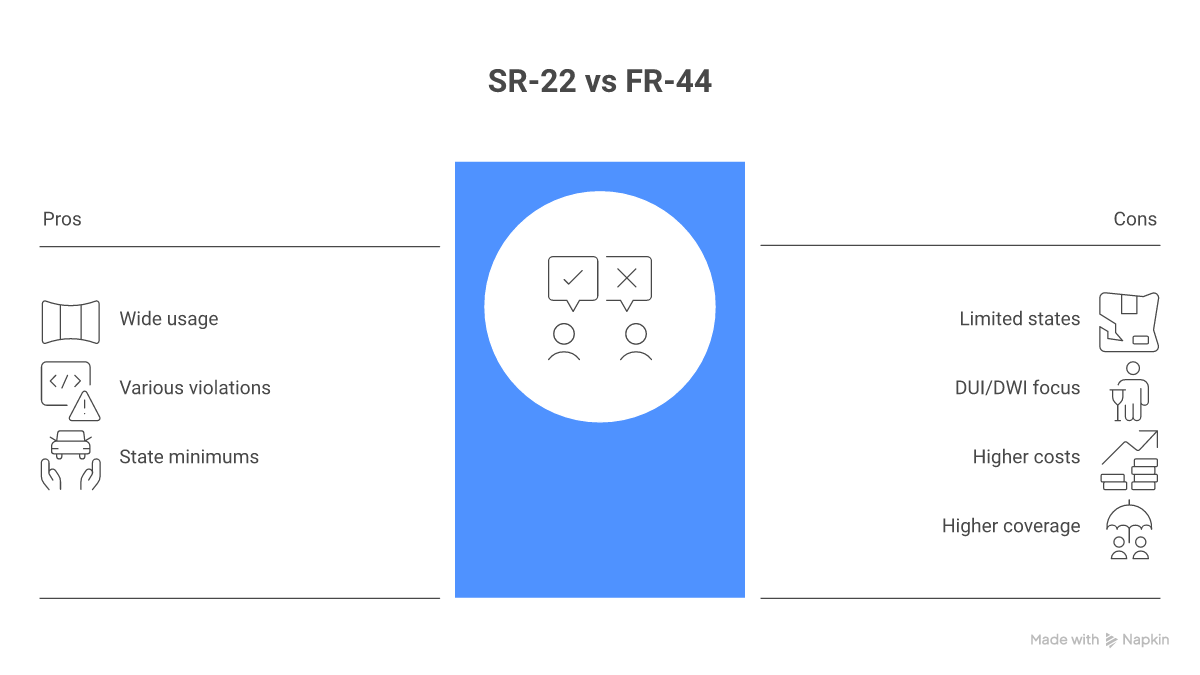
FR-44 is similar to SR-22 but requires higher liability coverage limits. Only Florida and Virginia use FR-44, and it's typically required for DUI/DWI convictions. While a standard SR-22 requires you to carry your state's minimum liability limits, FR-44 requires significantly higher coverage — in Florida, that means $100K/$300K/$50K versus the standard $10K/$20K/$10K minimums. This higher coverage requirement makes FR-44 insurance considerably more expensive than standard SR-22.
SR-22 vs FR-44: Key differences in high-risk driver insurance requirements
Can You Buy SR-22 Insurance Online?
Yes. Most major insurance companies and high-risk specialists let you get SR-22 quotes and purchase policies entirely online. Progressive, The General, Root, and GEICO all offer online SR-22 quotes. The filing is handled electronically — you don't need to visit an office or mail paperwork. In most cases, you can have an SR-22 filed with your state within 1-3 business days of purchasing your policy.
Frequently Asked Questions
See what you could be paying
Get auto insurance quotes from top carriers in a couple of minutes.
Compare pet insurance plans that cover dental cleanings, extractions, and periodontal disease. See which top insurers include dental — and which exclude it.
Home warranties cover appliance and system breakdowns; home insurance covers disasters and liability. Here's what each covers, what they cost, and whether you need both.
Young drivers pay 2-3x more for car insurance. We compared the best and cheapest options for 18-25-year-olds — including discounts that can cut your rate by 30%.