Collectively, Americans owe over $1.2 trillion in outstanding credit card balances. That’s a lot of money. And for many people who owe money on their credit cards, eliminating these high-interest debts feels impossible.
The right credit card payment strategy can make all the difference, though. In this guide, learn the different approaches to help you tackle your credit card debt for good.
Understand Your Debt: Start With a Budget
Before you begin designing your repayment strategy, you need to understand where your money is going every month. How? By tracking your income and expenses.
Make a list of typical expense categories and how much you typically spend on them each month. For example:
Housing (rent or mortgage payment)
Utilities
Transportation
Groceries
Healthcare
Childcare
Insurance
Look over the bank and credit card statements from the last few months to estimate your monthly expenses in each category. You can also use personal finance apps to sort your expenses into different groups.
Then, compare your total monthly expenses to your income. How much money, if any, do you have left over after subtracting your expenses from your monthly pay? You need room in your budget to put extra money toward your credit card debt if your goal is to pay it off faster.
Use this information to create your budget. You might realize that you could cut spending in certain categories to have more money for credit card repayment. Set spending limits in each category, and use budgeting tools to help stay on track.
Popular Credit Card Payment Strategies (and How They Work)
To decide on the best credit card payment strategy for your situation, you need to know your options. Two main strategies have worked for many people: avalanche and snowball debt repayment.
Avalanche vs. Snowball: What's the Difference?
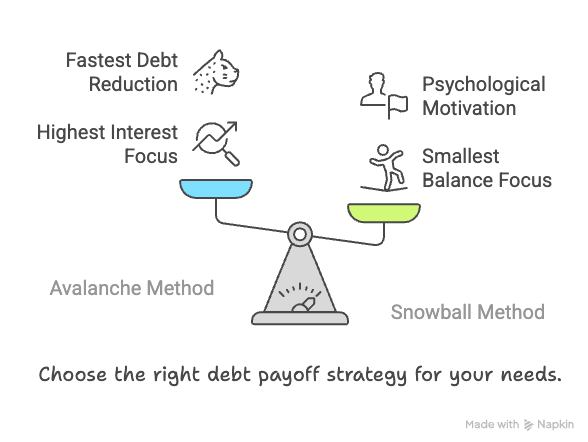
A graphic showing popular credit card payment strategies.
If you’re wondering which credit card payment strategy would pay off your credit card debt the fastest, it’s probably the avalanche method.
In this method, you list out all of your credit card balances from highest to lowest interest rates, disregarding the balance amount. For example, your list could be:
26% interest on Credit Card A with a $2,000 balance
22% interest Credit Card B with a $5,000 balance
17% interest Credit Card C with a $1,000 balance
Then, put as much money as possible toward paying off the credit card balance with the highest interest rate while just making minimum payments on the others. Once you clear the first balance, move on to the credit card with the next-highest interest rate, and so on, until you clear all your debt.
In the snowball method, list your outstanding balances from smallest to largest according to the balance amounts. So, using the examples above, your snowball list would be:
17% interest Credit Card C with a $1,000 balance
26% interest on Credit Card A with a $2,000 balance
22% interest Credit Card B with a $5,000 balance
Then, focus on paying off the smallest balance first while following a credit card minimum payment strategy for the others. Once you clear the smallest balance, move on to the next smallest, and so on. The idea is that clearing that first small balance will give you a psychological boost that makes it easier to tackle the rest of your debt.
Choosing the Right Strategy for You
Either one of these methods can work. If you’re trying to save as much money on interest as possible, choose the avalanche method. If you’re more worried about finding the motivation to stick with your credit card payment plan, try the snowball method. You can always switch if you find one method doesn’t work for you.
Step-by-Step Guide: Build Your Ideal Repayment Plan
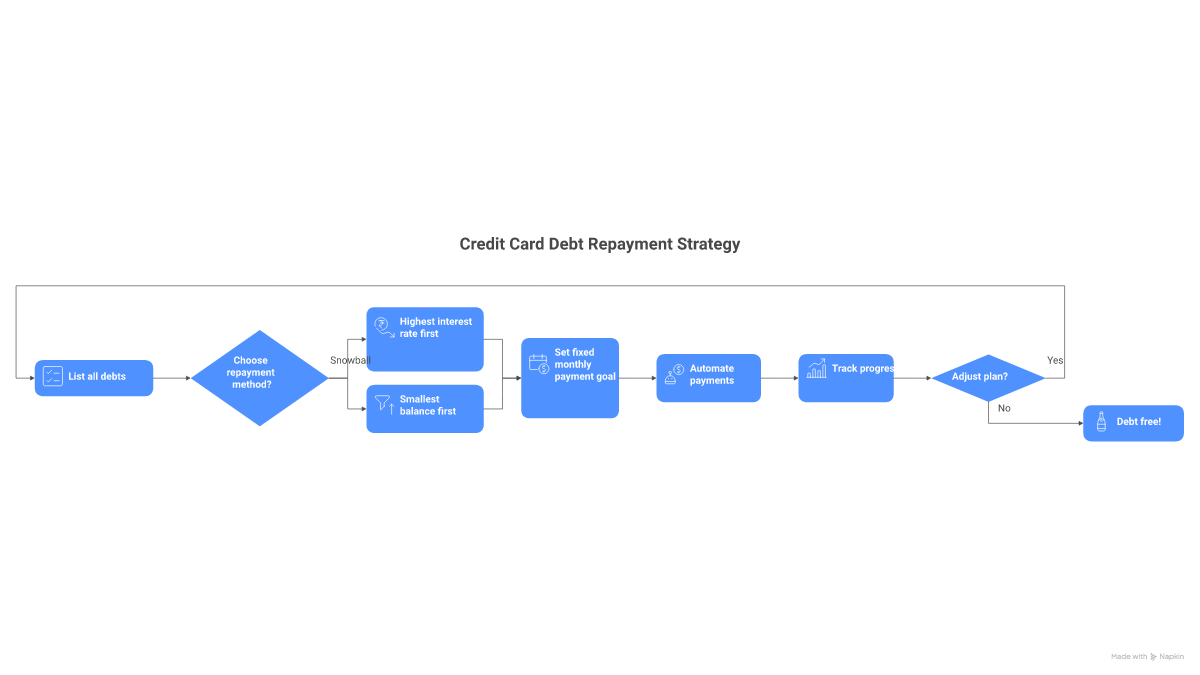
Build your personalized credit card debt repayment plan in 5 steps
Now it’s time to create your personalized repayment plan with these steps:
List all your debts with interest rates and balances. Credit cards for bad credit typically have higher interest rates, while other options like virtual credit cards may offer lower rates.
Choose between the avalanche and snowball methods for your repayment strategy.
Set a fixed monthly payment goal, deciding how much to set aside in your budget to pay down your credit card debt every month.
Automate your payments for this amount to avoid missing deadlines and getting hit with late fees.
Track your progress with personal finance apps and adjust if the plan isn’t working for you.
How To Boost Your Credit Card Payment Strategy: Speed-Up Tactics That Work
Classic debt management plans work over time. To speed up the process, try these tactics.
However, you have to be careful with this option. These cards may charge a significant balance transfer fee of 3 to 5% of your balance, which can eat into your financial savings. And when the promotional low or no-interest introductory period ends, you can end up with even higher interest rates.
Consider a Debt Consolidation Loan
A debt consolidation loan takes multiple loans or credit card balances and combines them into a single debt account. For example, if you owe $1,000 on one credit card, $3,000 on another, and $2,500 on a third, your debt consolidation loan would be for $6,500.
Consolidating your debt can make it easier to manage and sometimes help you access lower interest rates.
Increase Your Monthly Contributions
Putting more money toward your debt each month will help you pay it off faster. The more you can spare to pay off your credit card debt, the sooner you will be debt-free.
Find or Free Up More Income
If you don’t currently have any extra room in the budget to pay more toward your credit cards, try to make some adjustments. Maybe you could start a side hustle or sell some items you no longer need for extra cash. Or you could cut back your spending and put the extra money toward your debt.
Get Professional Financial Advice From Money Atlas
Getting control of your personal finances can feel overwhelming, but go step by step. Each step you take is progress toward your goal financial future. And rely on resources like Money Atlas.
Money Atlas thoroughly compares credit cards, bank accounts, and other financial products to help you find the options that best suit your needs. Compare top credit cards today.
Ready to pick a card?
Compare the cards our editors rate highest right now, side by side, with the fees and rewards that matter.
Should I get an American Express Gold card? Explore the 4X rewards on dining and groceries vs. the $325 fee to see if this premium card fits your budget.
Learn how to get the American Express Gold Card with our guide on credit score requirements, income, and the 'Apply with Confidence' tool. Apply today!