When you sign up for a new credit card, you’ll have tons of numbers and terms thrown at you. Billing cycle, credit history, grace period, annual fee — the list goes on and on.
You don’t need to become an expert in all the details. What you do need is an understanding of how your credit card works to make smart financial decisions. One of the key terms to pay attention to is your credit card APR.
What Is APR and Why Does It Matter?
APR, or annual percentage rate, is what credit card companies charge consumers for borrowing money. The higher your APR is, the more expensive it is to carry credit card balances.
When you get your credit card bill, if you don’t make your monthly payment in full, you carry a balance to the next month’s statement. That balance is what you still owe the credit card company. You have basically taken out a loan from your credit card issuer, which costs you extra in interest. The credit card company uses the APR to calculate how much interest to charge you for borrowing this money.
Understanding Different Types of APR
There are two types of APR: fixed and variable.
If you have a fixed APR, the APR on your account will not change. Whatever your APR is set at when you sign your cardholder agreement, it will stay there for the life of the card.
Variable APRs are a little more complicated. With these, the APR on your account can increase or decrease depending on market conditions. Your APR might be tied to the prime rate published in the Wall Street Journal, for example. If the prime rate goes down, your APR does, too.
Keep in mind that your credit card issuer may impose different APRs on various borrowing categories on your credit card. The APR on your regular purchases and outstanding balance is likely the most important, but check the others, too.
For example, if you take out cash advances — borrowing cash straight from your credit card — you often have to pay a higher APR than the regular purchase rate. Check the balance transfers and penalty APRs, too, as they may differ. The penalty APR is a higher, punitive APR that your credit card company may charge you if you exceed your credit limit or make a late payment.
APR vs. Interest Rate: What’s the Key Difference?
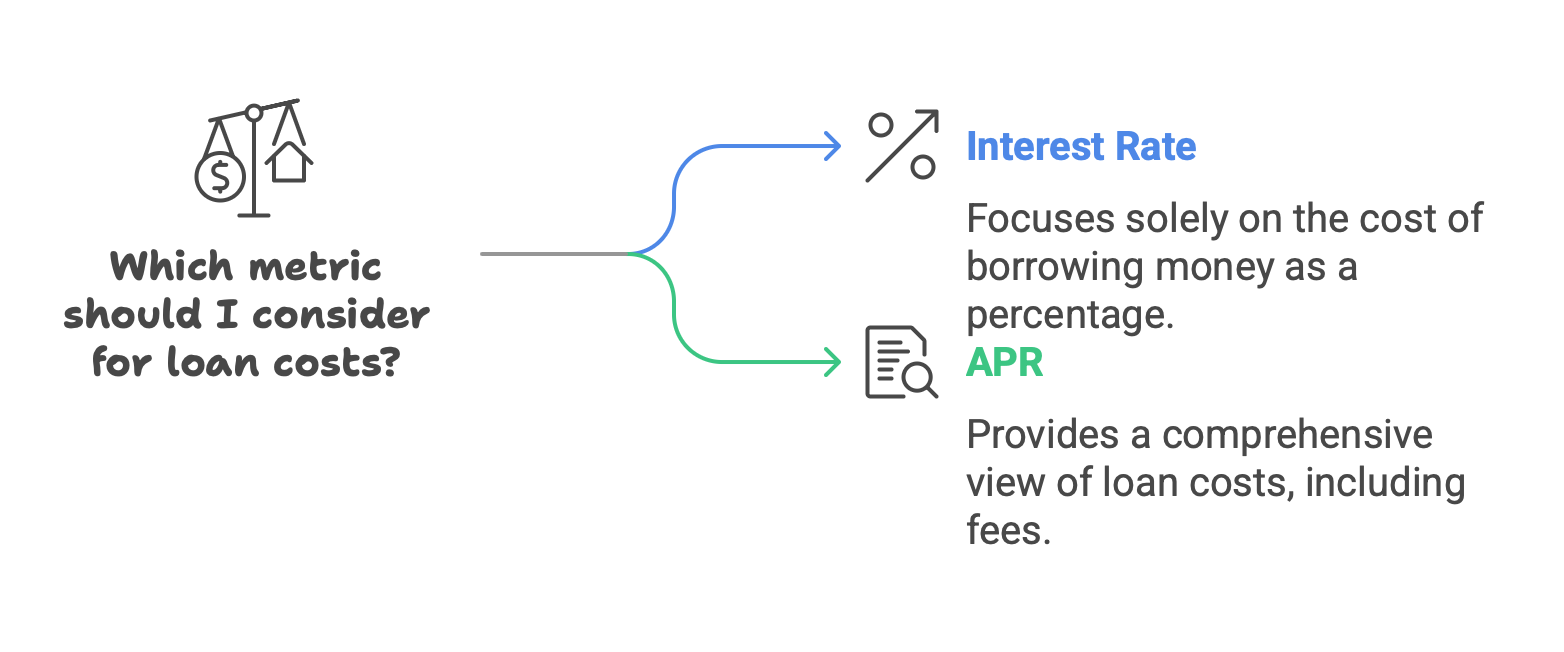
A simple graphic briefly explaining interest rate vs. APR.
With many types of loans — like auto loans, mortgages, and personal loans — the loan’s interest rate and APR are slightly different. The APR will generally be a bit higher than the interest rate.
Here’s the difference: The interest rate is the cost of borrowing money as a percentage of how much you borrow. Meanwhile, the APR represents all the costs associated with taking out a loan, including the interest rate plus any other applicable fees, like origination fees, closing costs, or mortgage insurance. When you look at the APR instead of the interest rate, you get a full picture of how much your loan will cost you.
You don’t have to worry about the difference between APR and interest rates when it comes to credit cards, though. Credit card issuers tend to use APR and interest rates interchangeably.
What Is a Good APR on a Credit Card? Understanding High vs. Low Rates
What is the average APR on a credit card?
As of November 2024, the national average credit card APR is 22.80%. That’s much higher than the interest rates on other types of loans, like mortgages, auto loans, and even personal loans.
You could say that if an APR on a credit card is below the national average, it’s a good APR. It’s a little more complicated than that, though. Your credit score, income, and payment history affect the APR you qualify for. For example, if you have a high credit rating, you can generally expect a lower APR.
There are even some 0% APR credit cards. That sounds great, but remember that the 0% APR is typically only available for an introductory period. Once that period ends, you’ll be subject to a higher APR. American Express, for example, has cards with up to 15 months of 0% APR.
How APR Affects the Total Cost of Credit Card Debt
Higher APRs mean your credit card debt is more expensive. Your interest payments will be higher, and as a result, it can take longer to pay off your debt.
Sample APR Calculation
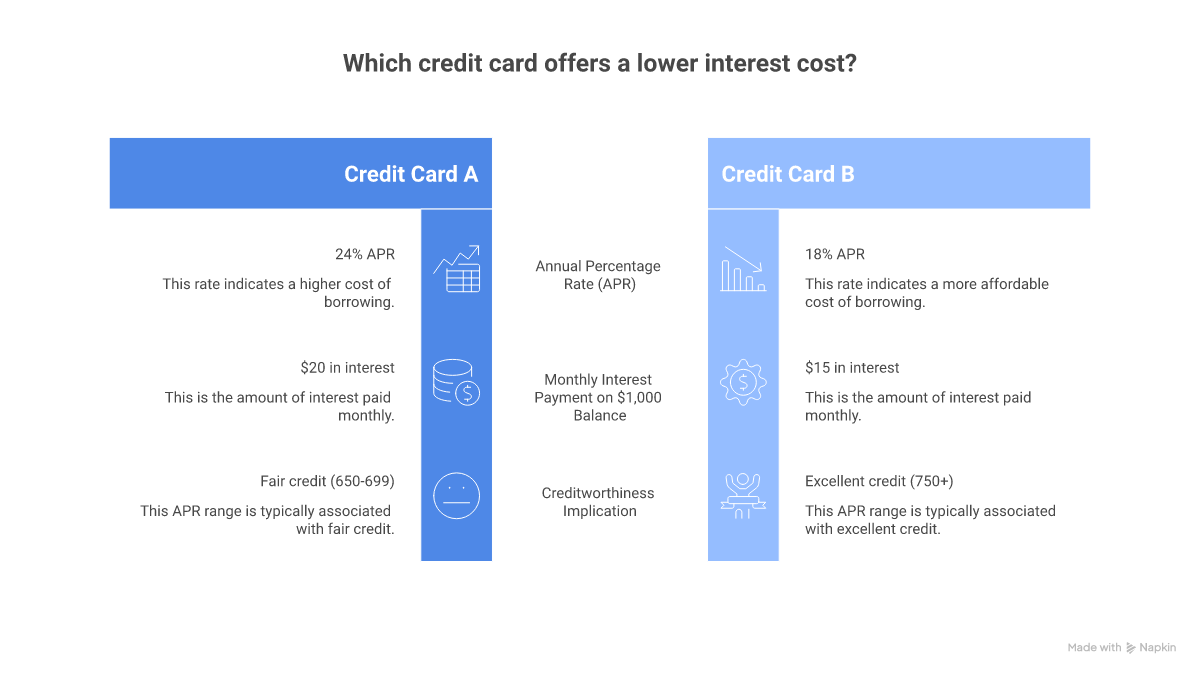
Consider these two example calculations for someone with $1,000 of credit card debt:
Credit Card A: 24% APR: The monthly interest rate is the APR divided by 12, so 2% in this case. Multiplying the 2% monthly rate by the $1,000 of debt, you get $20. You pay $20 in interest a month on $1,000 of debt with this credit card.
Credit Card B: 12% APR: With a 12% APR, your monthly rate is 1%. Multiplying this 1% by the same $1,000 of credit card debt, you get $10. Your monthly interest payment with Credit Card B, if you have a $1,000 balance, is $10. That’s a savings of $10 compared to Credit Card A with the higher APR.
Credit card APR ranges by credit score tier
Strategies To Lower Your Credit Card APR
If you’re not happy with your current APR, try these tips:
Contact your credit card issuers and see if you can negotiate a lower interest rate
The Importance of Understanding APR in Credit Management
If you don’t understand the APR on a credit card, it’s easy to underestimate how expensive credit card debt can be. By learning about APR and familiarizing yourself with the rates that apply to your account, you can make much more informed, responsible choices about your credit card use.
Taking Control of Your Credit: What To Do Next
Understanding your APR is just one step in taking control of your credit. A comprehensive comparison guide will help you find your perfect options for credit cards. Compare credit cards at MoneyAtlas to see if you can find a better APR today.
How Different APRs Affect a $1,000 Balance
Card issuers charge interest daily, using a daily periodic rate equal to your APR divided by 365. The table below shows what a $1,000 balance costs at three common rates if you carry it from month to month. For the official rundown on how credit card interest works, the CFPB explains rates and grace periods in plain terms.
APR
Daily periodic rate
Interest on $1,000 (1 month)
Interest on $1,000 (1 year)
18%
0.049%
~$15
~$180
24%
0.066%
~$20
~$240
29%
0.079%
~$24
~$290
FAQ
Ready to pick a card?
Compare the cards our editors rate highest right now, side by side, with the fees and rewards that matter.
Should I get an American Express Gold card? Explore the 4X rewards on dining and groceries vs. the $325 fee to see if this premium card fits your budget.
Learn how to get the American Express Gold Card with our guide on credit score requirements, income, and the 'Apply with Confidence' tool. Apply today!