How Does Credit Card Interest Work and How to Calculate It


Introduction
Understanding how credit card interest is calculated is the first step in managing the cost of revolving debt. Most people realize that carrying a balance from month to month leads to extra charges, but the specific mechanics often remain hidden in the fine print. These charges can add up quickly, especially with average interest rates on many cards currently ranging between 21% and 25%. MoneyAtlas provides the tools and reviews necessary to compare these rates across hundreds of different cards, helping consumers identify which options align with their financial habits. This article explores the mechanics of interest rates, the math behind the monthly finance charge, and the specific terms that determine how much a balance actually costs over time. Understanding these factors makes it easier to compare credit products and choose a card that minimizes unnecessary expenses.
The Core Concept of Credit Card Interest
Credit card interest is a fee charged by the card issuer for the privilege of carrying a balance. Unlike a personal loan or an auto loan with a set repayment schedule, a credit card is a revolving line of credit. This means a cardholder can borrow, pay back, and borrow again up to a specific limit.
The cost of this flexibility is expressed as the Annual Percentage Rate, or APR. While the name implies a yearly cost, the interest is actually calculated on a much more frequent basis. For someone who pays their statement balance in full every single month, interest is usually a non-factor. However, for those who carry even a small amount of debt over to the next month, the interest charges begin to compound. For a deeper breakdown of this term, see our guide to credit card APR.
APR vs. Interest Rate: The Key Differences
In many areas of finance, the interest rate and the APR are different numbers. For a mortgage, the APR is typically higher than the interest rate because it includes closing costs, points, and other fees. For credit cards, however, the interest rate and the APR are generally the same number.
The APR on a credit card reflects only the interest charged on the balance. It does not include the annual fee, late fees, or foreign transaction fees. While these other costs are part of the overall expense of the card, they are not factored into the interest calculation itself.
Most credit cards today use variable interest rates. These rates are tied to a benchmark, such as the U.S. Prime Rate. When the benchmark moves up or down, the credit card APR usually follows. This means the cost of carrying a balance can change even if the cardholder's credit score remains the same. Fixed interest rates exist but are much less common in the current market. If an issuer decides to change a fixed rate, they must provide a 45 day notice to the cardholder.
How to Calculate Credit Card Interest Step by Step
Calculating the exact interest charge on a statement can be difficult because most issuers compound interest daily. This means they add the interest earned today to the balance, and then calculate tomorrow's interest based on that new, higher amount. MoneyAtlas makes it easier to compare cards with different rates by providing clear breakdowns of these terms in our reviews. You can also browse our credit card review library when you want to compare cards more closely.
To estimate the interest charges, follow these steps:
How to Calculate Credit Card Interest
- 1
Find the APR on the statement
Look at the most recent credit card statement, usually in a section labeled "Interest Charge Calculation." If the card has different rates for purchases and cash advances, identify the purchase APR.
- 2
Convert the APR to a Daily Periodic Rate
Since interest is calculated daily, divide the APR by 365. For example, if the APR is 24%, the math is 0.24 divided by 365, which equals a Daily Periodic Rate of approximately 0.0006575.
- 3
Determine the Average Daily Balance
The issuer tracks the balance for every day of the billing cycle. Add the balance from each day of the month together and divide by the number of days in the billing cycle. This accounts for any payments made or new purchases added mid-month.
- 4
Multiply the Daily Rate by the Average Daily Balance
Take the daily rate from Step 2 and multiply it by the average daily balance from Step 3. If the average balance was $1,500, the daily interest would be $1,500 multiplied by 0.0006575, which is roughly $0.98.
- 5
Multiply by the number of days in the billing cycle
If the billing cycle is 30 days long, multiply the daily interest charge by 30. Using the previous example, $0.98 multiplied by 30 equals a monthly interest charge of approximately $29.40.
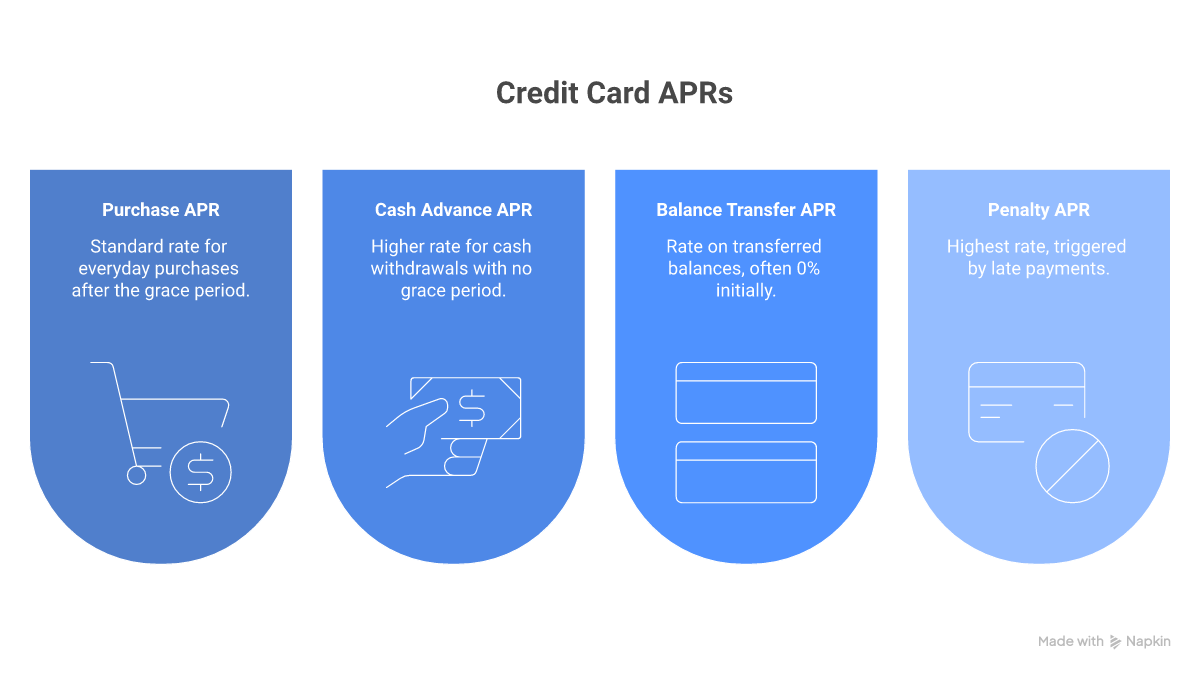
Understanding Different Types of APRs
Not every transaction on a credit card is charged the same way. Most cards have several different APRs that apply depending on how the card is used. Reviewing these rates side by side is a critical part of choosing a new card.
Purchase APR
This is the standard rate applied to most things bought with the card, such as groceries, gas, or online orders. This is the rate most people are referring to when they talk about a card's interest rate.
Cash Advance APR
When a cardholder uses their credit card to get cash from an ATM, the issuer typically charges a significantly higher rate than the purchase APR. It is common for cash advance rates to be 25% or 30%. Furthermore, cash advances usually do not have a grace period. Interest starts accruing the moment the cash is in hand. If you want a deeper look at that scenario, read our cash advance ATM guide.
Balance Transfer APR
This rate applies to debt moved from one credit card to another. Many cards offer a promotional 0% APR on balance transfers for a set period, such as 12 to 18 months. These offers are worth comparing for someone looking to pay down high-interest debt faster. After the promotional period ends, the remaining balance will be subject to the standard balance transfer APR. For side-by-side options, compare our balance transfer credit cards.
Penalty APR
If a cardholder misses a payment or a payment is returned, the issuer may increase the interest rate to a penalty APR. This rate is often as high as 29.99%. This higher rate can stay in effect for six months or longer, significantly increasing the cost of any existing debt.
The Role of the Grace Period
A grace period is the time between the end of a billing cycle and the date the payment is due. For most cards, this period must be at least 21 days. If the cardholder pays the entire statement balance by the due date, the issuer does not charge interest on new purchases made during that billing cycle.
The grace period is a valuable feature that allows consumers to use a credit card as a short-term, interest-free loan. However, there are two common ways people lose this benefit:
- Carrying a balance: If even a small portion of the balance remains unpaid after the due date, the grace period is usually waived for the following month. This means interest will begin accruing on every new purchase the moment it is made.
- Specific transactions: Cash advances and balance transfers rarely qualify for a grace period. Interest on these items starts on the day of the transaction.
Regaining a grace period usually requires paying the statement balance in full for two consecutive billing cycles. This "reset" is important for anyone who has recently paid off a large debt and wants to stop interest from accruing on daily purchases.
Factors That Influence Your Interest Rate
Credit card issuers do not charge everyone the same rate. When someone applies for a card, the issuer looks at several factors to determine the APR.
Credit score is the most significant factor. Generally, applicants with scores in the 740+ range qualify for the lowest available rates. Those with fair or average credit might be approved but will likely be assigned a higher APR. If you are comparing cards for this stage, our no annual fee credit cards can be a useful starting point.
The prime rate also plays a role. Since most cards are variable-rate products, the APR is often expressed as "Prime + X.XX%." If the Federal Reserve raises interest rates, the Prime Rate goes up, and the interest on the credit card balance will increase automatically.
The type of card matters as well. Rewards cards that offer high cash back or travel points often have higher APRs than basic, no-frills cards. For someone who consistently carries a balance, a card with a lower APR is often more valuable than a card with travel perks. MoneyAtlas tracks these different categories to help users weigh the value of rewards against the potential cost of interest. You can also compare broader options in our best credit cards rankings.
- Credit scores determine the starting APR.
- Market conditions drive changes in variable rates.
- Reward cards typically have higher interest rates.
- Credit unions often have lower APR caps than national banks.
Why Compounding Interest Matters
Compounding is the process of earning or paying interest on top of interest. In a savings account, compounding helps money grow. In a credit card account, compounding makes debt more expensive.
Most credit card issuers compound interest daily. This means at the end of every day, the issuer calculates the interest charge and adds it to the principal balance. The next day, the interest is calculated based on that new, slightly larger sum. While the difference on a single day might be only a few cents, over months or years, this adds up to a significant amount of money.
This is why making only the minimum payment is a difficult path to debt freedom. When the minimum payment barely covers the interest charge, the principal balance decreases very slowly. In some cases, if the interest charge is higher than the payment, the balance can actually grow even if no new purchases are made.
How to Manage and Reduce Interest Charges
While paying the balance in full is the most effective strategy, there are other editorial considerations for someone managing existing interest costs. Comparing different credit products can reveal options that make debt repayment more manageable. If you are comparing payoff strategies, our credit card payment strategy guide is a helpful next read.
Comparing 0% APR Offers
For those carrying a high-interest balance, a balance transfer card with a 0% introductory APR is worth comparing. These cards allow the cardholder to move their balance to a new account where it will not accrue interest for a set period. This can save hundreds of dollars and allow 100% of the monthly payment to go toward the principal balance. It is important to note that most of these cards charge a balance transfer fee, often 3% to 5% of the amount moved. For more detail on the mechanics, read how balance transfers work.
Low-Interest Credit Cards
Some cards are designed specifically to offer a lower standard APR rather than rewards. For someone who knows they will occasionally carry a balance, these cards are often a smarter financial choice than a high-rewards card with a 28% APR. MoneyAtlas provides side by side comparisons of low-interest cards for this specific purpose.
Strategic Payment Timing
Because interest is calculated based on the average daily balance, the timing of a payment matters. Making a payment as soon as the money is available, rather than waiting for the due date, reduces the average balance for that billing cycle. This results in a lower interest charge at the end of the month. If you are weighing different payoff methods, you may also want to look at paying a credit card with another card.
Identifying the Real Cost of Borrowing
Credit cards are one of the most expensive ways to borrow money. For comparison, the interest rates on personal loans or home equity lines of credit are often significantly lower than the 21% to 25% common on credit cards.
When a consumer carries a $5,000 balance at 24% APR and makes only a 3% minimum payment, it could take over 15 years to pay off the debt. In that scenario, the interest paid would be nearly as much as the original balance. This highlights why it is vital to understand the terms before using a card for long-term financing.
MoneyAtlas reviews help clarify these "real costs" by breaking down the math and showing how different cards stack up. Whether someone is looking for their first card or trying to find a better rate to pay down existing debt, comparing the fine print is the only way to make a smart decision.
Conclusion
Credit card interest is a complex but manageable part of personal finance. By understanding how the APR translates into a daily charge and how the grace period protects against extra costs, cardholders can take control of their spending. The key factors to watch are the average daily balance, the specific APR for each transaction type, and the impact of daily compounding. For those currently carrying a balance, comparing options like balance transfer cards or low-interest products is a practical next step. MoneyAtlas provides the comparison tools and expert ratings needed to evaluate these options side by side. Exploring the current top-rated low-interest cards can help identify a more affordable way to manage a revolving balance.
FAQ
MoneyAtlas Staff
Articles and reviews from the MoneyAtlas editorial team — independent research on credit cards, banking, loans, insurance, and investing.
Related Articles

Which Card Is Better: American Express Gold or Platinum?
Deciding which card is better: American Express Gold or Platinum? Compare fees, 4X dining rewards, and luxury travel perks to find your perfect match.

Should I Get an American Express Gold Card? Breaking Down the Value
Should I get an American Express Gold card? Explore the 4X rewards on dining and groceries vs. the $325 fee to see if this premium card fits your budget.

How to Get the American Express Gold Card: A Practical Guide
Learn how to get the American Express Gold Card with our guide on credit score requirements, income, and the 'Apply with Confidence' tool. Apply today!