BankingMay 17, 2026
SoFi vs Discover: Banking, HYSA, and Personal Loan Comparison
Side-by-side comparison of SoFi and Discover for checking, savings, and personal loans: APYs, fees, rates, and who each bank is best for.
Continue Reading

As the economy tightens in 2026, saving money has become more important.
To safely put money aside, consider getting a high-yield savings account with no minimum balance. These bank accounts have higher interest rates than typical accounts, allowing you to earn some cash to protect your money's value from inflation.
Most high-yield savings accounts have a minimum balance to open. They also often have a minimum balance to maintain to get a higher interest rate. The specific minimums depend on the type of account and institution.
You can open most online bank accounts, including many high-yield savings accounts, with $0. The bank approves your application first, and you fund the account afterward by linking another account or setting up direct deposit. The application itself usually takes 5 to 10 minutes.
Pick an account with a $0 opening deposit
Check three numbers in the account terms: the minimum opening deposit, the balance needed to earn the advertised APY, and the monthly maintenance fee. You want $0 on the first and ideally the third. If you're still shopping, compare high-yield savings rates before you commit.
Gather your ID and personal details
Have your Social Security number or ITIN, a government-issued photo ID such as a driver's license or passport, a U.S. residential address, and your date of birth ready. The FDIC's guide lists the documents you need to open a bank account. Some online banks accept an ITIN and some don't, so check before you apply.
Apply online
Fill out the application on the bank's website or app, create your login, and accept the account disclosures. Read the fee schedule before you agree to it. This step takes most people under 10 minutes.
Pass identity verification
The bank matches your details against public and credit-bureau records and usually pulls your banking history from a screening company. Many applicants are approved on the spot. Others get asked to upload a photo of their ID and wait a business day or two.
Fund the account when you're ready
Once you're approved, link an external checking account to transfer money in, deposit a check in the mobile app, or send part of your paycheck by direct deposit. A $0 opening requirement means there's no day-one deadline, but some banks close accounts that sit empty for months, so read the terms.
People treat these as one feature. They're three. The opening deposit is what you put in on day one. The minimum balance is what you have to keep in the account, either to dodge a fee or to earn the top rate. The monthly maintenance fee is a charge some banks waive only if you meet a balance or direct deposit requirement. An account can pass one test and fail another: LendingClub LevelUp Savings needs nothing to open, but it pays its top APY only in months you deposit at least $250. Check all three before you apply.
Checking works the same way. Most online checking account options open with $0, and SoFi Checking and Savings bundles both account types with no minimum balance. Capital One, whose 360 Performance Savings appears in our list below, also offers a no-fee checking account you can open online. If you're not sure which one you need, our checking vs. savings account guide walks through it. Most people end up with both: checking for bills, savings for the money you don't want to touch.
If you keep getting turned down because of an old overdraft or a closed account, look at second-chance checking. These accounts are built for people with a negative banking history. Expect a small monthly fee or fewer features in exchange for the approval.
Opening with no money doesn't guarantee approval. Banks have to verify who you are, and most also check your history with checking account screening companies like ChexSystems. Unpaid overdraft balances, an account closed for suspected fraud, or a burst of recent applications can all lead to a denial. So can a mismatch between the name, address, or SSN you enter and what's on file with the credit bureaus. If a screening report was the reason, the bank has to tell you, and you can get a free copy of that report and dispute anything that's wrong.
Once your account is open, the money in it is protected the same way a branch account is. At an FDIC-insured bank, FDIC insurance covers up to $250,000 per depositor, per bank, for each account ownership category.
Minimum balance requirements can make accessing and moving money difficult. Fortunately, some high-yield savings accounts don’t have a minimum.
Here are the best high-yield savings accounts with no minimum balance required. To help you choose, we’ve ranked and reviewed SoFi® and Discover accounts, among others.
MoneyAtlas Rating: 5/5
APY: 4.40% if you deposit at least $250 monthly (3.40% if you miss a month)
Bonus: N/A
Why We Like It: LendingClub’s LevelUp Savings account offers 4.40% APY. All you have to do is deposit at least $250 per month. If you miss a month, you’ll still get a Standard Rate of 3.40% APY.
Other features of this account include:
MoneyAtlas Rating: 5/5
APY: 4.25% (may change any time before or after the account is opened)
Bonus: N/A
Why We Like It: Forbright Bank Growth Savings is another popular high-yield savings account. It has a high APY of 4.25% and the following features:
MoneyAtlas Rating: 4.7/5
APY: 3.80%
Bonus: $50 to $400, depending on your direct deposit amount
Why We Like It: SoFi High-Yield Savings Account offers an APY of 3.80%. This means you can earn more interest in seven weeks than you would in one year through a standard savings account.
It also provides other great features for saving, including:
MoneyAtlas Rating: 4.6/5
APY: 3.70%
Bonus: N/A
Why We Like It: An American Express High-Yield Savings Account offers an APY of 3.70% with a range of standout features:
MoneyAtlas Rating: 4.5/5
APY: 3.60%
Bonus: N/A
Why We Like It: Capital One 360 Performance Savings is another popular high-yield savings account. It has an APY of 3.60% and the following benefits:
Here is how three of the strongest no-minimum, no-fee high-yield savings accounts stack up on live APY. Want the full field? Compare all high-yield savings accounts.


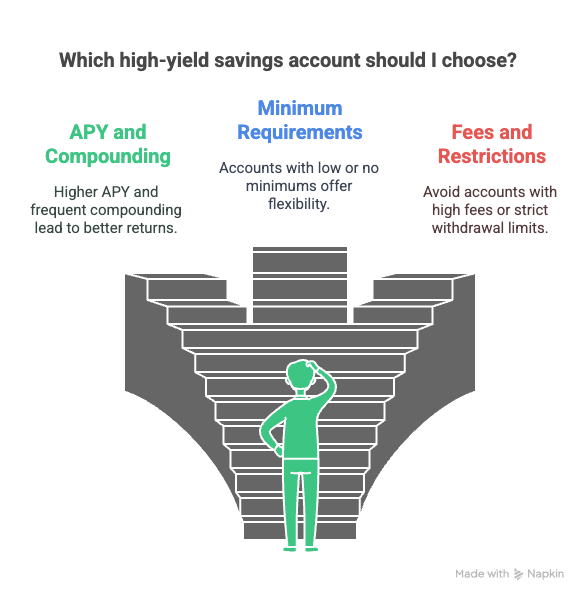
Before choosing a high-yield savings account with no minimum balance, you should compare and contrast the options to pick the best account for your needs.
Here’s a breakdown of the key comparison criteria to look at:
To calculate your expected earnings with different accounts, feel free to use our APY calculator.
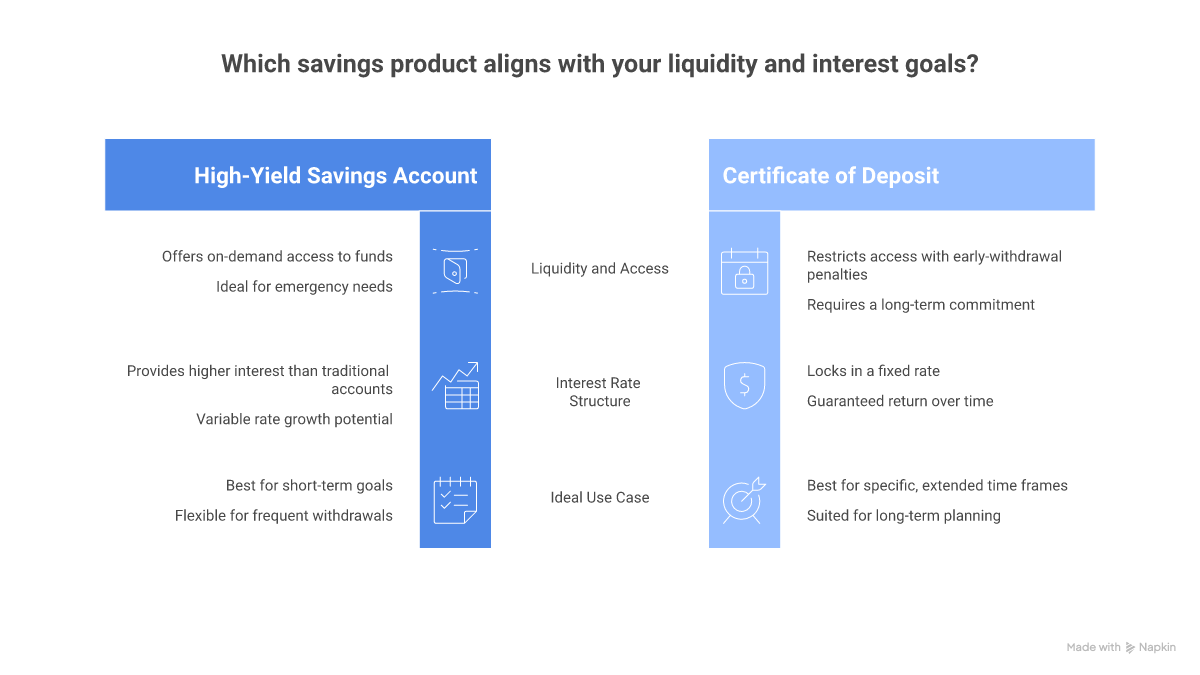
A high-yield savings account is a good fit when you need on-demand access to funds while earning a higher interest rate than through a traditional savings account. Consider getting a high-yield savings account when saving for a short-term goal and wanting easy access to funds.
On the other hand, you may prefer a certificate of deposit (CD) or money market account (MMA) over a high-yield savings account if you:
To make the most of your savings account returns, follow these tips:
Making mistakes when opening a high-yield account can lead to lower savings. Here are the top errors to avoid:
Yes, you can lose your money in a high-yield savings account if your account provider isn’t insured by the Federal Deposit Insurance Corporation (FDIC).
The FDIC will give your money back up to a certain amount (usually $250,000 per depositor per ownership category per insured bank if a FDIC-insured bank fails to protect your deposit.
With so many high-yield savings accounts on the market, picking the best one can be challenging. Here’s what you should keep in mind when looking for the best account for your goals:
MoneyAtlas is here to de-mystify money and savings. To learn more about these accounts so you can make the right financial choices for your situation, read about whether a brokerage account or a high-yield savings account is better for you.
See which high-yield savings accounts are paying the most today.
Compare savings accountsSide-by-side comparison of SoFi and Discover for checking, savings, and personal loans: APYs, fees, rates, and who each bank is best for.
Wondering what do you need to open a business bank account? Here's a complete checklist, including IDs, licenses, and business formation documents.

Checking accounts are ideal for daily spending, while savings accounts earn more interest. Learn the pros, cons, and when to use each account type.