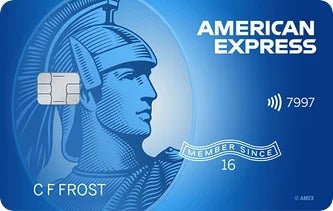
The American Express Blue Cash Everyday card is a cash-back rewards credit card that offers a range of benefits to cardholders. While any cardholder can earn rewards, individuals may have different credit limits based on their creditworthiness and income. Like most credit cards, the Amex Blue Cash Everyday credit limit is revolving, meaning that once you've made payments on the balance, you'll have access to that credit again.
Here's what to know about the Amex Blue Cash Everyday card.
Pros and Cons of the Amex Blue Cash Everyday Card
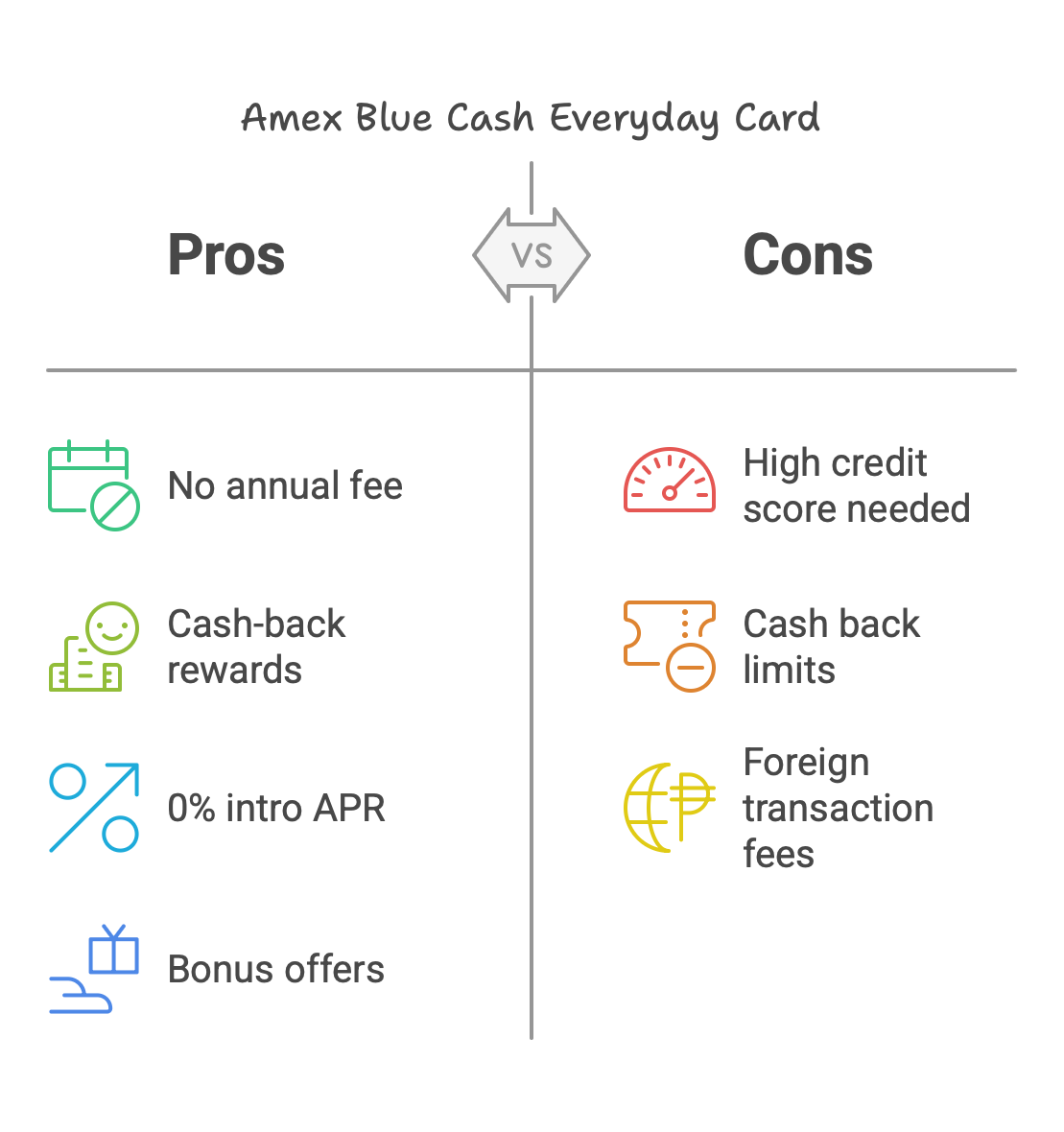
A graphic showing the pros and cons of AMEX Blue Cash Everyday Card
Like any credit card, there are pros and cons to the Amex Blue Cash Everyday card.
Advantages
No annual fee
Cash-back rewards
0% intro APR for the first 15 months
Bonus offers
The key advantages of the Amex Blue Cash Everyday card are the high cash-back value and the lack of an annual fee. For a card with no fee, the Blue Cash Everyday card offers surprisingly strong rewards, with 3% cash-back atU.S. supermarkets, U.S. gas stations, and U.S. online retail purchases up to the first $6,000 of annual spending in each category. (After that, the cash-back percentage drops to 1%.) It also offers 1% cash-back on all other purchases.
The Amex Blue Cash Everyday card has several introductory benefits, including a 0% intro APR on purchases and balance transfers for 15 months, and a $200 statement credit after spending $2,000 on your card within the first six months. Some other bonuses you'll get with the card include an $84 Disney Bundle Credit and a $180 Home Chef credit.
Since the card has no preset spending limit, it's a good choice for applicants with a high credit score and income who want to earn rewards without paying an annual fee.
Disadvantages
Requires a high credit score to qualify
Cash back limits
Foreign transaction fees
Despite the advantages, there are a few drawbacks to the Amex Blue Cash Everyday card. One we already mentioned: cash-back rewards drop after a certain amount of annual spending. While $6,000 is a sizable number for each category, it's not unreasonable to think you may spend more than $6,000 on groceries in a year, thereby earning reduced rewards by the end of the year.
Additionally, American Express charges a 2.7% fee on international purchases on this card, making it a poor option as a travel card.
Finally, Amex sets a high bar here. The card is aimed at applicants with good to excellent credit, which is demanding for a card with no annual fee. If your file is thin or you have recent late payments, expect a decline or a starting limit at the floor.
Comparing the Amex Blue Cash Everyday with Similar Cards
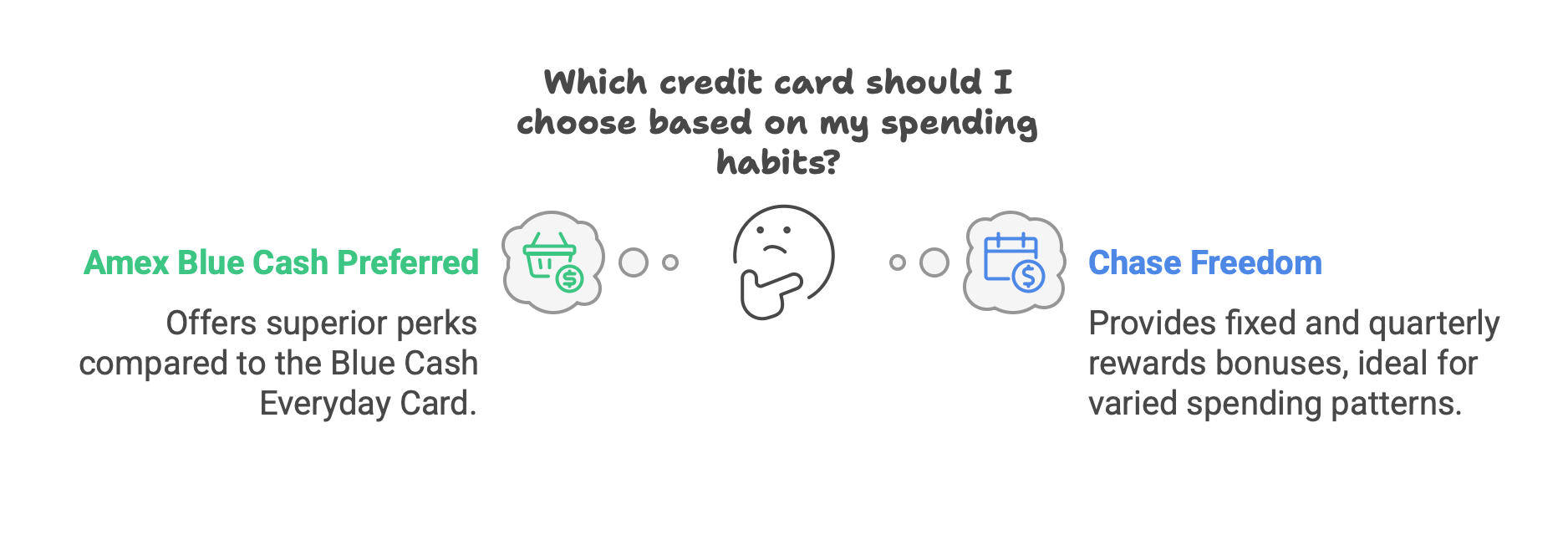
A graphic showing comparing the Amex Blue Cash Everyday with Amex blue cash preferred and Chase freedom.
The Amex Blue Cash Everyday card is most commonly compared to two other cards: the Amex Blue Cash Preferred card and the Chase Freedom card.
Amex Blue Cash Preferred
Another American Express card, the Blue Cash Preferred card offers no annual fee for the first year and is then $95 per year after. While the annual fee might be a turnoff for some applicants, the Preferred card offers significantly better perks than the Blue Cash Everyday card, including:
6% cash-back at U.S. supermarkets (up to $6,000)
6% cash-back on U.S. streaming subscriptions
3% cash-back at U.S. gas stations (with no spending limit)
3% cash-back on transit
The Preferred card also offers a $250 statement credit after spending $3,000 in the first six months, and an intro offer of 0% APR for the first 12 months.
Chase Freedom
Like the Blue Cash Everyday card, the Chase Freedom card has no annual fee and offers cash back on a variety of purchases. It also offers an intro 0% APR for the first 15 months but has a $200 bonus after just $500 of spending within the first three months.
A key difference between how Chase and Amex do rewards, however, is that Chase offers both fixed and quarterly rewards bonuses that incentivize you to spend in different ways. For instance, Chase Freedom offers the following fixed rewards:
5% cash back on travel booked through Chase
3% cash back on dining
3% cash back on drugstore purchases
1% on all other purchases
In addition, you can also earn 5% cash back in quarterly bonus categories on up to $1,500 of spending. Bonus categories change every quarter, and you have to activate them to receive the additional rewards. While this is a nice perk, it makes it much more complicated to maximize the Chase Freedom card's value.
Understanding Credit Limits
Your Amex Blue Cash Everyday credit limit is the maximum amount you may spend on the card before making payments on the balance. The credit limit range depends on a number of factors, and you can typically request a credit limit increase if you've experienced an increase in credit score or income. American Express regularly reviews your financial information and may offer a new credit limit during your membership too.
The average credit limit for Amex Blue Cash Everyday cards is $7,479, but the most common limit is $1,000.
Is there a maximum? Amex does not publish a ceiling for this card, and limits above $10,000 get reported by long-tenured cardholders with high verified income. The practical constraint is not the card, it is Amex's view of your total exposure across every account you hold with them. The CFPB's primer on how issuers set credit limits covers the general mechanics.
Factors Influencing Credit Limits
Your credit limit is primarily informed by your creditworthiness and your income. Most Blue Cash Everyday cardholders sit in the good-to-excellent credit band, and stronger profiles tend to carry higher limits. If you only just clear Amex's approval bar, you will need significant verified income to get a high credit limit.
Your credit score is calculated using a number of factors, including payment history, credit utilization, length of credit history, and more. Missed payments, using too much of your available credit without being able to pay it back promptly, and opening many new credit cards can all lower your credit score or credit limit.
What credit score do you need for an Amex Blue Cash Everyday?
American Express typically approves Blue Cash Everyday applicants with good to excellent credit, and approval odds improve as you move toward the upper end of that band. Amex weighs your whole credit profile, not just the score: income, debt-to-income ratio, and any prior Amex relationship all factor in.
Sitting at the lower edge of that band is not an automatic denial. Applicants who just clear the bar often receive starting limits at the floor, around $1,000 to $2,500, while stronger profiles more frequently see starting limits in the $3,000 to $10,000 range. If your credit falls short of good, build a few months of on-time payment history before applying.
For the full underwriting picture across Amex's lineup, see our Amex approval requirements overview. The CFPB's Consumer Credit Card Market report confirms that issuers like Amex weigh FICO scores heavily for prime, no-annual-fee cards like the Blue Cash Everyday.
How to request a credit limit increase on your Blue Cash Everyday
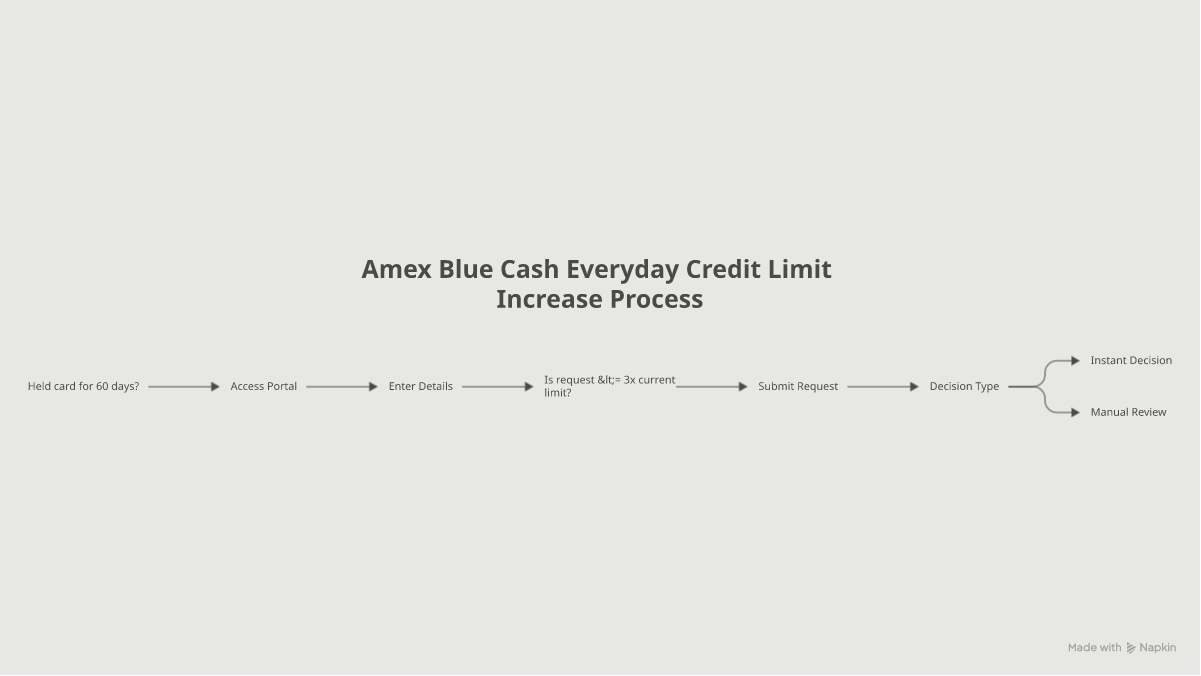
Once you've held the card for at least 60 days, you can request a credit line increase (CLI) through your Amex online account or the mobile app. The process is straightforward:
Log in to americanexpress.com and navigate to Account Services, then Card Management, then Increase Credit Limit.
Enter your updated income and the desired new credit limit. Don't ask for more than a 3x multiple of your current limit — Amex often denies requests that look out of step with the relationship.
Submit and wait. Most decisions arrive instantly, but some go to manual review (24 to 72 hours).
Amex CLI requests are typically processed as a soft pull, meaning your credit score won't take a hit just from asking. That's a meaningful advantage versus issuers like Capital One or Chase, which often use hard pulls on increase requests. The FTC's guidance for consumers denied credit explains your rights if Amex denies the request — you're entitled to the specific reason in writing.
Amex also runs automatic CLI cadences roughly every 6 months for cardholders in good standing. If you've made on-time payments and your utilization stays under 30%, you may see an unprompted increase without ever asking.
The Amex Blue Cash Everyday credit limit increase request process
Why is my Amex Blue Cash Everyday limit so low?
If your starting credit limit came in at $1,000 or $1,500 and you expected more, the most common causes are:
Thin credit file. Newer credit profiles (under 3 years of history) get conservative starting limits regardless of score.
High existing Amex exposure. Amex looks at total credit lines across all your Amex cards. If you already have a Gold or Platinum charge card or another Blue Cash variant, your Blue Cash Everyday limit may be capped to keep your overall Amex exposure in check.
Modest reported income. Lower-income applicants get lower starting limits — typical for any prime issuer.
High utilization on other cards. If your total revolving utilization across all issuers is above 30%, Amex assumes additional credit-line risk.
The fix is patient: keep utilization under 30%, make every payment on time, and request a CLI after 60 days. Most cardholders see their first automatic or requested increase within 6 months. The Federal Reserve G.19 consumer credit data shows revolving credit lines have been climbing nationally over the past 24 months, so issuers like Amex are generally extending more credit than they were two years ago — your timing is decent.
Blue Cash Everyday vs Blue Cash Preferred credit limit
Searchers comparing the Blue Cash Everyday to the Blue Cash Preferred often assume the Preferred carries a higher starting credit limit because of its annual fee. The data doesn't support that assumption. Both cards draw from the same Amex underwriting model — starting limits cluster in the same $1,000 to $10,000 band, and credit profile drives the outcome, not the card tier.
What does differ between the two cards:
Factor
Blue Cash Everyday
Blue Cash Preferred
Annual fee
No annual fee
Annual fee after intro year
Grocery cash-back rate
3% at U.S. supermarkets (up to $6,000/yr)
6% at U.S. supermarkets (up to $6,000/yr)
Starting credit limit
Same Amex underwriting band
Same Amex underwriting band
CLI mechanics
Soft pull
Soft pull
The Preferred makes sense if your annual spend at U.S. supermarkets is high enough that the higher cash-back rate beats the annual fee. It does not give you a meaningfully higher starting credit limit, so don't pay the fee for that reason alone.
One practical consequence: if you already carry the Preferred, applying for the Everyday will not hand you a second large line. Amex splits exposure across your accounts rather than stacking it. If you are weighing the pair, pick on rewards fit instead, which is what our roundup of cash back credit cards is for.
Choose the Right Card for You with MoneyAtlas
The American Express Blue Cash Everyday card will allow you to earn cash back while shopping for gas, groceries, and more. It has a range of perks, including a $0 annual fee, but it's not without its drawbacks. To compare cards and find the best options for you, check out MoneyAtlas, a platform for expert comparisons of banking, loans, credit cards, and investments.
Nick has worked with some of the world's biggest brands and organizations as a copywriter, editor, content manager, and marketing consultant. He's managed editorial e-commerce initiatives with The Walt Disney Company and Hello! Magazine, and developed the brand voice and go-to-market messaging for Fanatics' live commerce platform, Fanatics Live. His written work has appeared on CNN Underscored, PC Mag, TechCrunch, Forbes, Inc., Entrepreneur, and more.
Should I get an American Express Gold card? Explore the 4X rewards on dining and groceries vs. the $325 fee to see if this premium card fits your budget.
Learn how to get the American Express Gold Card with our guide on credit score requirements, income, and the 'Apply with Confidence' tool. Apply today!