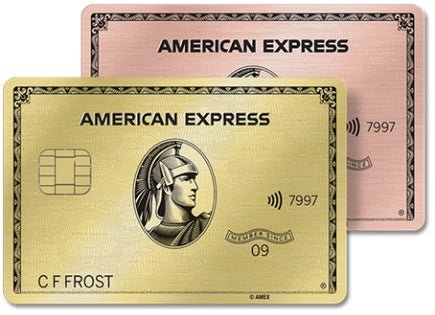
American Express® Gold Card
Top-tier dining and grocery rewards for foodies
Updated September 14, 2026 · By the MoneyAtlas Editorial Team
Pros
High rewards rate on dining and groceries: The Gold Card offers 4X Membership Rewards points at restaurants worldwide (up to $50,000 per calendar year, then 1x) and U.S. supermarkets (up to $25,000 per calendar year, then 1x), making it one of the best cards for food-related spending
Valuable credits that can offset the annual fee: Up to $424 in combined credits (Uber Cash, Dining, Dunkin', and Resy) can more than offset the annual fee for those who can fully utilize them
Flexible redemption options: Membership Rewards points can be transferred to various airline and hotel partners, providing excellent value for travelers who can optimize their redemptions
Cons
Increased annual fee: The recent hike to $325 may be difficult to justify for those who don’t fully utilize the card’s credits and benefits
Complex benefit management: The card’s multiple credits and perks require careful tracking to ensure you’re getting the most out of them, which might be overwhelming for some users
Limited bonus categories: While the 4X points on restaurants and supermarkets are great, the card lacks bonus categories for everyday expenses like gas, streaming services, or online shopping
Why we rate it 4.6/5
A dining-and-grocery powerhouse: the 4x points plus annual credits can outweigh the $325 fee, but only if you actually use the credits.
Among the best earn rates for everyday spend: 4x Membership Rewards at restaurants worldwide and U.S. supermarkets, plus 3x on flights.
The $325 annual fee is real, but the dining, Uber Cash, Resy, and Dunkin' credits can offset most of it for members who use them monthly.
Strong food-and-travel perks: monthly statement credits, no foreign transaction fees, and Membership Rewards transfer partners for outsized redemptions.
The credits are split across monthly windows and need enrollment, and points take some know-how to maximize through transfer partners.
The American Express® Gold Card is a premium rewards card for food enthusiasts and frequent travelers. It offers a robust rewards structure, focusing on dining, groceries, and travel, along with a suite of benefits to enhance cardholders' lifestyle and travel experiences.
Key Features
- Rewards Structure:
- 4X Membership Rewards® points at restaurants worldwide, including takeout and delivery (up to $50,000 per calendar year in purchases, then 1X)
- 4X points at U.S. supermarkets (up to $25,000 per calendar year in purchases, then 1X)
- 5X points on prepaid hotel stays booked through AmexTravel.com or the Amex Travel App
- 3X points on flights booked directly with airlines, on AmexTravel.com, or through the Amex Travel App
- 2X points on prepaid car rentals booked through AmexTravel.com or the Amex Travel App and cruises booked through AmexTravel.com
- 1X points on other eligible purchases
- Welcome Offer:
- Annual Fee:
- Additional Benefits:
- Up to $120 Uber Cash annually ($10 monthly credits for Uber rides or Uber Eats orders in the U.S.) Effective 11/8/2024, an Amex Card must be selected as the payment method for your Uber or Uber Eats transaction to redeem the Amex Uber Cash benefit.
- Up to $120 Dining Credit annually ($10 monthly statement credits at participating partners)
- $100 Experience Credit at over 1,300 upscale hotels in The Hotel Collection (2-night minimum, booked through AmexTravel.com or the Amex Travel App)
- Up to $100 Resy Credit annually given in statement credits
- $84 Dunkin'® Credit annually (You can earn up to $7 in monthly statement credit after you enroll and pay with the American Express Gold Card at U.S. Dunkin' locations)
- No foreign transaction fees (see rates and fees)
Is the Amex Gold Card Worth It?
The Gold Card is worth it if you eat out, order in, or buy groceries often, and if you will actually remember to use the monthly credits. Those two conditions carry the whole case. The card charges a $325 annual fee up front and hands back up to $424 a year in statement credits, so on paper it pays for itself with $99 left over. On paper.
Here is what the credits are actually worth, and what the card costs you at three levels of use:
The 50% row is the one to sit with. Every credit here except Resy resets monthly, and an unused month is gone. Miss the Dunkin' credit through a busy August and you do not get it back in September. Cardholders on forums complain about exactly this: not that the credits are small, but that they are fiddly. If you are the sort of person who forgets which card is attached to your Uber account, budget for the 50% row rather than the 100% one.
Ignore the credits entirely and the rewards can still carry it. At 4x on restaurants and U.S. supermarkets, and valuing Membership Rewards points conservatively at one cent each, roughly $8,200 a year of combined dining and grocery spend covers the fee on points alone. That is about $685 a month. Under that, you need the credits to make the math work. Well over it, and the credits are gravy. Premium rewards cards have been moving toward this credit-heavy structure across the market, as the CFPB's consumer credit card market report documents.
Skip it if your food spending is modest, if most of your money goes to gas, streaming, or online shopping, or if you want a card you can set and forget. None of those profiles fit here. Outside dining, groceries, and travel booked through Amex there is no bonus category at all, so a flat 2% cash-back card will quietly beat the Gold Card on the rest of your spending. It is also a charge card at heart: Pay Over Time has to be arranged rather than assumed, and if you carry a balance month to month the interest will eat the rewards long before the credits make up the difference.
Rewards Program
The American Express Gold Card uses the Membership Rewards® program, known for its flexibility and value. Points can be redeemed for travel, gift cards, statement credits, or transferred to airline and hotel partners, often yielding high value for savvy travelers.
Rates and Fees
- Penalty APR: 29.99% variable APR (may be applied for late or returned payments)
- Late Payment Fee: Up to $40
- Returned Payment Fee: Up to $40
- Cash Advance Fee: Either $10 or 5% of the amount of each cash advance, whichever is greater
- See rates and fees
Who Is This Card For?
The American Express Gold Card is ideal for:
- Food enthusiasts who frequently dine out or order in
- Regular grocery shoppers who can maximize the U.S. supermarket category
- Travelers who book hotels, flights, and rentals through AmexTravel.com or the Amex Travel App
- Those who can take full advantage of the card's credits to offset the annual Fee
- Consumers who value flexible reward points for travel
Amex Gold Approval Odds and Credit Score Requirements
The Gold Card is a mid-tier approval, not a velvet rope. American Express looks for good to excellent credit, which in practice means a FICO score in the upper 600s and up, alongside steady income and a clean recent payment history. There is no published cutoff and no stated income floor. Chase's 5/24 rule does not apply here, but Amex's own once-per-lifetime bonus rule does: if you have had this card before, you likely cannot earn the welcome offer again. For the full picture on score bands and what actually gets declined, see our guide to approval odds and credit score requirements for this card, and the broader Amex application rules.
One point worth naming plainly: this is a charge card with a flexible limit rather than a preset one, so Amex leans harder on your ability to pay than on a single number. A thin file with a high score can still be declined.
Compare




The three cards above split cleanly by what you are optimising for. The Amex Platinum costs several times more and pays for itself through travel perks, lounge access, and hotel status rather than earn rate; if you fly a few times a year it is the wrong card. The Blue Cash Preferred is the closer rival for most people: it carries a much smaller fee, pays 6% at U.S. supermarkets against Gold's 4x, and gives you cash back instead of points you have to work to redeem well. Gold wins when restaurant spending is heavy and you are willing to learn transfer partners. Blue Cash Preferred wins when the groceries dominate and you want the value handed to you without effort.