A purchase interest charge is the cost of borrowing money for purchases made with a credit card that are not paid off in full by the end of a billing cycle. For someone holding a Chase credit card, this charge appears on a monthly statement when a balance remains after the payment due date. MoneyAtlas provides comparison tools and financial breakdowns to help cardholders understand how these costs are calculated and how they impact a total balance. This article covers the mechanics of interest calculation, the role of grace periods, and the reasons why interest might appear even after a payment is made. Understanding how purchase interest works is essential for anyone looking to minimize the cost of credit and manage debt effectively.
What a Purchase Interest Charge Represents
A purchase interest charge is a finance fee applied to the portion of a credit card balance that consists of everyday buying activity. While credit cards can carry various types of interest, purchase interest specifically applies to goods and services bought with the card. If a cardholder pays the entire statement balance by the due date every month, they generally avoid this charge entirely.
When only a partial payment is made, or only the minimum payment is met, the remaining balance begins to accrue interest. This interest is not just a one-time fee but a recurring cost that compounds. MoneyAtlas notes that most major issuers, including Chase, use a daily compounding method. This means interest is calculated every day and added to the balance, which then becomes the new base for the next day's calculation.
The rate used for this calculation is the purchase Annual Percentage Rate (APR). This rate is typically variable, meaning it can fluctuate based on the Prime Rate. For a cardholder, the specific APR is determined by their creditworthiness and the specific terms of the Chase card they hold. If you want a broader comparison of borrowing costs, start with the best credit cards comparison.
Understanding the math behind the interest charge can help a cardholder see exactly how their balance grows. Chase, like most banks, uses a step-by-step process to arrive at the final dollar amount seen on a statement.
The Daily Periodic Rate
The first step in the calculation is determining the Daily Periodic Rate (DPR). Since the APR is an annual figure, the bank must break it down into a daily format to apply it to a balance. To find the DPR, the APR is divided by 365. For example, if a card has a 24% APR, the calculation is 24% divided by 365, which results in a DPR of approximately 0.0657%.
The Average Daily Balance
The bank does not just look at the balance on the last day of the month. Instead, it uses the average daily balance. To find this, the bank adds up the balance at the end of every single day in the billing cycle and divides that sum by the number of days in the cycle.
If someone starts the month with a $1,000 balance and makes a $500 payment halfway through a 30-day cycle, their average daily balance would be $750. This method ensures that interest is charged fairly based on how much was owed on each specific day.
The Final Monthly Charge
Once the bank has the DPR and the average daily balance, it multiplies them together and then multiplies that result by the number of days in the billing cycle.
Step-by-Step Interest Calculation
1
Step 1
Divide the APR by 365 to find the Daily Periodic Rate.
2
Step 2
Sum the balance for each day of the billing cycle and divide by the number of days to find the average daily balance.
3
Step 3
Multiply the average daily balance by the Daily Periodic Rate.
4
Step 4
Multiply that daily interest amount by the total number of days in the statement period.
The Importance of the Grace Period
A grace period is the window of time between the end of a billing cycle and the payment due date. During this period, a cardholder is typically not charged interest on new purchases as long as they paid the previous month's statement balance in full. For most Chase cards, this grace period is at least 21 days.
If the full statement balance is not paid by the due date, the grace period is usually lost. This means that interest starts accruing on new purchases immediately from the date of the transaction. For someone who consistently carries a balance, the grace period does not apply, and every new dollar spent begins costing interest from day one.
Regaining a grace period typically requires paying the statement balance in full for two consecutive billing cycles. This is a critical detail because many cardholders are surprised to see interest charges on their statement even after they finally pay their balance in full. For a deeper look at the timing rules, see how APR fees can be avoided on credit card balances.
Understanding Residual or Trailing Interest
Residual interest, often called trailing interest, is one of the most common sources of confusion for credit card users. It refers to the interest that accumulates on a balance between the time a statement is issued and the time the payment is actually received.
For example, if a statement is generated on the first of the month with a $1,000 balance, and the cardholder pays that $1,000 on the 15th of the month, interest has been accruing for those 15 days. Because that interest was not yet calculated when the statement was printed, it will appear on the following month's statement as a purchase interest charge.
Different Types of APR on a Chase Card
It is common for a single credit card to have multiple interest rates. While purchase interest is the focus of most statements, other activities can trigger different charges.
Purchase APR: The standard rate applied to everyday buying activity.
Balance Transfer APR: The rate applied to debt moved from another card to the Chase card. This often comes with an introductory 0% period for new cardholders.
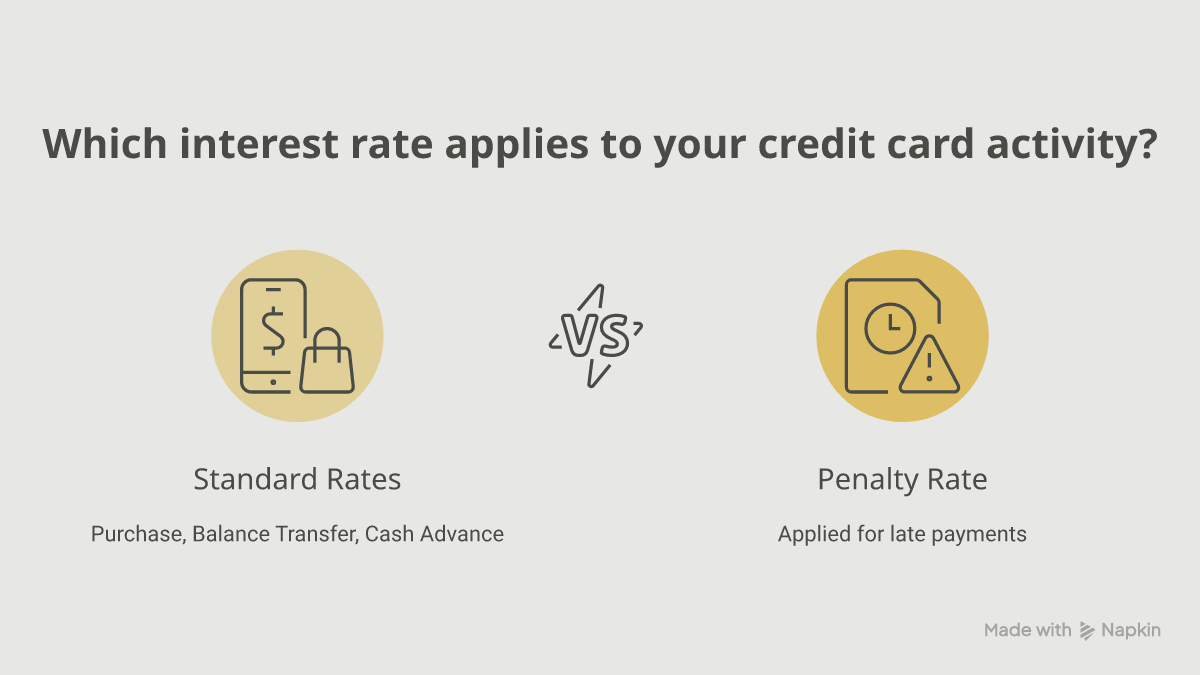
Cash Advance APR: This rate is usually significantly higher than the purchase APR and applies when using the card to get cash from an ATM. There is typically no grace period for cash advances.
Penalty APR: If a payment is more than 60 days late, Chase may increase the APR on the card to a much higher rate.
MoneyAtlas compares these rates across different products to help consumers find cards with lower ongoing costs or better introductory offers. Knowing which rate applies to which activity is vital for avoiding high-cost mistakes like taking a cash advance. If you want to compare cards with rewards against borrowing costs, browse the cash back credit card rankings.
Standard Chase rates versus the penalty rate triggered by late payment
Where to Find Your Interest Rate Details
The specific APR for a Chase card is not a secret, but it is often tucked away in the fine print. There are three primary places to locate this information.
The Monthly Statement: Usually found on the last page or in a section titled "Interest Charge Calculation," the statement will list the APRs for purchases, cash advances, and balance transfers. It will also show the specific dollar amount charged for interest in that period.
The Schumer Box: When someone applies for a card, the issuer must provide a standardized table of rates and fees known as the Schumer Box. This includes the APR ranges and any annual fees.
Online Account Access: Logging into the Chase mobile app or website allows a cardholder to view their current account terms, including their current interest rates.
How to Minimize or Avoid Purchase Interest Charges
While interest is a standard part of using a credit card for those who do not pay in full, there are several ways to reduce the impact of these charges.
Pay the Statement Balance in Full
The most effective way to avoid purchase interest is to pay the statement balance in full by the due date every month. This keeps the grace period active and ensures that the card serves as a free short-term loan rather than a high-interest debt tool.
Make Multiple Payments
Since interest is calculated based on the average daily balance, making payments throughout the month can lower that average. Paying $250 every week instead of $1,000 at the end of the month reduces the balance on which the Daily Periodic Rate is applied, resulting in a lower total interest charge.
Use Chase Pay Over Time
For larger purchases, Chase offers a feature called Chase Pay Over Time. This allows cardholders to break up a specific purchase into monthly installments with a fixed monthly fee instead of the standard variable interest rate. For some, this can be a more predictable and potentially cheaper way to finance a large buy.
Consider a Balance Transfer
If someone is currently paying a high interest rate on a Chase card, they might look at balance transfer options. MoneyAtlas tracks current 0% APR offers that allow cardholders to move debt to a new card and pay it off without interest for a set period, often 12 to 21 months. For a more detailed explanation, read how credit card balance transfers work.
Checklist for Reducing Interest Costs:
Set up autopay for the full statement balance to ensure the grace period remains active.
Review your statement monthly to identify which transactions are driving interest charges.
Avoid using your credit card for cash advances due to the lack of a grace period and higher rates.
Make extra payments as soon as funds are available to lower your average daily balance.
The Impact of Your Credit Score on Purchase Interest
The interest rate Chase assigns to a cardholder is heavily influenced by their credit score. Those with excellent credit scores, typically above 740, are more likely to receive APRs at the lower end of the card's advertised range. Conversely, those with fair or average credit may be assigned rates at the higher end.
Maintaining a high credit score involves paying all bills on time and keeping credit utilization low. Credit utilization is the percentage of available credit currently being used. Keeping this number below 30% is a common benchmark for maintaining a healthy score.
If a cardholder's credit score improves significantly over time, they may be able to contact Chase to request a lower APR. While not guaranteed, issuers sometimes adjust rates for long-term customers with a perfect payment history. For more on how credit profile affects borrowing costs, see what APR means for credit cards.
How Variable Rates Change
Most Chase credit card APRs are variable. This means they are tied to an index, usually the U.S. Prime Rate. When the Federal Reserve raises or lowers its target interest rate, the Prime Rate typically moves in tandem.
If the Prime Rate increases, the purchase interest charge on a credit card will also increase, even if the cardholder's behavior has not changed. This is why it is important to monitor the "Total Interest for This Year" section on a statement to see how much the cost of carrying debt may be rising due to market conditions. If you want a current market benchmark, check the average credit card interest rate right now.
Managing Debt and Comparing Options
A purchase interest charge is a sign that the credit card is being used as a long-term financing tool. While this is sometimes necessary for emergencies, the high rates on credit cards make them one of the most expensive ways to borrow money.
MoneyAtlas tracks over 1,500 financial products, including personal loans and alternative credit cards, which may offer lower interest rates for those who need to carry a balance. If a purchase interest charge is becoming a significant monthly burden, it may be worth comparing other debt consolidation options that offer a fixed interest rate and a clear path to repayment. To compare more options, visit our product reviews or explore broader borrowing alternatives through our best credit cards comparison.
Conclusion
The purchase interest charge on a Chase credit card is the cost of not paying the full statement balance by the due date. It is driven by the card's APR, the average daily balance, and the daily compounding of interest. While features like the grace period offer a way to avoid these costs entirely, failing to meet the full payment requirement can lead to a cycle of growing debt. By understanding the mechanics of how interest is calculated and monitoring statements for residual interest, cardholders can make more informed decisions about their spending and payment habits. For those looking to lower their interest costs, comparing different credit products and debt consolidation tools is a practical next step.
FAQ
Ready to pick a card?
Compare the cards our editors rate highest right now, side by side, with the fees and rewards that matter.
Should I get an American Express Gold card? Explore the 4X rewards on dining and groceries vs. the $325 fee to see if this premium card fits your budget.
Learn how to get the American Express Gold Card with our guide on credit score requirements, income, and the 'Apply with Confidence' tool. Apply today!