A purchase interest charge on a Chase credit card is the cost you pay for borrowing money to make purchases when you do not pay your monthly statement balance in full. This charge is a form of a finance charge, and it is calculated based on your card's Annual Percentage Rate (APR) and your average daily balance. For most cardholders, interest only becomes an issue when a balance is carried over from one month to the next, triggering the end of what is known as a grace period.
MoneyAtlas provides comparison tools to help you evaluate different credit cards and their interest structures side by side. If you want a broader starting point, begin with our best credit cards comparison. This article breaks down exactly how these charges are calculated, when they apply, and how you can manage your account to minimize these costs. Understanding these mechanics is a key step in making informed decisions about how to use your credit line.
What Is a Purchase Interest Charge?
The purchase interest charge is the most common type of finance charge found on a credit card statement. It specifically applies to the transactions you make at retailers, online stores, or for services. Credit cards are essentially revolving lines of credit. If you pay the entire statement balance by the due date every month, the issuer generally does not charge interest on those purchases.
However, if even $1 of that statement balance remains unpaid after the due date, the issuer begins charging interest. This interest is not just a one-time fee. It is an ongoing cost that accumulates daily based on the amount you owe. The purchase interest charge appears on your Chase statement under the "Interest Charge Calculation" section.
Defining APR and Periodic Rates
To understand the charge, you must first understand the Annual Percentage Rate (APR). The APR is the yearly cost of borrowing, expressed as a percentage. For example, a card might have a 24% APR.
Because credit card interest is calculated more frequently than once a year, banks use a Daily Periodic Rate (DPR). This is the APR divided by 365 days. If a card has a 24% APR, the DPR would be roughly 0.0657%. This is the percentage applied to your balance every single day you carry debt.
Most major issuers, including Chase, use the average daily balance method to determine your interest charge. This method is more complex than simply looking at your balance at the end of the month. It takes into account every transaction, payment, and credit that occurred during the 28 to 31 days of your billing cycle.
Divide your card's current purchase APR by 365. For a card with a 21.99% APR, the calculation is 21.99 / 365, which equals a daily rate of 0.0602%.
2
Daily balance
Start with the beginning balance for the day.
Add any new purchases and fees.
Subtract any payments or credits.
The result is your balance for that specific day.
3
Average daily balance
Add up the balances from every day in the billing cycle.
Divide that total by the number of days in the cycle.
This gives you a single "average" figure representing what you owed throughout the month.
4
Apply daily rate
Take the average daily balance from Step 3 and multiply it by the daily periodic rate from Step 1.
5
Multiply by days
Multiply the daily interest amount by the number of days in the month to reach the final purchase interest charge shown on your statement.
The Importance of the Grace Period
A grace period is the window of time between the end of a billing cycle and your payment due date. During this time, you are typically not charged interest on new purchases if you paid your previous balance in full. For Chase cards, this grace period is generally at least 21 days.
Losing the Grace Period
If you do not pay the full statement balance by the due date, you lose your grace period. This is a critical turning point for your finances. Once the grace period is gone:
Interest begins accruing on your existing balance immediately.
Interest begins accruing on new purchases the very day you make them.
You must typically pay your statement balance in full for two consecutive billing cycles to "reset" the grace period and stop interest from accruing on new purchases.
Paying only the minimum amount due keeps your account in good standing and prevents late fees, but it does not stop interest. The remaining balance will still trigger a purchase interest charge. For someone looking to avoid interest entirely, the statement balance, not the minimum payment, is the figure that matters.
Different Types of APR to Monitor
Your Chase card does not have just one interest rate. Different types of transactions carry different costs. It is important to look at the Schumer Box, the standardized table in your cardmember agreement, to see these variations.
Purchase APR
This is the rate applied to standard buying activity. It is the focus of most cardholders and usually the lowest rate of the three main categories. It is almost always a variable rate, meaning it can change based on the Prime Rate.
If you use your credit card to get cash from an ATM, you are taking a cash advance. This APR is typically much higher than the purchase APR, often exceeding 29%. Furthermore, cash advances usually have no grace period. Interest starts the moment the cash is in your hand.
Balance Transfer APR
When you move debt from one card to another, the balance transfer APR applies. While many cards offer 0% introductory periods for balance transfers, the standard rate after that period ends is often similar to the purchase APR. Note that balance transfers also usually involve a one-time fee of 3% to 5% of the transferred amount.
Penalty APR
If you fall 60 days behind on your payments, Chase may apply a penalty APR. This rate is significantly higher than your standard rate. If you make six consecutive on-time payments, the bank must generally return your balance to the original APR, though the penalty rate may still apply to new purchases.
Why Interest Appears After You Pay in Full
One of the most confusing parts of credit card management is seeing an interest charge on a statement even after you thought you paid the balance in full. This is often called residual interest or trailing interest.
Understanding Residual Interest
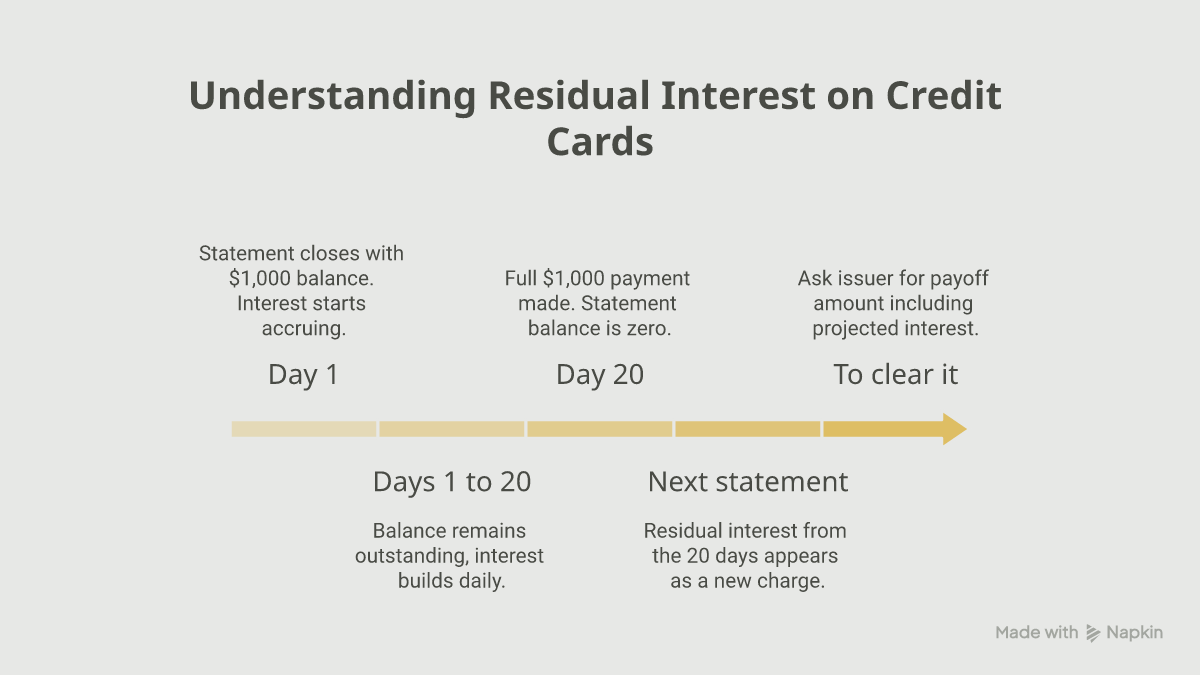
Residual interest is the interest that accumulates between the time your statement is printed and the time your payment is actually received. For example, if your statement closes on the 1st of the month with a $1,000 balance, but you do not pay it until the 20th, interest has been growing on that $1,000 for those 20 days.
Even if you pay the full $1,000 on the 20th, the 20 days of interest will appear on your next month's statement. To truly clear a balance that has been accruing interest, you often need to contact the issuer for a "payoff amount" that includes the interest projected through the date of your payment.
Residual interest: why a paid-in-full balance can still generate a charge next month
Strategies to Reduce Purchase Interest Charges
While paying in full is the best way to handle interest, it is not always possible for every person in every situation. If you are carrying a balance, there are editorial strategies worth comparing to help lower your costs.
Making Multiple Payments
Because interest is calculated based on an average daily balance, reducing that balance earlier in the month can lower your total charge. If you get paid every two weeks, making a payment each time you receive a paycheck can lower the average amount the bank uses to calculate interest.
Using "Chase Pay Over Time"
Chase offers a feature called Chase Pay Over Time (formerly My Chase Plan) for certain purchases over a specific dollar amount. Instead of a standard interest charge, this plan allows you to pay for a purchase in monthly installments with a fixed monthly fee. For some, the fee may be lower than the interest that would have accumulated at the card's standard APR. It is worth comparing the total cost of the fee versus the projected interest before selecting this option.
Exploring 0% Intro APR Cards
If you have a large purchase coming up or are already carrying debt, a card with a 0% introductory APR period is worth considering. These offers can last from 6 to 21 months, giving you a window to pay down the principal without the weight of compounding interest. MoneyAtlas tracks these offers across various issuers to help you see which promotional periods are currently the most competitive.
Negotiating Your Rate
If your credit score has improved significantly since you opened your account, you can contact the issuer to request a lower APR. While not guaranteed, issuers sometimes lower rates for long-term customers with a history of on-time payments. A lower APR directly reduces the daily periodic rate used in your interest calculation.
How Interest Impacts Your Overall Financial Health
Interest charges represent money that is not going toward your principal balance, your savings, or your investments. Over time, high interest charges can lead to a debt cycle where your monthly payments are mostly covering interest rather than reducing what you owe.
Credit Utilization and Your Score
Carrying a balance that generates interest also means you have a higher credit utilization ratio. This ratio is the amount of credit you are using compared to your total credit limits. A high utilization ratio can negatively impact your credit score, even if you make all your payments on time. Most experts suggest keeping utilization below 30% to maintain a healthy score.
The Math of Compounding
Credit card interest compounds, which means you pay interest on your interest. If you have a $100 interest charge this month and do not pay it, next month the bank will calculate interest on your original balance plus that $100. This is why credit card balances can feel like they are spiraling out of control if only minimum payments are made.
Comparing Your Options with MoneyAtlas
Deciding which credit card to use often comes down to the interest rate and the features offered by the issuer. While Chase offers various rewards and tools like Chase Pay Over Time, other banks might offer lower ongoing APRs or longer introductory periods.
MoneyAtlas makes it easier to compare these details. Our platform allows you to look at hundreds of credit products side by side. When you compare cards, focus on:
The purchase APR range, usually based on your creditworthiness.
The length of any 0% introductory offers.
Fees that could add to your balance, such as annual fees or late fees.
Tools provided by the issuer to help manage interest costs.
If you are still comparing the market, browse current credit card interest rates before you choose. By looking at the real costs and the fine print, you can choose a card that fits your spending habits and financial goals. Whether you are looking for a low-interest card to carry a balance occasionally or a rewards card you plan to pay in full, having the data side by side simplifies the process.
Conclusion
A purchase interest charge on a Chase credit card is a manageable cost if you understand the mechanics behind it. By knowing your APR, monitoring your grace period, and understanding the average daily balance method, you can take control of your statement. If you find yourself frequently paying interest, it may be time to evaluate whether your current card is the best fit for your needs or if a different product would better serve your financial situation.
Pay your statement balance in full to avoid interest entirely.
Understand that the grace period is lost once a balance is carried.
Make payments early in the cycle to reduce your average daily balance.
Watch for residual interest on the statement following a full payoff.
For those ready to see how their current card stacks up against others on the market, the APR on a Chase credit card is a useful next read, and comparing broader market averages can help you decide whether a different card would save you money. You can also review what interest rate consumers pay on credit cards to see how your card fits into the wider landscape.
FAQ
Ready to pick a card?
Compare the cards our editors rate highest right now, side by side, with the fees and rewards that matter.
Should I get an American Express Gold card? Explore the 4X rewards on dining and groceries vs. the $325 fee to see if this premium card fits your budget.
Learn how to get the American Express Gold Card with our guide on credit score requirements, income, and the 'Apply with Confidence' tool. Apply today!