In the world of credit cards, there are two similar terms that come up a lot: pre-approval and pre-qualification. They’re easy to confuse, and credit card applications already have enough confusing terms to worry about.
Use this guide to understand the difference between pre-approved vs pre-qualified credit cards to make your application process simpler.
A pre-approved credit card offer means an issuer screened your credit file with a soft pull and found that you meet its initial criteria for a specific card. It is not a guarantee. You still fill out a full application, the issuer runs a hard inquiry, and it can still say no.
Understanding Pre-Qualified Offers
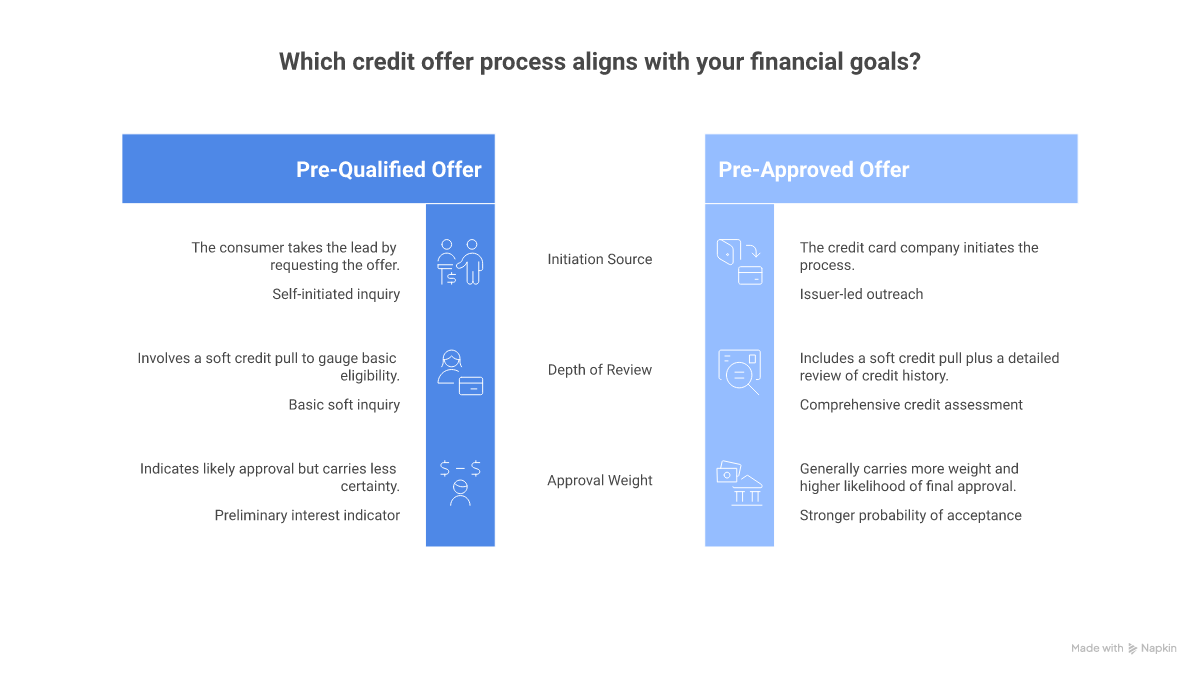
If you’re interested in opening a new credit card, you may reach out to a credit card company to see whether it will pre-qualify you for a card. A pre-qualified offer means the credit card issuer does a soft credit inquiry — it reviews your credit report without impacting your credit scores. The issuer also does a basic review of your personal information and uses those details to decide whether it should pre-qualify you for a card.
Keep in mind that even if you are pre-qualified, there is no guarantee that the credit card company will approve your formal application. Credit card companies reserve the right to deny your application.
Even so, getting a pre-qualified offer is generally a step in the right direction. If you’re pre-qualified, you know there’s a good chance you’ll get approved for the card. You can use that information to narrow down the list of credit cards to apply for.
Exploring Pre-Approved Offers
A pre-approved offer means the credit card company is the one initiating the process — it reaches out to you to let you know you are pre-approved for a certain card.
Like pre-qualification, the pre-approval process generally involves a soft credit inquiry and a general review of credit history. Neither pre-approved nor pre-qualified credit cards affect your credit score.
If the credit card company decides you’re a good fit for one of their cards, it may send you a pre-approval offer. Generally, being pre-approved means you’re even more likely to get approved for the card than being pre-qualified, but it’s still no guarantee.
Comparing Pre-Qualified and Pre-Approved Offers
You may be pre-qualified for some cards and pre-approved for others. But is it better to be pre-approved or pre-qualified?
When you’re comparing pre-approved vs. pre-qualified credit card offers, you can generally assume that pre-approval carries a bit more weight. Since the credit card issuer initiated the pre-approval process, that’s a good sign that you have a better chance of approval than for a pre-qualified card.
Can you get denied after pre-approval for a credit card, though? Yes, with both pre-qualification and pre-approval, the credit card company can still deny your application.
Here's how the two stack up at each stage, from the first offer to the application itself.
Pre-qualified
Pre-approved
Who starts it
You, usually through an issuer's online tool
Usually the issuer, using a prescreened list from a credit bureau
Credit check at the offer stage
Soft inquiry, no score impact
Soft inquiry, no score impact
Credit check when you apply
Hard inquiry
Hard inquiry
How reliable it is
A rough signal; terms can change
A stronger signal, but still not a guarantee
Where it usually shows up
Issuer website or app
Mail, email, or your online banking account
If you have poor credit and are worried you won’t be approved, work on improving your credit history or check out credit cards for bad credit.
Pre-qualified vs pre-approved: who initiates, weight, and approval likelihood
Does Getting Pre-Approved Hurt Your Credit Score?
Not at the offer stage. When an issuer prescreens you, or when you run a pre-qualification tool yourself, it uses a soft inquiry. Soft inquiries don't count toward your credit score, as the CFPB explains. You can check your own pre-qualification status as often as you like without moving your score.
The hard inquiry comes later, and only if you actually apply. It can knock a few points off your score and stays on your credit report for two years, though scoring models like FICO weigh it for about 12 months. So a pre-approved offer costs you exactly what any other application does: one hard pull. Apply for several cards in a short window and those pulls add up.
Prescreened offers exist because the Fair Credit Reporting Act (FCRA) lets credit bureaus sell lists of people who meet a lender's criteria, as long as the lender makes a firm offer of credit. If you'd rather not be on those lists, the FTC's guide to prescreened offers explains how to opt out.
Major Financial Institutions Offering Pre-Qualification
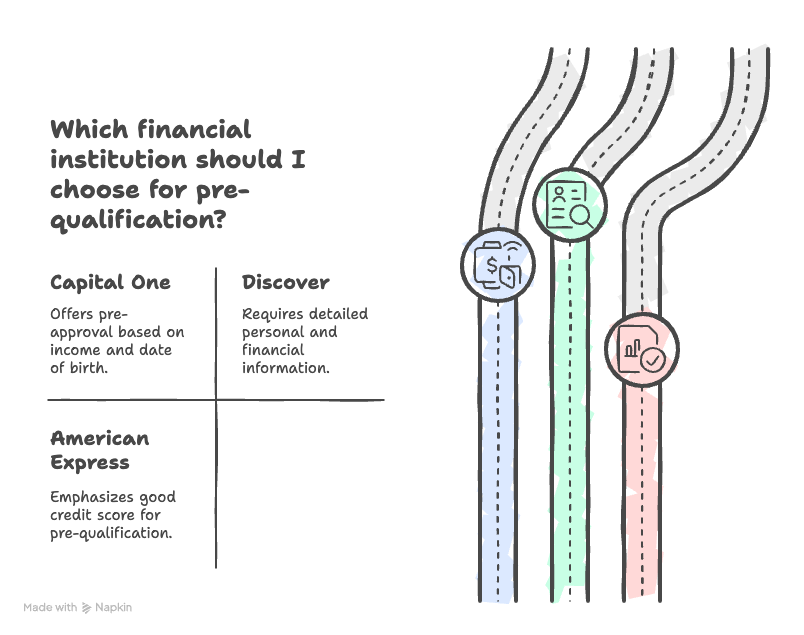
A graphic showing the main companies offering pre-qualification for credit cards.
Many major financial institutions offer a pre-qualification or pre-qualification process. If you're looking for a new card, check out the process with Capital One, Discover, and American Express.
Capital One’s Pre-Qualification
With Capital One, you can check whether you have any pre-approval offers by simply answering pre-approval questions about topics like your income and date of birth. If you’re pre-approved for any cards, you can explore your offers and accept the one that fits your needs.
Discover’s Pre-Approval Features
Visit Discover’s website to see if you’re pre-approved for any Discover cards. You just need to enter simple details, including your:
Name
Address
Date of birth
Monthly housing payment
Annual income
Whether you are a student
If you’re pre-approved, you can submit an application for that card right from the website.
American Express Pre-Qualification Options
American Express runs a similar check: you enter basic personal and income details, and it shows the cards you pre-qualify for without a hard pull. Amex cards generally call for good credit, and our Amex pre-approval guide covers how that process and the approval odds work. If no traditional card comes up, virtual credit cards are another option.
How to Check If You're Pre-Approved for a Credit Card
How to check if you're pre-approved for a credit card
1
Check your credit score
Look at your score and your free credit reports before you shop. The score tells you roughly which tier of card to aim for, and the reports let you catch errors before an issuer does.
2
Use issuer pre-qualification tools
Capital One, Discover, Citi, and American Express all have online tools that check for offers with a soft pull. Enter the same income and housing details on each. Cards people often check this way include the Capital One Quicksilver and the Discover it Cash Back.
3
Compare the offers side by side
Line up the APR range, annual fee, rewards rate, and any intro offer for each result. A pre-approval is only worth acting on if it's a card you'd pick anyway.
4
Read the terms before you apply
Check the penalty APR, the foreign transaction fee, and how rewards actually pay out. Pre-approval terms are often shown as a range, and your final APR depends on the full application.
5
Apply for one card at a time
Each application triggers a hard inquiry. Pick the best fit, apply, and wait for a decision before trying another issuer.
Benefits of Pre-Qualified and Pre-Approved Offers
Since pre-qualification and pre-approval don’t guarantee approval, you may wonder how they help you. Well, there are a few benefits to these offers, such as:
Getting a better idea of what cards you’ll be approved for
Avoiding unnecessary hard credit inquiries that could hurt your credit score
Being able to strategically plan your credit accounts
You don’t need to pursue pre-qualified and pre-approved offers, but they’re great options for making more informed decisions about your credit card applications.
Dealing with Unsolicited Offers
You may have received unsolicited credit card offers in the mail before. It’s normal but also annoying.
If you want to stop receiving these offers, you can opt out for five years or permanently on optoutprescreen.com, an official, confidential website recommended by the Federal Trade Commission. Alternatively, you can call 1-888-5-OPT-OUT and follow the directions.
Remember that credit card offers are just that — offers. You can ignore them or choose other options as you see fit.
For example, you might get an offer for a balance transfer card, which is essentially paying off a credit card with another credit card to save on interest payments. But if you don’t have much credit card debt, it probably wouldn’t make sense to act on that offer.
FAQ
Learn More About the Best Credit Card Offers with Money Atlas
When it comes to pre-approved vs pre-qualified credit cards, there are so many options that it can be challenging to find the right choice for your needs. That’s what Money Atlas is here for.
With thorough credit card comparisons that cover interest rates, terms, rewards, and more, Money Atlas makes the search easy. Compare offers to find the best credit card for you with Money Atlas today.
Ready to pick a card?
Compare the cards our editors rate highest right now, side by side, with the fees and rewards that matter.
Learn how to lower credit card APR with 5 proven strategies. From negotiating with issuers to 0% transfers, discover how to offset rising interest rates.