

Your credit card APR is going up. Here's what to do before your next statement

MoneyAtlas Staff
MoneyAtlas Staff
·1 min read
Your credit card APR is going up. Here's what to do before your next statement

Rates checked September 2026

On September 16, the Federal Reserve raised its benchmark rate by a quarter point, to a range of 3.75% to 4% (Federal Reserve). Banks followed right away, moving the prime rate from 6.75% to 7% the next day (Business Wire).

Almost every credit card has a variable APR, built as prime plus a fixed margin. So yours just went up too, and your issuer doesn't have to warn you. When your rate is variable and the index it's tied to rises, the higher rate can apply to the balance you already have, with no advance notice (CFPB). Expect it to show up within the next couple of months (CNBC).

If you pay your card in full every month, none of this affects you. No balance, no interest. You can stop here.

What the hike actually costs you

Less than the headlines suggest. The average card APR is around 24.95% (Forbes Advisor). Here's yearly interest on a carried balance, before and after a quarter-point hike:

BalanceInterest per year at 24.95%At 25.20%Extra per year
$3,000$748$756$8
$6,000$1,497$1,512$15
$10,000$2,495$2,520$25

The hike isn't the problem, but the balance is. Nobody's budget breaks over $15 a year, but $1,500 a year in interest on $6,000 is real money, and the Fed signaled another increase could come before the end of the year (Federal Reserve). That makes now a good time to deal with it.

5 moves to make now

  1. 1

    Find your actual rate

    Your statement shows your APR in the interest charge section. Your cardholder agreement shows how it's built, usually "prime + X%." Write both down. Everything below depends on them.

  2. 2

    Call and ask for a lower one

    This works more often than people think. In a recent LendingTree survey, 84% of cardholders who asked for a lower APR in the past year got one, and the average cut was 6.3 percentage points (InvestigateTV). On a $6,000 balance, a cut that size saves about $380 a year.
    Keep the call short: how long you've been a customer, that you pay on time, your current rate, and a lower offer you've seen elsewhere. Then ask if they'll match it. A strong credit score does a lot of the work for you.

  3. 3

    Move the balance to a 0% card

    Balance transfer cards charge no interest for a set period, often 12 to 21 months (Forbes Advisor). Most charge a transfer fee, typically 3% to 5% of the amount you move.
    Before you apply, do one piece of math: balance plus fee, divided by the number of promo months. That's the monthly payment you need to hit. Whatever's left when the promo ends goes back to the regular APR. You'll usually need good to excellent credit to qualify. Compare current 0% APR cards.

  4. 4

    Lock in a fixed rate with a personal loan

    Personal loans have fixed rates, so future Fed moves can't touch them. The average 3-year personal loan rate was 14.54% in the week ending September 20, up from 14.31% the week before (Credible). That's roughly 10 points under a typical card, and rates are drifting up week to week. Check for origination fees, which some lenders subtract from the loan upfront. Compare personal loan rates.

  5. 5

    Don't trigger a penalty rate

    Being late is how a manageable rate becomes a painful one. If your minimum payment is more than 60 days late, your issuer can raise the rate on your existing balance, and you only get the old rate back after six on-time payments in a row (CFPB). Set autopay for at least the minimum, then pay extra on top by hand.

Best For Restaurants & Food Delivery

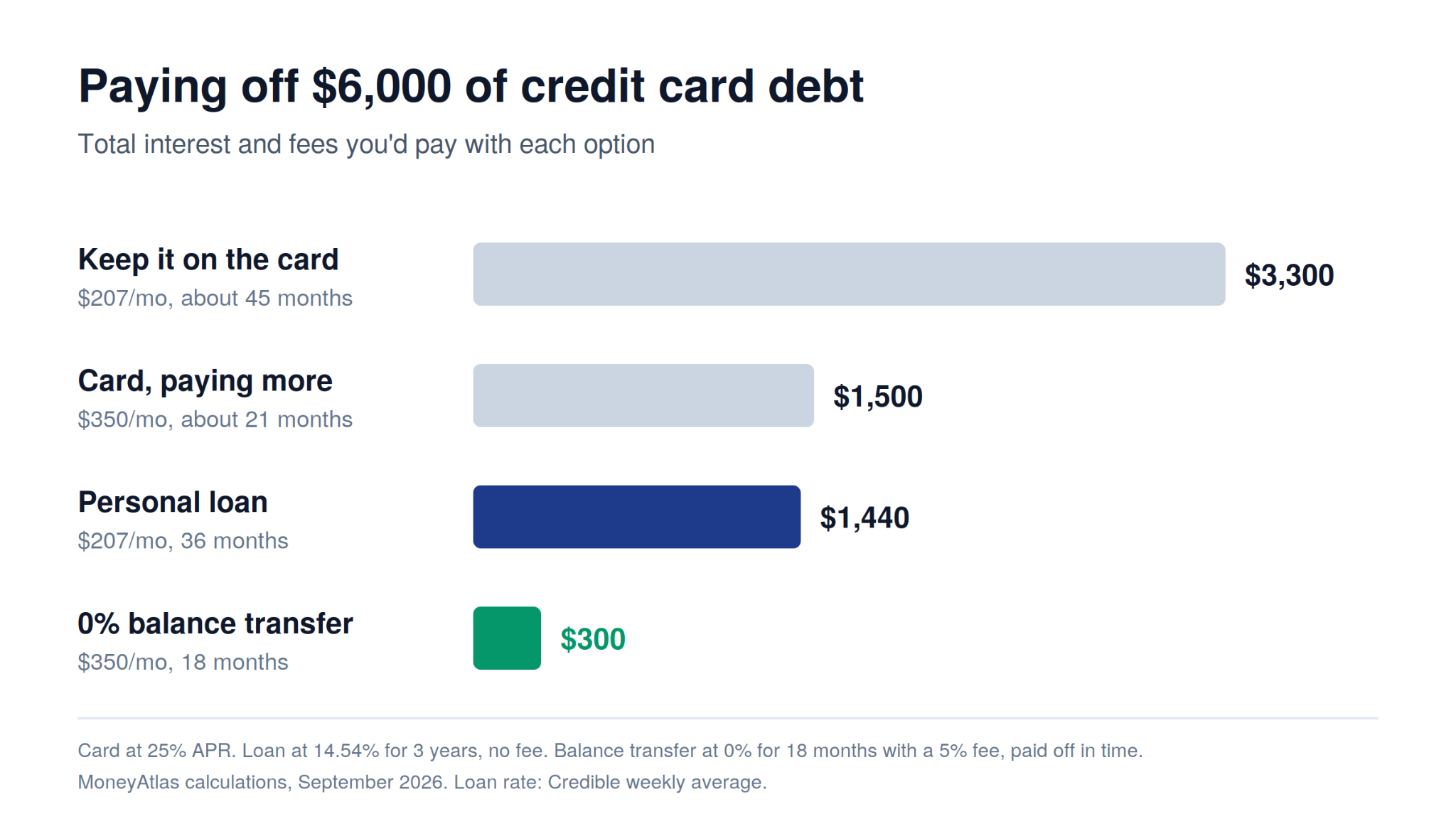
The math on a $6,000 balance

Bar chart comparing total interest and fees on $6,000 of credit card debt: keeping it on the card costs about $3,300, paying more on the card about $1,500, a personal loan about $1,440, and a 0% balance transfer $300.

A 0% balance transfer is the cheapest option, but only if you pay it off before the promo ends.

This assumes the card stays at 25%. It may not.

A few things to consider: A 5% origination fee on the loan adds another $300. The balance transfer only wins if you clear it inside the promo window. And the loan's biggest advantage isn't the rate: it gives you a payoff date, which a credit card never will. Run your own numbers with our payoff calculator.

Quick answers

MoneyAtlas Staff

MoneyAtlas Staff

MoneyAtlas Editorial Team

Articles and reviews from the MoneyAtlas editorial team — independent research on credit cards, banking, loans, insurance, and investing.

Related Articles

Credit CardsAugust 18, 2026

What is the American Express Senior Gold Card?

What is American Express Senior Gold Card? Discover this $95 fee legacy card featuring medical referrals and travel perks tailored for retirees.

Continue Reading