Deciding how to pay off credit card debt involves a choice between two primary goals: saving the most money on interest or gaining the psychological momentum needed to finish the process. With total US consumer credit card debt surpassing $1 trillion, many people find themselves managing balances with an Annual Percentage Rate that often exceeds 20%. MoneyAtlas tracks hundreds of financial products and provides tools to help compare the costs of different repayment strategies. This guide examines the most effective methods for clearing balances, from behavioral shifts like the snowball and avalanche methods to financial tools like consolidation loans and balance transfer cards. Understanding the mechanics of interest and fees is the first step toward choosing a path that fits a specific financial situation.
The Financial Mechanics of Credit Card Debt
Before choosing a strategy, it is helpful to understand why credit card debt is so difficult to eliminate. Most credit cards use daily compounding interest. This means the issuer calculates interest every day based on the current balance and adds it to the total. This new, slightly higher balance then serves as the basis for the next day's interest calculation.
Credit card debt is also revolving debt. Unlike a car loan or a mortgage where there is a set end date, a credit card allows for continuous borrowing up to a specific limit. This flexibility often leads to a cycle where the monthly minimum payment barely covers the interest charges. In this scenario, the principal balance remains almost unchanged.
Strategy 1: The Debt Avalanche Method
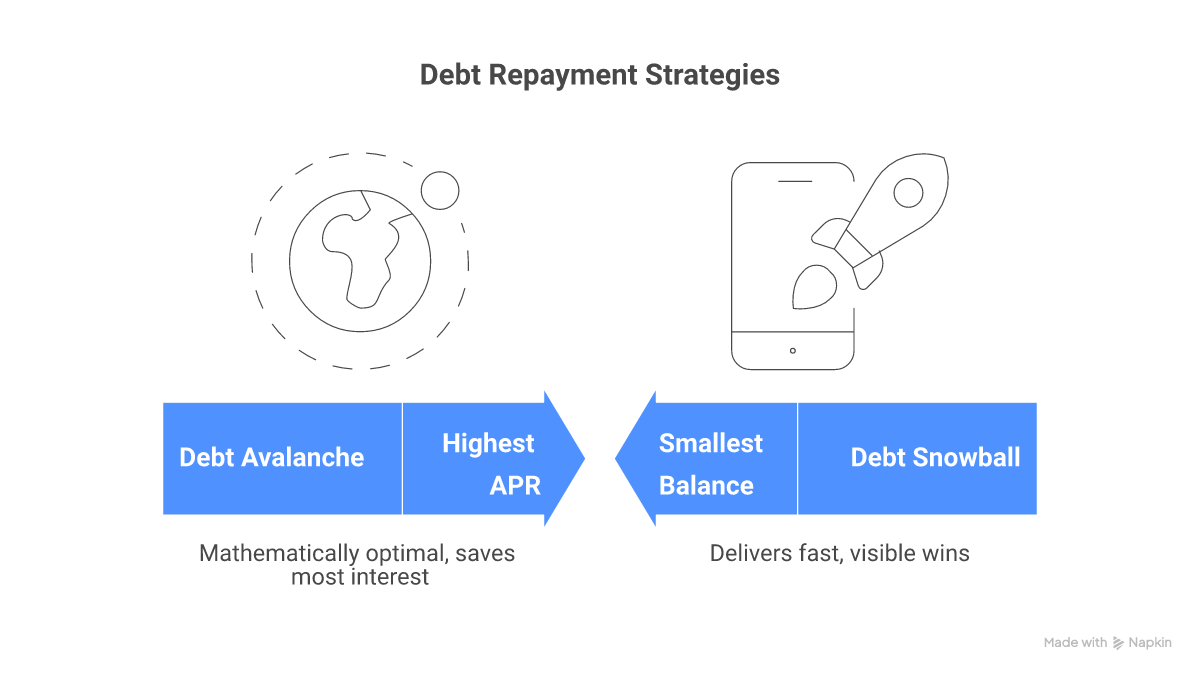
The debt avalanche method is an editorial favorite for those who want the mathematically optimal way to save money. This strategy prioritizes interest rates over balance sizes.
To use this method, list all credit card balances and their respective Annual Percentage Rates. You continue making the minimum payments on every card to protect your credit score. Any extra funds in the budget are then directed toward the card with the highest interest rate. Once that card is paid in full, the entire payment amount from that card is rolled over to the card with the next highest rate.
It minimizes the total amount of interest paid over the life of the debt.
It typically results in a faster overall repayment timeline because less money is lost to interest charges.
It is the most efficient use of every extra dollar available for debt repayment.
The primary drawback is psychological. If the card with the highest interest rate also has a very large balance, it may take months or even years to see that first account reach zero. For some, this lack of immediate gratification makes it harder to stay motivated.
Strategy 2: The Debt Snowball Method
The debt snowball method focuses on behavioral psychology rather than mathematical efficiency. Instead of looking at interest rates, this strategy prioritizes the size of the balances.
Under the snowball method, you make the minimum payments on all cards and put every extra dollar toward the smallest balance first. When that small debt is gone, you take the money you were paying on it and add it to the payment for the next smallest balance. This creates a "snowball" effect as the payments grow larger with each account you close.
The benefits of the snowball method:
It provides quick wins that boost motivation.
The psychological satisfaction of seeing an account closed can help people stick to the plan long-term.
It simplifies your financial life by reducing the number of monthly bills more quickly.
The downside is the cost. By ignoring interest rates, someone might continue paying 28% interest on a large balance while focusing on a 15% interest rate on a small one. This usually results in paying more total interest over time compared to the avalanche method.
Debt Avalanche vs. Debt Snowball: two proven payoff strategies
Using a 0% APR Balance Transfer Card
For those with good to excellent credit, typically a score of 670 or higher, a balance transfer card is a powerful tool to consider. These cards offer an introductory period with 0% interest on transferred balances. This period often lasts between 12 and 21 months.
A good example is our Chase Slate® review, which covers one of the longer 0% intro APR windows available.
When interest is paused, 100% of the monthly payment goes toward the principal balance. This can accelerate the repayment process significantly. However, there are several fine-print details to compare before applying.
Balance Transfer Fees
Most issuers charge a one-time fee to move debt from one card to another. This fee usually ranges from 3% to 5% of the total amount transferred. For a $5,000 balance, a 3% fee would add $150 to the debt. It is important to calculate whether the interest saved over the 0% period outweighs the cost of the fee.
The "Cliff" at the End of the Intro Period
The 0% rate is temporary. Once the introductory period ends, any remaining balance will be subject to the card's standard Annual Percentage Rate. This rate can be high, often ranging from 18% to 29%. It is vital to have a plan to pay off the entire balance before the clock runs out.
Comparison Factors for Balance Transfer Cards
Duration of the 0% offer: Look for the longest possible window to pay down the balance.
Transfer fee percentage: Compare cards to see which offers the lowest fee.
Credit limit: There is no guarantee that the new card will have a high enough limit to cover all existing debt.
New purchase rates: Avoid making new purchases on a balance transfer card, as these may not be covered by the 0% offer.
A debt consolidation loan is a type of personal loan used to pay off multiple credit card balances. This converts revolving debt into installment debt. Instead of managing several different cards with varying rates and due dates, the borrower has a single monthly payment with a fixed interest rate and a set end date.
Lower Interest Rates: If the loan rate is significantly lower than the weighted average of the credit card rates, the borrower saves money.
Fixed Repayment Timeline: Personal loans typically have terms of 2 to 5 years. Knowing exactly when the debt will be gone provides a clear light at the end of the tunnel.
Credit Score Impact: Moving debt from credit cards (revolving) to a loan (installment) can improve the credit utilization ratio. This is a major factor in credit scoring.
Tapping Into Home Equity
Homeowners may have the option to use a Home Equity Loan or a Home Equity Line of Credit (HELOC) to pay off credit card debt. Because these loans are secured by the home, the interest rates are usually much lower than credit cards or personal loans.
If you are comparing secured borrowing options, check our HELOC comparison before deciding.
A Home Equity Loan provides a lump sum with a fixed interest rate. A HELOC works more like a credit card, providing a line of credit that can be used as needed, usually with a variable interest rate.
While the low interest rates are attractive, this strategy carries the highest risk. By using a home as collateral, the borrower is converting unsecured debt (credit cards) into secured debt. If the borrower cannot make the payments, the lender could eventually foreclose on the home. This is a significant tradeoff that requires careful consideration of job stability and monthly cash flow.
Feature
Balance Transfer Card
Personal Loan
Home Equity Loan
Typical Interest Rate
0% (Intro period)
8% to 20%
7% to 10%
Repayment Term
12 to 21 months
2 to 7 years
5 to 15+ years
Fees
3% to 5% transfer fee
0% to 8% origination fee
Closing costs
Collateral Required
None
None
Your Home
Best For
Smaller debt/Short term
Moderate debt/Fixed plan
Large debt/Homeowners
Negotiating with Creditors
It is a common misconception that credit card terms are set in stone. If someone is struggling to make payments due to a job loss, illness, or other hardship, contacting the card issuer is a practical step.
Many lenders have internal hardship programs. These programs might temporarily lower the interest rate, waive late fees, or provide a structured repayment plan. It is better to call the issuer before a payment is missed, as this demonstrates a proactive approach to debt management.
When calling, ask specifically about:
Interest rate reduction programs.
Forbearance or payment deferment options.
Fixed repayment plans that close the account in exchange for a lower rate.
A Step-by-Step Plan to Pay Off Debt
Successfully paying off debt requires more than just picking a method. It requires a procedural approach to ensure the plan sticks.
A Step-by-Step Plan to Pay Off Debt
1
Audit all current debt
Create a spreadsheet or a list that includes every credit card, the current balance, the Annual Percentage Rate, and the minimum monthly payment. Having a clear view of the total $10,000 or $20,000 debt is necessary for planning.
2
Calculate the monthly surplus
Review bank statements from the last three months to determine average income and expenses. Identify areas to reduce spending, such as unused subscriptions or dining out, and determine exactly how much extra cash is available each month for debt repayment.
3
Choose a primary strategy
Decide between the avalanche and snowball methods, or evaluate if a consolidation tool like a personal loan is accessible based on your credit profile. MoneyAtlas comparisons can help identify which products might offer the most savings for a specific credit range.
4
Automate the minimums
Set up automatic payments for the minimum amount on every card. This ensures that no late fees are incurred and the credit score is protected while focusing on the primary target debt.
5
Direct the surplus to the target
Direct every extra dollar toward the first debt in the chosen strategy. If an unexpected windfall occurs, such as a tax refund or a bonus, apply it immediately to the target debt to accelerate the process.
6
Review and adjust monthly
Financial situations change. Revisit the budget once a month to see if the surplus can be increased or if the strategy needs to be adjusted.
Avoiding the Debt Trap in the Future
Paying off the debt is only half the battle. Preventing it from returning is the long-term goal. This involves changing the way credit cards are used and building a financial safety net.
Build an Emergency Fund
Many people fall into credit card debt because of an unexpected expense, such as a car repair or a medical bill. Without savings, the credit card becomes the only option. Even a small emergency fund of $1,000 can act as a buffer and prevent new debt from accumulating during the repayment process.
A simple way to manage money is the 50/30/20 rule. This allocates 50% of income to needs, 30% to wants, and 20% to savings and debt repayment. If debt is high, it might be necessary to temporarily adjust the "wants" category to 10% and move the extra 20% toward debt.
Strategic Card Use
For some, the best way to avoid debt is to stop using credit cards entirely and switch to debit cards or cash. For others, it means only using a credit card for a single recurring bill that is paid in full every month. The goal is to ensure that new charges never exceed the amount of cash available in a bank account.
There is no single best way to pay off credit card debt because every financial situation is different. Someone with a high income and a small amount of debt may find a 0% APR card to be the perfect solution. Someone else with a lower credit score and multiple small balances might find the psychological boost of the snowball method more effective.
If you want to make a short-term savings target part of your reset plan, this guide to saving $10,000 in 3 months can give you a practical starting point.
The most important factor is the decision to start. By comparing the real costs of interest and fees, you can choose a path that minimizes the financial impact and maximizes the chances of success. MoneyAtlas provides the ratings and side-by-side comparison tools to help evaluate these options clearly. Whether you choose a personal loan, a balance transfer, or a behavioral strategy, the path to zero balance starts with a clear understanding of your choices. For readers ready to compare their next move, start with our best balance transfer credit cards.
FAQ
Ready to pick a card?
Compare the cards our editors rate highest right now, side by side, with the fees and rewards that matter.
Learn how to lower credit card APR with 5 proven strategies. From negotiating with issuers to 0% transfers, discover how to offset rising interest rates.