How Do You Calculate APR on a Credit Card?


Introduction
Understanding how to calculate APR on a credit card is the first step toward managing debt and comparing financial products effectively. Most cardholders see a high interest rate on their statement but do not understand how that annual figure translates into the specific dollar amount charged every month. This article explains the mechanics of the Annual Percentage Rate (APR), the role of the daily periodic rate, and how the average daily balance method determines your final costs. MoneyAtlas compares over 1,500 financial products to help consumers identify which terms and rates suit their specific needs. If you want a broader starting point for shopping, you can also browse our credit card reviews or compare options in our best cash back credit cards roundup. By breaking down the math behind your monthly finance charge, you can better understand the real cost of carrying a balance and how to use comparison tools to find more affordable options.
The Relationship Between APR and Monthly Interest
The Annual Percentage Rate represents the cost of borrowing money over a full year, but credit card companies do not wait until the end of the year to charge you. Instead, they apply interest periodically, typically at the end of every billing cycle. Because interest is often calculated daily, the 20% or 25% figure you see on your statement is a starting point for a more complex calculation. For a more detailed breakdown of the term itself, see our guide to what APR means on a credit card.
To understand your monthly bill, you must first convert that yearly percentage into a daily one. This is known as the Daily Periodic Rate. For most cards, this is found by taking your APR and dividing it by 365, representing the days in a year. Some issuers may use 360 days, but 365 is the standard for most US consumer cards.
Calculating the Daily Periodic Rate (DPR) is the fundamental first step. If a cardholder has an APR of 24%, the math looks like this: 0.24 divided by 365 equals approximately 0.000657. This means that for every day you carry a balance, you are charged 0.0657% of that balance in interest. While this seems like a tiny fraction, it adds up quickly when applied to thousands of dollars over 30 days.
Step-by-Step: How to Calculate Your Finance Charge
How to Calculate Your Finance Charge
- 1
Locate your APR
Check your latest credit card statement under the section labeled "Interest Charge Calculation." Note that you may have different APRs for purchases, cash advances, and balance transfers.
- 2
Determine the daily periodic rate
Divide your APR by 365. For example, an 18% APR divided by 365 equals a daily rate of 0.0493%. Convert this to a decimal for the calculation: 0.000493.
- 3
Find your average daily balance
Your statement should list this figure. If it does not, you can calculate it by adding up your balance at the end of every single day in the billing cycle and dividing by the total number of days in that cycle.
- 4
Calculate the daily interest
Multiply your average daily balance by the daily periodic rate. If the average daily balance is $1,000 and the daily rate is 0.000493, the daily interest is approximately $0.49.
- 5
Calculate the monthly total
Multiply the daily interest by the number of days in the billing cycle. In a 30 day month, a $0.49 daily charge results in a $14.70 monthly interest fee.
Understanding the Average Daily Balance Method
The average daily balance is perhaps the most critical component of the interest calculation because it accounts for every transaction made during the month. Most credit card issuers do not just look at your balance on the day the statement closes. Instead, they look at what you owed at the end of every day between the start and end of the billing period.
If you start a 30 day billing cycle with a $0 balance, spend $1,000 on day 15, and leave it there until the end of the month, your average daily balance is $500. This is because you owed $0 for 15 days and $1,000 for 15 days. Your interest would be calculated on $500, even though your statement balance shows $1,000.
Conversely, making a payment early in the billing cycle can significantly lower the interest charge. If you owe $2,000 and pay off $1,000 on day five of a 30 day cycle, you owe $1,000 for 25 days of that month. This lowers your average daily balance much more than if you had waited until the end of the month to make that same $1,000 payment. When comparing cards, it is useful to understand that the timing of your payments is almost as important as the interest rate itself.
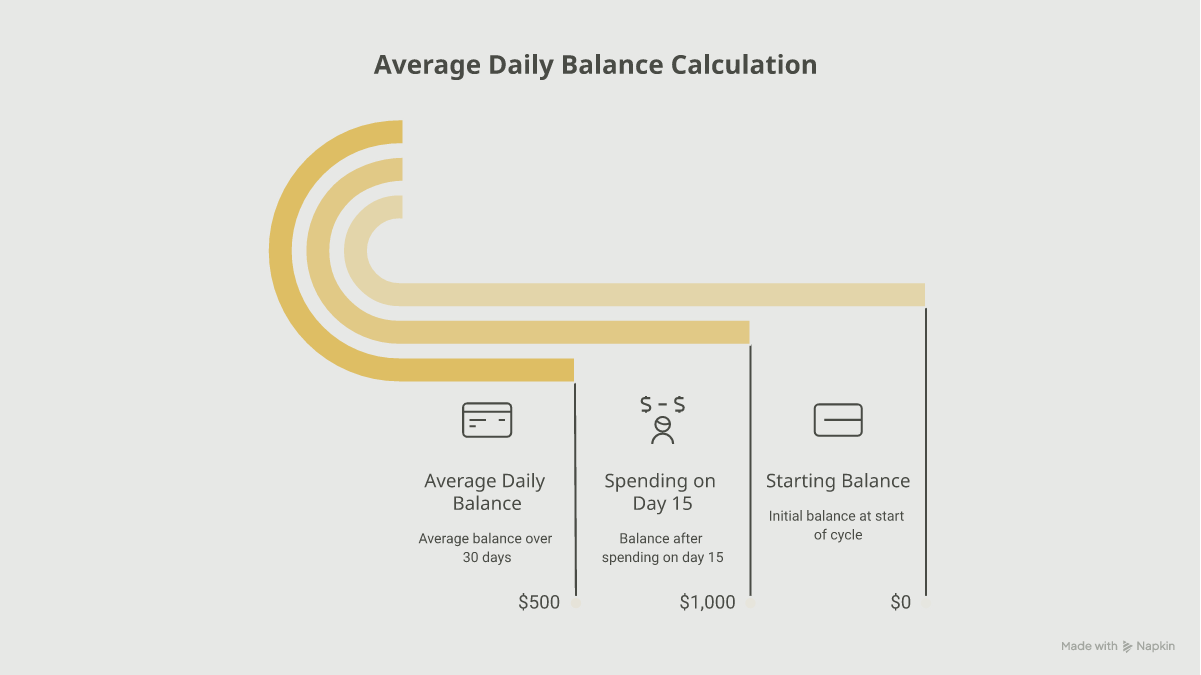
Example: Average Daily Balance Scenarios
The Impact of Daily Compounding Interest
Credit card interest typically compounds daily, which means the issuer adds the interest you earned today to the balance you owe tomorrow. This creates a "snowball" effect where you are eventually paying interest on the interest. While the daily periodic rate is small, the fact that it is added back into the principal every day means the effective rate you pay is slightly higher than the stated APR.
This is why credit card debt can feel so difficult to pay down. If you only make the minimum payment, a large portion of that payment goes toward the interest that has been compounding daily throughout the month. This leaves very little to reduce the actual principal balance you spent.
Compounding makes the cost of carrying a balance over several months significantly higher than the simple math might suggest. For someone carrying a $5,000 balance at a 24% APR, the first month of interest might be roughly $100. If no payments are made, the next month's interest is calculated on $5,100, not $5,000. Over a year, this compounding can add hundreds of dollars to the total debt. When evaluating different credit cards, look for those with lower APRs to minimize the impact of this daily compounding.
The Role of the Grace Period
The grace period is the most effective tool for avoiding interest charges entirely. A grace period is the window of time between the end of a billing cycle and the date your payment is due. For most cards, this period is at least 21 days. If you pay your statement balance in full by the due date every month, the issuer generally does not charge any interest on your purchases.
However, the grace period is usually only available if you do not carry a balance from the previous month. If you fail to pay the full balance and carry even a small amount over to the next month, you typically lose the grace period. This means interest begins accruing on new purchases the moment you make them.
Losing a grace period can make a credit card much more expensive for daily use. Without it, every cup of coffee or grocery trip starts earning interest immediately. To regain the grace period, most issuers require the cardholder to pay the statement balance in full for two consecutive billing cycles. Understanding this rule is vital when deciding whether to carry a balance or prioritize a full payoff.
Different Types of APR on a Single Card
A single credit card can have multiple APRs that apply to different types of transactions. It is common for a card to have one rate for standard purchases and a significantly higher rate for cash advances. Many cardholders are surprised to find that cash advances often do not have a grace period, meaning interest starts the moment the cash is in your hand.
Common APR Categories
- Purchase APR: The rate applied to standard transactions like shopping or dining.
- Balance Transfer APR: The rate applied to debt moved from another card. This is often lower than the purchase APR for a promotional period.
- Cash Advance APR: The rate for withdrawing cash from an ATM using your card. This is typically the highest rate on the card.
- Penalty APR: A very high rate triggered by late payments or returned payments.
When you make a payment on a card with multiple APRs, the law requires the issuer to apply any amount above the minimum payment to the balance with the highest rate. This helps consumers pay down the most expensive debt first. However, the minimum payment itself can be applied to the lowest interest balance first at the issuer's discretion. MoneyAtlas makes it easier to compare these various rates across different issuers so you can see the potential cost of every transaction type.
Variable vs. Fixed APRs
The vast majority of modern credit cards use variable APRs, which means your interest rate can change without notice. Variable rates are usually tied to an index, such as the U.S. Prime Rate. When the Federal Reserve raises or lowers interest rates, the Prime Rate usually follows, and your credit card APR will likely adjust by the same amount.
Your card's terms will typically state that your APR is the "Prime Rate + X%." The "X%" is the margin the bank adds based on your creditworthiness. For example, if the Prime Rate is 8.5% and your margin is 12%, your APR is 20.5%. If the Prime Rate moves to 9%, your APR will automatically move to 21%.
Fixed APRs are increasingly rare in the credit card market. Even fixed rates are not necessarily permanent, and the issuer can still change them, but they must provide advance notice. Because most cards are variable, it is important to check your statement regularly to see if your rate has increased. This fluctuation is a key factor to consider when comparing long-term debt options like personal loans, which often feature fixed rates, versus the variable rates of credit cards.
How Credit Scores Influence Your APR
Lenders use your credit score to determine the margin they add to the Prime Rate. Borrowers with excellent credit scores usually qualify for the lowest available margins. Those with fair or poor credit will likely be assigned a much higher APR, as the lender views them as a higher risk.
When you see a credit card advertisement showing a range like "17.99% to 28.99% APR," the rate you actually get depends on your credit profile. If your score has improved significantly since you opened your account, you might be able to qualify for a lower rate on a new card. MoneyAtlas provides expert ratings and breakdowns of cards suited for various credit tiers, and our guide to American Express approval requirements shows how credit score can affect approval odds.
Monitoring your credit utilization is also vital for maintaining a lower APR environment. High balances relative to your credit limits can lower your credit score, which may prevent you from qualifying for better rates in the future. Keeping your utilization below 30% is a general guideline used to maintain a healthy credit profile.
How to Lower the Interest You Pay
While you cannot always change the APR on an existing card, you can change how much interest you actually pay. The most effective strategy is to reduce your average daily balance by making multiple payments throughout the month. If you have extra cash on hand, putting it toward your card balance immediately rather than waiting for the due date will reduce the interest accrued.
Another option is to explore a balance transfer. Many cards offer a 0% introductory APR on balance transfers for 12 to 21 months. Moving high-interest debt to one of these cards can save someone hundreds or even thousands of dollars in finance charges, provided they pay off the balance before the promotional period ends. If that sounds like the right route, compare offers in our balance transfer credit cards guide and read how balance transfers work before you apply.
For those with high-interest debt that feels unmanageable, a personal loan may be a viable alternative. Personal loans often have lower fixed rates than credit cards and offer a structured repayment schedule. This eliminates the daily compounding of a credit card and provides a clear end date for the debt. Comparing these options side by side is the best way to determine which path offers the greatest savings, and our personal loan comparison page can help you review current offers.
- Make bi-weekly payments: Instead of one large payment, pay half of your bill every two weeks to lower your average daily balance.
- Request a rate reduction: If your credit score has improved, call your issuer and ask if they can lower your APR.
- Avoid cash advances: These high-interest transactions rarely have a grace period and often carry extra fees.
- Use 0% APR offers: Use these for large purchases or debt consolidation, but have a plan to pay it off before the rate jumps.
Comparing Cards Using APR and Terms
When comparing credit cards, the APR should be one of the primary factors you evaluate, but it is not the only one. You must also look at annual fees, rewards rates, and the length of any introductory periods. A card with a slightly higher APR might be a better value if it offers significant cash back and you plan to pay the balance in full every month.
However, if you know you will carry a balance, the APR is the most important number. A difference of 5% in APR can cost hundreds of dollars over a year on a large balance. MoneyAtlas reviews over 1,500 products across every major financial category, providing clear breakdowns of these costs so you can compare apples to apples. For fee-conscious shoppers, our no annual fee credit cards page is a useful place to start.
Always look at the Schumer Box on a credit card application. This is the standardized table that lists the APR, fees, and interest calculation method. It is required by law and is the best way to see the true cost of a card without the marketing fluff. Pay close attention to the penalty APR and how easily it can be triggered, as this can nearly double your interest costs if you miss a payment.
Conclusion
Calculating the APR on a credit card involves more than just looking at a single percentage. By understanding the daily periodic rate and the average daily balance method, you can see exactly how your spending and payment habits influence your monthly finance charges. While credit cards are convenient, the daily compounding of interest makes them an expensive way to borrow money over the long term.
To manage your costs, focus on maintaining your grace period, making early payments to lower your average daily balance, and monitoring your credit score to qualify for better rates. If you are currently carrying high-interest debt, comparing your current card against balance transfer offers or personal loans could reveal a more affordable path forward. You can also review the broader credit card review library to compare features across multiple products.
- Find your daily periodic rate by dividing your APR by 365.
- Use your average daily balance to estimate your monthly interest charge.
- Pay in full every month to keep your interest cost at zero.
- Compare different card offers to ensure you have the most competitive rate available for your credit profile.
FAQ
MoneyAtlas Staff
Articles and reviews from the MoneyAtlas editorial team — independent research on credit cards, banking, loans, insurance, and investing.
Related Articles

Which Card Is Better: American Express Gold or Platinum?
Deciding which card is better: American Express Gold or Platinum? Compare fees, 4X dining rewards, and luxury travel perks to find your perfect match.

Should I Get an American Express Gold Card? Breaking Down the Value
Should I get an American Express Gold card? Explore the 4X rewards on dining and groceries vs. the $325 fee to see if this premium card fits your budget.

How to Get the American Express Gold Card: A Practical Guide
Learn how to get the American Express Gold Card with our guide on credit score requirements, income, and the 'Apply with Confidence' tool. Apply today!