IRA CD Rates in 2026: What They Pay and How They Work


An IRA CD is a certificate of deposit held inside an individual retirement account. Rates are quoted as APY and move with the term you pick and the institution offering it. Longer terms usually pay more, and every dollar you put in counts against your annual IRA contribution limit.
Current IRA CD Rates
The highest IRA CD rate we found on October 10, 2026 was 4.75% APY, on an 18-month term at Bread Savings. None of the institutions we checked was paying 5%. Every figure below was read from the institution’s own IRA rate page on the date shown, and rates can change without notice.
IRA CD rates by institution
A few notes on reading the table. Navy Federal certificates require credit union membership, and its APYs step up slightly at $20,000 and $100,000. Ridgewood opens IRA CDs in a branch only. Roth IRA CD rates and Traditional IRA CD rates are the same at Bread Savings and Navy Federal, because the rate belongs to the CD and not to the tax wrapper. Our Bread Savings CD review covers that bank’s standard certificates, and you can compare standard CD rates if the money does not need to sit inside an IRA.
MoneyAtlas tracks CD rates across the banks below, and the comparison updates as those APYs move. Read them as a benchmark rather than a quote. Not every bank that sells a standard CD offers an IRA version, and the ones that do sometimes price it differently, so confirm IRA eligibility with the institution before you assume the headline rate carries over.
To model what a given APY actually returns over a five-year term, the CD rates calculator does the arithmetic, and the retirement savings calculator puts that number next to the rest of your retirement plan. For money you might need before the term ends, a high-yield savings account is the better home, because an IRA CD punishes early access twice over.
Compare


What Is an IRA CD?
An IRA CD is two products stacked. The CD half fixes a rate for a fixed term. The IRA half decides how the interest gets taxed. Credit unions sell the same thing under a different name, a share certificate, which is worth knowing once you shop beyond banks.
The constraint people miss is the ceiling on deposits. A regular CD takes as much as you want to put in. An IRA CD is capped by the annual IRA contribution limit, so building a large position takes years of contributions or a rollover from an existing retirement account. Balances are covered by FDIC deposit insurance at banks and NCUA share insurance at credit unions, up to the applicable limits.
Traditional vs. Roth IRA CD: Which Tax Treatment Fits
The CD mechanics are identical either way. The tax treatment is not. A Traditional IRA CD may give you a deduction now and taxes the money when you take it out. A Roth IRA CD takes after-tax dollars and, if you follow the rules, pays out tax free. Which one wins depends on whether your tax rate will be higher now or in retirement, and nobody knows that with confidence. If you are weighing the retirement wrapper itself rather than the CD inside it, our Roth IRA vs. brokerage account comparison covers that decision.
Age matters more here than it does with an ordinary CD. Withdraw before 59½ and the IRS can add a 10% additional tax on early distributions on top of whatever the bank charges for breaking the term. Going the other direction, from age 73 a Traditional IRA is subject to required minimum distributions, which can force a withdrawal while the CD is still locked. Roth IRAs carry no RMD for the original owner. If you are near either age, stagger your terms so a maturity date is always close.
It helps to put numbers on that stacked penalty, because the two charges are additive and most explanations skip the arithmetic. Say you hold $10,000 in a five-year IRA CD, you are 55, and you break the term two years in. A common early-withdrawal charge on a five-year CD is a year of interest, so at a 4% APY that is roughly $400. The IRS then applies its 10% additional tax to the distribution, another $1,000 on the full $10,000, and a Traditional IRA distribution is taxable as ordinary income on top of that. You set out to move $10,000 and the exit cost alone is $1,400 before income tax. That is the real argument for a shorter term.
How to Choose an IRA CD Term
Longer terms usually pay more, but the premium for stretching from one year to five is often thin, and you are taking five years of rate risk to collect it. If the gap between a one-year and a five-year APY is a quarter of a point, take the short term and keep the option to reinvest. The same logic applies across the wider set of CD accounts outside a retirement wrapper.
A ladder splits the difference. Divide the money across several terms so part of it matures every year, which gives you a reinvestment window without unlocking the whole position. Whatever you pick, put a reminder on the maturity date, because IRA CDs typically roll into a new term on their own and the window to change your mind is short. The CFPB's explainer on how certificates of deposit work covers the general mechanics, and our brokerage vs. high-yield savings comparison is the better read if you are still deciding whether to lock the money up at all.
Where you open it matters as much as the term. Plenty of banks sell CDs but never wrapped one in an IRA, and among those that do, the IRA version sometimes carries a shorter menu of terms or a higher minimum. Credit unions are the half of this market most rate tables ignore, and they list the product as a share certificate rather than a CD, so a search for IRA CD rates will miss them entirely. If you are comparing seriously, search both terms and check whether membership eligibility is something you actually qualify for before you get attached to the rate.
IRA CD vs. IRA Savings Account
Both accounts sit inside the same IRA wrapper, so the tax treatment is identical and both count toward one annual limit. For 2026 the IRS contribution limit is $7,500 across all your IRAs, or $8,600 if you are 50 or older. The difference is what the money does once it is in there.
An IRA CD fixes your rate for the term and charges a penalty if you break it. An IRA savings account pays a variable rate that the bank can change at any time, and in exchange you can move the money within the IRA whenever you like. Some institutions sell both. Bread Savings, for example, lists a retirement high-yield savings account next to its retirement CDs.
Pick the CD when you want to lock in today’s rate and you are confident the money stays put until maturity. Pick the IRA savings account when you are parking a rollover while you decide, building toward a CD minimum, or close to taking distributions. IRA savings account rates often trail the best CD terms, so check both at the same institution before choosing. Outside a retirement account it is the same trade you would weigh with high-yield savings accounts.
What Interest Rate Does an IRA Earn?
An IRA has no interest rate of its own. It is an account type, a tax wrapper, and what it earns depends on what you hold inside it. Put a CD or a savings account in the IRA and you earn that product’s stated APY. Hold mutual funds, stocks or bonds and there is no fixed rate at all, only whatever the investments return, which can be negative in a given year.
That is why a search for traditional IRA interest rates turns up bank rate tables. The rate belongs to the deposit product, and the Traditional or Roth label only changes how the earnings are taxed. If you are deciding between holding cash and investing inside the account, our guide to a Roth IRA vs. a brokerage account walks through that choice.
CD vs. IRA: How the Two Accounts Differ
Saving money is an important step toward your financial goals. Maybe you've decided to start saving. But where? Financial advisors don't usually recommend piggy banks. And tucking cash under your mattress isn’t the way to go either.
Luckily, you have better options. Two popular choices are certificates of deposit (CDs) and individual retirement accounts (IRAs). Compare the features, benefits, and limitations of CD vs. IRA accounts to decide which is right for you.
Key Differences Between CDs and IRAs
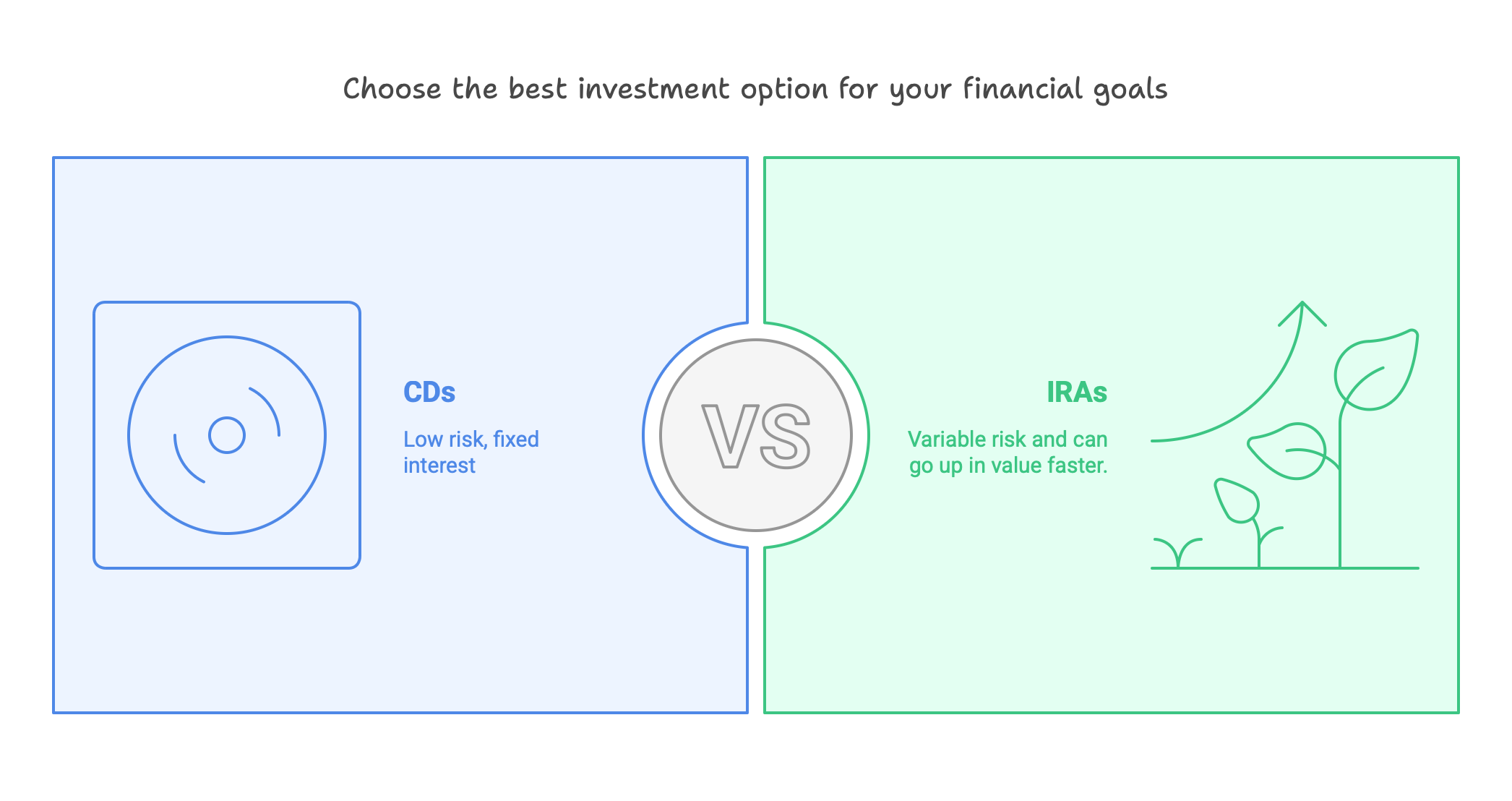
While both CDs and individual retirement accounts can be great saving options, there are some significant differences between them.
CDs: Advantages and Drawbacks
CDs are ideal for people looking for short-term savings with guaranteed returns. Because these accounts typically have fixed interest rates and terms, you know exactly how much you’ll earn when you deposit your money. Plus, the deposits are guaranteed up to $250,000 by either the FDIC or the NCUA, so your money is safe.
On the downside, even top CDs don’t offer very high interest rates. You can't touch your money for the length of the CD — otherwise, you’ll face early withdrawal penalties that eat into your savings.
A CD’s rigid terms might not suit someone who needs more flexibility. Minimum balance savings accounts may be the better option. Browse banking account reviews to find the best account for your needs.
Benefits and Limitations of Choosing an IRA
IRAs generally provide better long-term growth and contribution flexibility than CDs. You can start saving in an IRA as soon as you have taxable income and grow that money for years or even decades until your retirement. Both Roth and traditional IRAs offer tax benefits that make them extra appealing for your retirement savings.
A notable drawback is that IRAs are subject to a contribution limit. For 2026, you can contribute $7,500 across all your IRAs or $8,600 if you’re 50 or older.
Some people may also find the complex rules governing IRAs confusing. Though you can withdraw your money at any time, there are potential penalties for early withdrawals.
Liquidity and Accessibility: Which Option Gives You More Flexibility?
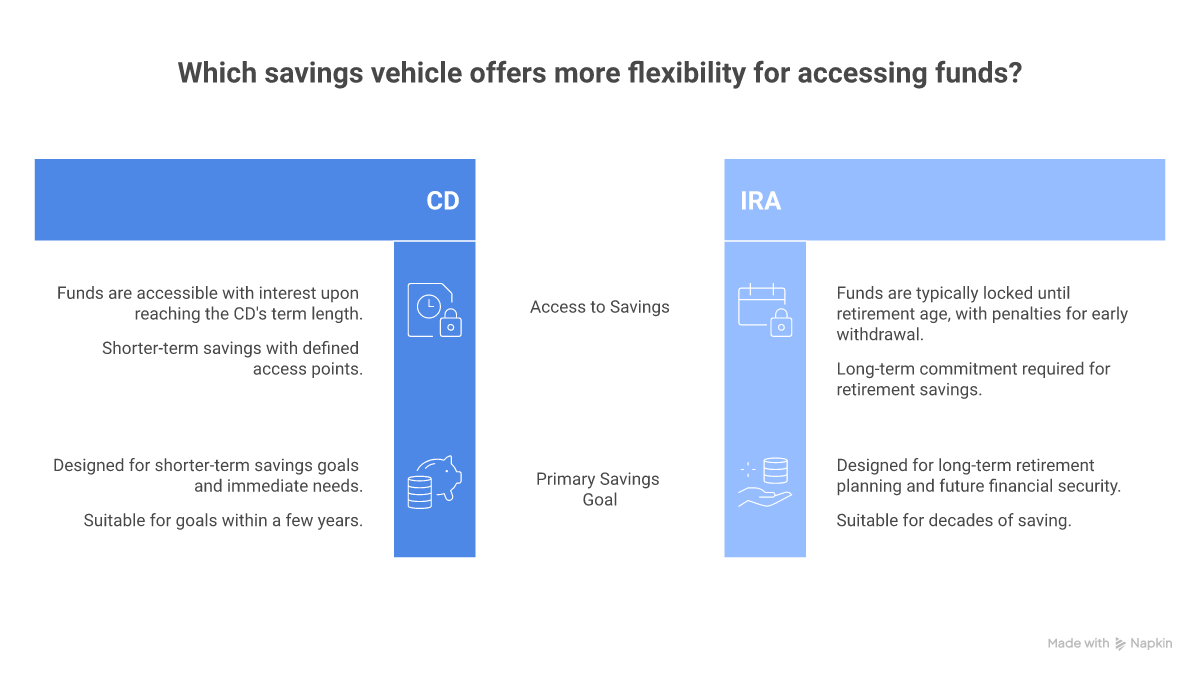
When deciding between a traditional or Roth IRA vs. a CD account, one thing to consider is how accessible your money will be. If your financial situation changes and you need to dip into your savings, which would be better: a CD or an IRA?
Both CDs and IRAs have penalties for early withdrawals. With a CD, early withdrawal is anytime before the maturity date — the day when the CD term is up and you get your money back with interest. With an IRA, early withdrawal is before you turn 59.5 years old.
Your age and the CD term length you select will determine whether you can access funds from a CD or an IRA sooner. Generally, though, CDs are considered more liquid and accessible than IRAs because they have fairly short term lengths.
Tax Implications: How CDs and IRAs Affect Your Taxes
The money you deposit in a CD is after-tax, meaning you have already paid income tax on it. Opening a CD doesn’t help you lower your taxable income. In fact, a CD raises your taxable income because you owe taxes on the interest you earn.
With a traditional IRA, your contributions are pre-tax, which can reduce your current tax burden by bringing down your taxable income. However, when you retire, you will owe taxes on your withdrawals.
Roth IRAs work the other way around. You pay income tax on the money you contribute to your Roth IRA now, but you don’t owe anything for qualified withdrawals in retirement.
Keep in mind that with both Roth and traditional IRAs, you’re subject to a 10% early withdrawal penalty if you take money out of your account before you turn 59.5 years old.
Making the Right Choice: Which Option Is Best for You?
Selecting the right account for your savings will help you grow your money and reach your financial goals. CDs and IRAs are both great choices — you just need to decide which is best for you. Explore CDs, IRAs, and other savings account options on MoneyAtlas to find the right fit.
FAQ
Put your savings to work
See which high-yield savings accounts are paying the most today.
Compare savings accountsEducation
- Bachelor’s Degree in Economics, Ramapo College of New Jersey
Expertise
- Debt and Credit Management
- Budgeting and Money-Saving Strategies
- Financial Digital Security and Fraud Protection
Related Articles

How to Open a Bank Account Online With No Deposit
Open a checking or savings account online today with $0. We compare no-deposit accounts by fees, ChexSystems, bonuses and how fast you can start, plus the exact steps.

SoFi vs Discover: Banking, HYSA, and Personal Loan Comparison
Side-by-side comparison of SoFi and Discover for checking, savings, and personal loans: APYs, fees, rates, and who each bank is best for.

High-Yield Savings Accounts with No Minimum Balance
Looking for a high-yield savings account with no minimum balance? Explore top options offering great interest with no deposit requirements.