Can You Lower Your Credit Card Interest Rate? 5 Proven Ways to Save


Introduction
Many credit card holders assume the interest rate assigned to their account is permanent. However, credit card interest rates are often negotiable. Whether you are facing a temporary financial setback or have recently improved your credit score, lowering your Annual Percentage Rate (APR) is one of the most effective ways to reduce the cost of debt. Even a small reduction in your rate can save hundreds or thousands of dollars over the life of a balance.
MoneyAtlas provides comparison tools and expert reviews to help you navigate these financial choices. This guide explores the mechanics of credit card interest, how to prepare for a negotiation with your bank, and alternative methods like balance transfers or consolidation loans. Understanding your options is the first step toward making a more informed decision about your debt, and it helps to start with our best credit cards comparison.
Understanding How Credit Card Interest Works
To lower your interest rate effectively, you must first understand how banks calculate what you owe. Most credit cards use a variable APR, which means the rate can change based on the prime rate set by the Federal Reserve. When the Fed raises rates, your credit card interest typically follows.
If you want a deeper explanation of how the math works, MoneyAtlas also breaks it down in how APR works on a credit card.
Interest on credit cards usually compounds daily. This is a critical distinction from other types of loans. The bank takes your APR, divides it by 365 to find a daily periodic rate, and applies that rate to your average daily balance every single day.
For example, a card with a 24% APR has a daily rate of roughly 0.065%. If you carry a $5,000 balance, you are being charged about $3.25 in interest every day. Because this interest is added to the balance, you end up paying interest on the interest the very next day. This compounding effect is why high-rate debt feels so difficult to pay down.
APR vs. Interest Rate
In the context of credit cards, APR and the interest rate are usually the same number. Unlike a mortgage or an auto loan, where the APR includes various closing costs or origination fees, credit card fees like annual fees or late fees are typically billed separately. However, a single card often has multiple APRs:
- Purchase APR: The rate applied to standard retail charges.
- Balance Transfer APR: The rate for debt moved from another card.
- Cash Advance APR: A much higher rate for ATM withdrawals, which usually begins accruing interest immediately without a grace period.
- Penalty APR: A high rate (often near 30%) triggered by late payments.
If you are comparing rates and fees across cards, the credit card APR guide is a helpful next step.
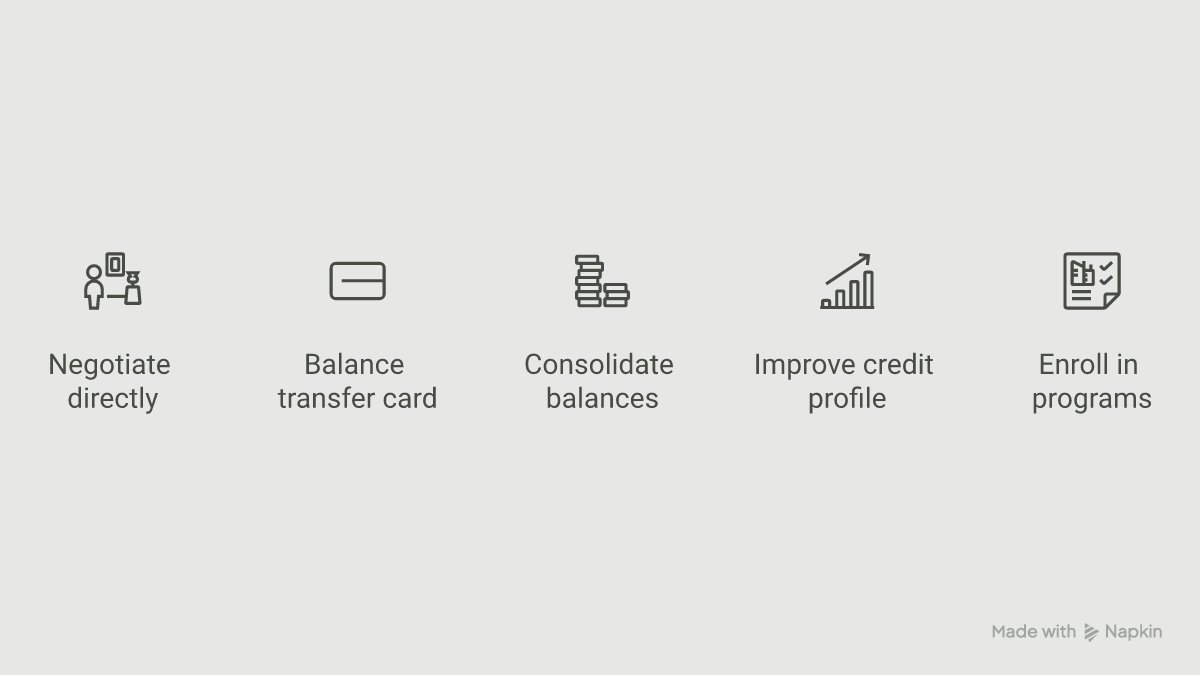
Strategy 1: Negotiating Directly With Your Issuer
Negotiating with your current credit card issuer is the simplest way to lower your rate because it does not require opening a new account. Many cardholders do not realize that retention departments have the authority to lower rates to keep customers from leaving.
How to Prepare for the Call
Before calling, gather evidence to support your request. A bank is more likely to lower your rate if you can prove you are a low-risk customer. Check your current credit score. If it has improved since you first opened the account, you have significant leverage.
Next, research the market. Look for offers from other banks for people with your credit profile. If a competitor is offering a 16% APR and you are currently paying 22%, keep that figure ready. Mentioning that you have received pre-approved offers for lower rates is a strong negotiating tactic.
The Negotiation Script
When you call the number on the back of your card, ask to speak with someone regarding your interest rate. If the first representative says they cannot help, politely ask to speak with the retention department.
You might say: "I have been a loyal customer for five years and have a perfect on-time payment record. My credit score has recently improved to 740, and I am seeing offers from other banks for rates significantly lower than my current 23% APR. I would like to stay with your bank, but I am looking for a lower rate to make my balance more manageable. Can you match the 17% rates I am seeing elsewhere?"
What if They Say No?
If the bank refuses a permanent reduction, ask for a temporary one. Some issuers offer promotional rates for 6 to 12 months to help customers through financial transitions. If they still decline, ask what specific steps you could take to qualify for a lower rate in six months.
Strategy 2: Utilizing Balance Transfer Credit Cards
If your current bank will not budge, moving your debt to a different institution is a powerful alternative. Balance transfer credit cards often feature introductory periods with 0% APR for 12, 15, 18, or even 21 months.
For a closer look at the tradeoffs, see how balance transfer cards work.
The Benefits of 0% APR
During the introductory window, 100% of your monthly payment goes toward the principal balance rather than interest. This can save someone carrying a $10,000 balance thousands of dollars in interest charges. MoneyAtlas tracks current 0% APR offers across major issuers, making it easier to see which cards offer the longest promotional windows.
Understanding the Transfer Fee
Most cards charge a balance transfer fee, typically ranging from 3% to 5% of the total amount moved. For a $5,000 transfer, a 3% fee would add $150 to your balance. While this is an upfront cost, it is usually much lower than the interest you would pay over several months at a standard 20% or 24% APR.
The "All or Nothing" Risk
If you want a broader look at the timing and payoff strategy, these balance transfer credit cards are a practical place to compare options.
Strategy 3: Consolidating With a Personal Loan
For those with larger amounts of debt across multiple cards, a debt consolidation loan may be more effective than a balance transfer. This involves taking out a personal loan at a lower fixed interest rate and using the funds to pay off your credit cards.
Fixed vs. Variable Rates
Credit card rates are variable, meaning they can rise if the market changes. Personal loans usually offer fixed rates and fixed monthly payments. This provides predictability, as you know exactly when the debt will be paid off.
Improving Credit Scores
Consolidating credit card debt into a personal loan can sometimes boost your credit score. This happens because the "Amounts Owed" category of your credit score looks at credit utilization. By moving revolving credit card debt to an installment loan, your credit card utilization drops to 0%, which is often viewed favorably by credit scoring models.
MoneyAtlas makes it easier to compare personal loan rates side by side. When evaluating a loan, pay attention to the origination fee, which is a one-time charge taken out of the loan proceeds. A loan with a slightly higher interest rate but no origination fee might be cheaper than a low-rate loan with a 5% fee.
Strategy 4: Improving Your Credit Profile for Future Leverage
Your credit score is the single most important factor in the interest rate you are offered. If you cannot lower your rate today, focusing on your credit profile can set you up for a successful negotiation or a better offer in a few months.
Lower Your Utilization
Credit utilization is the percentage of your available credit that you are currently using. If you have a $10,000 limit and a $5,000 balance, your utilization is 50%. Lenders generally prefer to see this under 30%. If you can pay down balances to reach that 30% threshold, your score may rise, giving you more leverage to ask for a rate reduction.
Correct Reporting Errors
Check your credit reports from Equifax, Experian, and TransUnion. Errors are common, and an incorrect late payment or a balance that appears higher than it actually is can drag down your score. Disputing these errors can lead to a quick score increase.
Consistency Matters
Length of credit history and payment consistency are vital. Avoid closing old accounts even after you pay them off, as the age of your accounts helps your score. Consistently paying at least the minimum by the due date protects your score from the heavy damage caused by 30-day late payments.
For a related breakdown of how utilization and rate choices fit into the bigger picture, see what APR is good for credit card purchases.
Strategy 5: Hardship Programs and Debt Management
If you are struggling to make even the minimum payments, standard negotiation might not be enough. In these cases, you may need to explore formal hardship or management options.
Internal Hardship Programs
Many credit card companies have internal hardship programs for customers facing job loss, illness, or other emergencies. These programs may temporarily lower your interest rate or waive fees. However, these programs often come with a catch: the bank may close your account or restrict your ability to make new purchases until the debt is paid.
Debt Management Plans (DMP)
A Debt Management Plan is organized through a non-profit credit counseling agency. The agency negotiates with your creditors to lower your interest rates and consolidate your debts into one monthly payment made to the agency.
Debt Management Plans (DMP)
Pros
Rates can be lowered significantly (sometimes to 0% to 10%).
Cons
You generally must close all credit card accounts included in the plan, and there is often a small monthly administrative fee.
Unlike debt settlement, which involves stopping payments and can ruin your credit, a DMP focuses on paying back the full principal at a lower interest rate, which is less damaging to your credit score over the long term.
If you want to understand where rate relief fits into broader debt payoff planning, MoneyAtlas’s credit card interest guide is a useful reference.
Why Your Interest Rate Might Have Gone Up Recently
It can be frustrating to see an APR increase when you haven't changed your spending habits. Understanding why this happens can help you prevent it in the future.
The Federal Reserve and Prime Rate: Most cards are tied to the U.S. Prime Rate. If the Federal Reserve increases the federal funds rate, the Prime Rate rises, and your variable APR will likely increase by the same amount within one or two billing cycles.
Penalty APRs: If you are 60 days late on a payment, the issuer can trigger a penalty APR. This rate is often 29.99% or higher. By law, if you make six months of on-time payments, the issuer must review the account and consider returning you to your original rate.
Promotional Period Expiration: If you had a 0% introductory rate for 12 months, the rate will automatically jump to the standard APR once that window closes. This is not a mistake by the bank; it is a standard part of the credit card agreement.
Credit Score Changes: Some lenders monitor your credit report periodically. If they see that you have taken on significant debt elsewhere or have missed payments with other creditors, they may view you as a higher risk and raise your rate.
If you are wondering whether rates are moving lower or higher overall, recent credit card rate trends can help put your account change in context.
How to Avoid Interest Entirely: The Grace Period
The most effective way to "lower" your interest rate is to bring it to 0% by utilizing the grace period. Most credit cards offer a grace period of about 21 to 25 days between the end of a billing cycle and the payment due date.
If you want the short version of how the grace period works, APR and grace period basics are worth a look.
If you pay your statement balance in full every month by the due date, the bank does not charge interest on your purchases. This essentially gives you an interest-free loan for a few weeks. However, if you carry even $1 over to the next month, you "lose the grace period."
When you lose the grace period, interest begins accruing on new purchases the moment you make them. To regain the grace period, you typically have to pay your balance in full for two consecutive billing cycles.
Conclusion
Lowering your credit card interest rate is a practical way to take control of your financial life. Whether you choose to negotiate with your current issuer, move your balance to a 0% APR card, or consolidate through a personal loan, the goal is the same: reduce the amount of money leaving your pocket in the form of interest.
High interest rates are not a permanent sentence. By improving your credit score and staying informed about market rates, you can position yourself for better terms. The best next step is to look at your most recent statement, identify your current APR, and use the best credit cards comparison to see how much you could save by switching to a more competitive option.
MoneyAtlas Staff
Articles and reviews from the MoneyAtlas editorial team — independent research on credit cards, banking, loans, insurance, and investing.
Related Articles

Which Card Is Better: American Express Gold or Platinum?
Deciding which card is better: American Express Gold or Platinum? Compare fees, 4X dining rewards, and luxury travel perks to find your perfect match.

Should I Get an American Express Gold Card? Breaking Down the Value
Should I get an American Express Gold card? Explore the 4X rewards on dining and groceries vs. the $325 fee to see if this premium card fits your budget.

How to Get the American Express Gold Card: A Practical Guide
Learn how to get the American Express Gold Card with our guide on credit score requirements, income, and the 'Apply with Confidence' tool. Apply today!