Knowing how much interest rate on credit card loan accounts you might pay is the first step toward managing debt effectively. Most credit card users encounter rates ranging from 15% to over 30% depending on their credit history and the type of card they use. MoneyAtlas tracks these shifts in the market to help you understand how your current or future rates compare to national averages. This article breaks down the mechanics of credit card interest, the factors that influence the rate you receive, and how different types of transactions carry different costs. By understanding how these numbers are calculated, you can better compare your options and find ways to minimize the cost of borrowing.
The Current Landscape: Average Credit Card Interest Rates
Interest rates on credit cards have reached historic highs in recent years. Recent data from mid-2026 shows that the average Annual Percentage Rate, or APR, for new credit card offers is approximately 23.79%. The APR is the yearly cost of borrowing money on your card, expressed as a percentage. This average is a broad look at the market, but the rate you see on a specific application can vary significantly.
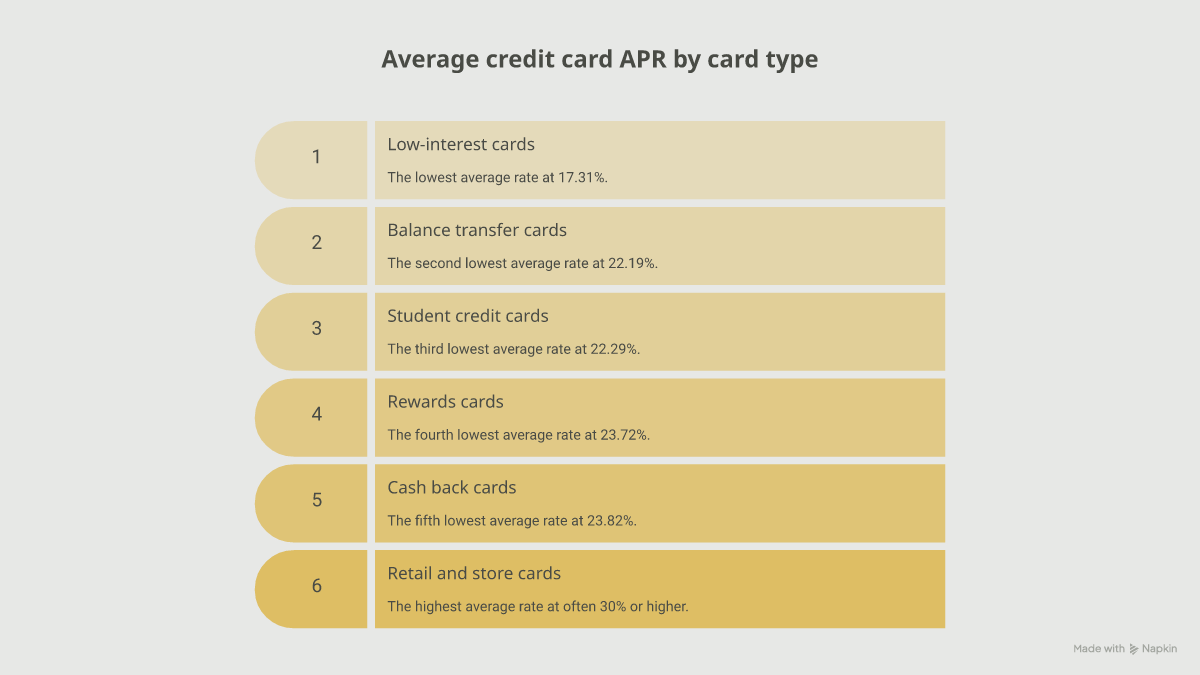
Different categories of cards carry different average rates. For instance, cards that offer rewards like cash back or travel points often have higher interest rates than cards without rewards. Based on recent market trends, here are the average rates for common card types:
Low-interest cards: 17.31%
Student credit cards: 22.29%
Balance transfer cards: 22.19%
Rewards cards: 23.72%
Cash back cards: 23.82%
Retail/Store cards: Often 30% or higher
While new offers might feature these rates, existing accounts sometimes have slightly lower averages. If you are comparing new cards, it is helpful to look at the current market data on MoneyAtlas to see which issuers are offering the most competitive terms for your credit tier. For a focused view on debt payoff options, compare balance transfer credit cards.
Average APR by credit card type, ranked lowest to highest
When you apply for a credit card, the issuer does not just pick a number at random. They use a combination of market benchmarks and your personal financial history to set your rate. This is known as risk-based pricing. The more likely the lender thinks you are to pay them back, the lower the interest rate they will offer.
Credit Score Impact
Your credit score is the most significant factor under your control. A FICO score, which ranges from 300 to 850, serves as a shorthand for your creditworthiness. Issuers generally group applicants into tiers. Someone with an excellent score of 740 or higher might receive an offer of 20.19% on a rewards card, while someone with a score in the 600s might be offered 27.40% or higher for the same product.
Debt-to-Income Ratio
Lenders also look at your debt-to-income ratio. This is the percentage of your gross monthly income that goes toward paying debts. If you have a high income but most of it is already committed to a mortgage, car loan, and other credit cards, a lender might view you as a higher risk. This can lead to a higher interest rate or a lower credit limit.
Credit History and Loyalty
Your history with a specific bank can sometimes play a role. If you have maintained a checking account or other loans with an institution for years without any issues, they may offer you a more competitive rate. Conversely, if your credit report shows recent late payments or a high number of new inquiries, your offered rate will likely be on the higher end of the issuer's range.
Most credit card interest rates are variable, not fixed. This means the rate can change over time without the bank needing to send you a special notice. These variable rates are tied to an index called the Prime Rate.
The Prime Rate is the interest rate that commercial banks charge their most creditworthy corporate customers. In the US, the Prime Rate is directly linked to the federal funds rate, which is set by the Federal Reserve. When the Federal Reserve raises or lowers the federal funds rate to manage the economy, the Prime Rate moves in lockstep.
A typical credit card APR formula looks like this:
Prime Rate + Margin = Your APR
The margin is a percentage determined by the credit card issuer based on their costs and your risk profile. For example, if the Prime Rate is 6.75% and your issuer sets a margin of 15.25%, your total APR would be 22%. Because the margin stays the same but the Prime Rate moves, your interest rate can fluctuate several times a year based on Federal Reserve policy.
One of the most confusing aspects of credit card loans is that a single card can have multiple different interest rates at the same time. You do not just have one interest rate; you have different rates for different ways you use the card.
Purchase APR
This is the standard rate applied to the things you buy, like groceries, gas, or online orders. This is the rate most people refer to when they ask about their credit card interest rate.
Balance Transfer APR
If you move debt from one card to another, the balance transfer APR applies to that specific amount. Many cards offer a 0% introductory APR on balance transfers for 12 to 21 months to attract new customers. Once that promotional period ends, the remaining balance usually switches to the standard purchase APR or a specific balance transfer rate.
Using your credit card to get cash from an ATM is known as a cash advance. These transactions almost always carry a much higher interest rate than purchases, often exceeding 28% to 30%. Furthermore, there is usually no grace period for cash advances. Interest begins accruing the moment the cash is in your hand.
Penalty APR
If you miss a payment or a payment is returned, the issuer may trigger a penalty APR. This is a significantly higher rate, often around 29.99%, that can be applied to your entire balance. Under the law, the issuer must generally see two consecutive missed payments before applying this to existing balances, but it can make your debt much harder to pay off.
The Math: How Credit Card Interest is Calculated
Understanding how much interest you will pay requires a look at the daily math. Credit card companies do not just calculate interest once a month. They usually use a method called the average daily balance.
To find your daily interest rate, the issuer takes your APR and divides it by 365 days. If your APR is 24%, your daily periodic rate is approximately 0.0657%.
The calculation steps are:
How Credit Card Interest Is Calculated
1
Calculate the Daily Balance
The issuer looks at your balance at the end of every day in the billing cycle.
2
Find the Average Daily Balance
They add up all those daily balances and divide by the number of days in the cycle.
3
Apply the Daily Rate
They multiply the average daily balance by the daily periodic rate.
4
Multiply by Days
Finally, they multiply that number by the number of days in your billing cycle.
Because interest is compounded daily, the interest from yesterday is added to your balance before the interest for today is calculated. This creates a snowball effect. For someone carrying a $5,000 balance at a 24% APR, the interest charges would be roughly $100 per month. If you only make the minimum payment, most of that money goes toward interest rather than reducing your actual debt.
The Credit Card Accountability Responsibility and Disclosure Act of 2009, often called the CARD Act, introduced significant protections for consumers. Before this law, banks could raise interest rates on existing balances for almost any reason at any time.
Today, there are strict rules. An issuer generally cannot raise the interest rate on your existing balance during the first year the account is open. If they decide to increase your rate on new purchases after that first year, they must provide you with 45 days of advance notice. This gives you time to decide if you want to keep using the card or pay it off under the old terms.
There are exceptions to this notice requirement. If your rate is variable and tied to the Prime Rate, the bank does not have to notify you when the Prime Rate itself changes. Also, if you are more than 60 days late on a payment, the issuer can move you to a penalty APR with notice.
How to Compare and Choose Lower Interest Options
If your current interest rate feels too high, you have several options to consider. Comparing products is the most effective way to see if you are paying more than necessary given your current credit profile.
Use Comparison Tools
MoneyAtlas provides side by side comparison tools that let you look at the APR, fees, and rewards of hundreds of cards. Instead of looking at one offer at a time, you can see how a card with a lower APR compares with a rewards card that may cost more to carry a balance.
Negotiate with Your Current Issuer
It is possible to call your credit card company and ask for a lower rate. If you have a history of on-time payments and your credit score has improved since you first opened the account, they may agree to reduce your APR to keep your business. This is an editorial judgment based on many cardholder experiences, though some specific lenders have policies against rate reductions.
Consider a Balance Transfer
For those carrying significant debt, a 0% introductory APR balance transfer card can be a powerful tool. These cards allow you to move high-interest debt to a new card where you pay 0% interest for a set period, often 12 to 18 months. This ensures every dollar you pay goes toward the principal balance. Be aware of the balance transfer fee, which is usually 3% to 5% of the amount you move.
Credit unions are member owned and not for profit. Because of this structure, they often have lower interest rates on credit cards than traditional commercial banks. Some credit union cards have APRs as low as 10% to 15% for qualified members.
If you want a broader set of options, browse cash back credit cards to compare rewards against rate tradeoffs.
Avoiding Interest Entirely
The most effective way to manage a credit card interest rate is to avoid paying it. Most credit cards offer a grace period on purchases. A grace period is the time between the end of your billing cycle and your payment due date.
If you pay your entire statement balance in full every month by the due date, the issuer will not charge you any interest on your purchases. You essentially get an interest-free loan for up to 30 or 50 days depending on when in the billing cycle you made the purchase.
This grace period only applies to purchases. As mentioned, cash advances and sometimes balance transfers do not have grace periods. Also, if you carry even a small balance from the previous month into the next, you usually lose your grace period for new purchases. This means you will start being charged interest on every new coffee or grocery run the moment you swipe your card.
Ensure the full statement balance is paid every month.
2
Monitor your statement balance
This is the specific amount you must pay to avoid interest, not the total current balance.
3
Avoid cash advances
These carry high rates and no grace period.
4
Pay off trailing interest
If you recently paid off a large debt, check your next statement for residual interest that accrued before your payment was processed.
Conclusion
Understanding how much interest rate on credit card loan accounts you pay is essential for staying in control of your finances. With national averages currently above 20%, even small balances can grow quickly if left unchecked. Your specific rate is a product of market conditions like the Prime Rate and your personal credit history. By improving your credit score and staying informed about the different types of APR on your card, you can make better decisions about when to borrow and when to pay in full.
If you feel your current rates are holding you back, use the best credit cards comparison to see if you qualify for a lower-interest card or a 0% balance transfer offer. The right choice depends on whether you plan to carry a balance or pay in full every month.
FAQ
Ready to pick a card?
Compare the cards our editors rate highest right now, side by side, with the fees and rewards that matter.
Learn how to lower credit card APR with 5 proven strategies. From negotiating with issuers to 0% transfers, discover how to offset rising interest rates.