Are All Credit Cards Variable APR? Comparing Your Options


Introduction
The short answer is no, but the vast majority of credit cards in the US use a variable interest rate. While fixed-rate credit cards exist, they are increasingly rare and typically offered by smaller financial institutions like credit unions. Most major national banks exclusively offer variable rates that fluctuate based on the economy. Understanding how these rates work is essential for anyone who carries a balance, as it directly impacts the monthly cost of borrowing. We see these distinctions every day while analyzing products. MoneyAtlas tracks over 1,500 financial products to help you see how these different interest structures affect your bottom line. This guide examines the mechanics of variable and fixed rates, how they change, and how to evaluate which structure suits your financial habits.
The Mechanics of Credit Card Interest
To understand if a card is variable or fixed, it is helpful to first define what Annual Percentage Rate (APR) actually means. The APR is the yearly cost of borrowing money on your credit card. This figure includes the interest rate and certain fees, though for most credit cards, the interest rate and the APR are identical.
If you want a deeper primer on the basics, our guide to what APR means on a credit card breaks down the core terms in plain English.
Credit card interest is typically calculated using a daily periodic rate. This is determined by dividing your APR by 365. For example, a card with a 24% APR has a daily periodic rate of approximately 0.065%. Every day that you carry a balance, the bank applies this percentage to your average daily balance. Because interest usually compounds daily, you end up paying interest on the interest that accumulated the day before.
Most credit cards offer a grace period. This is the window between the end of a billing cycle and your payment due date. If you pay your statement balance in full every month by the due date, the APR effectively becomes 0% for your purchases. However, if you carry even a small balance into the next month, the grace period typically disappears, and interest begins accruing on every purchase from the date it is made.
Understanding Variable APR
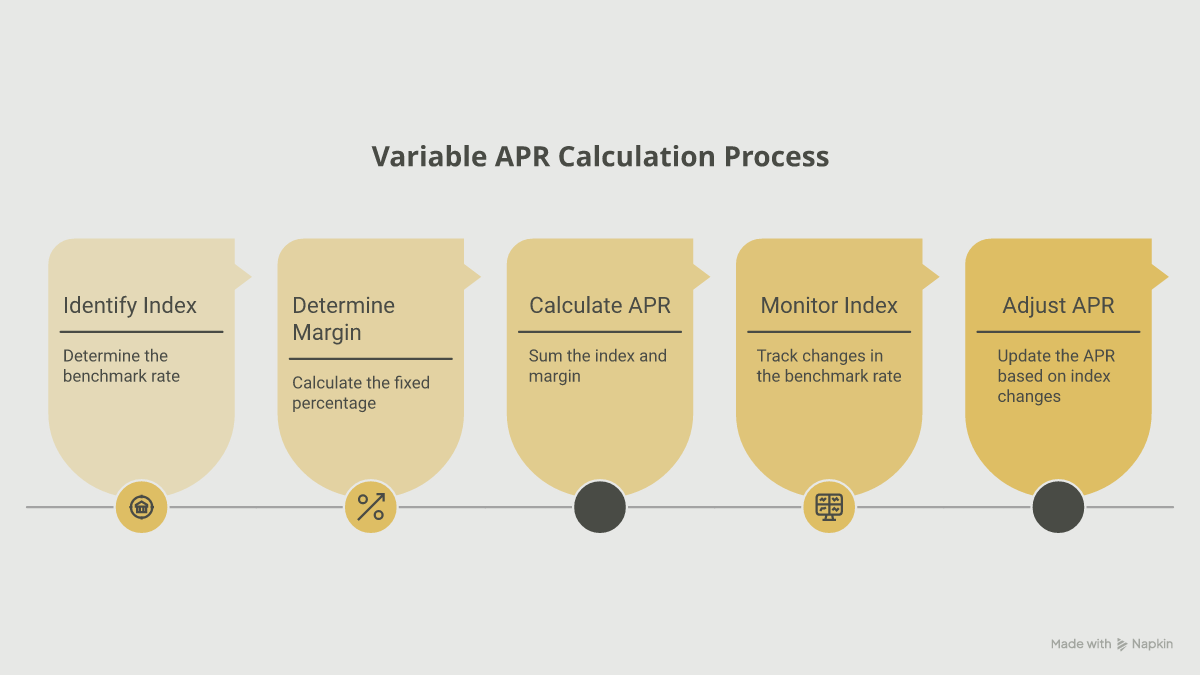
A variable APR is an interest rate that can change over time. These fluctuations are not random. Instead, they are tied to a specific financial benchmark called an index. In the US, the most common index used for credit cards is the Prime Rate.
How the Prime Rate Affects Your Card
The Prime Rate is the interest rate that commercial banks charge their most creditworthy corporate customers. It is directly influenced by the federal funds rate. When rates change, the Prime Rate usually moves too.
When you see a variable APR, it is actually a simple math equation: Index + Margin = Your APR.
- The Index: This is the benchmark, such as the Prime Rate.
- The Margin: This is the percentage the credit card issuer adds to the index. This number is usually fixed when you open the account and is based on your creditworthiness.
If the Prime Rate is 8.5% and your margin is 15.5%, your total APR is 24%. If rates rise and the Prime Rate goes to 9%, your APR will automatically climb to 24.5%.
Why Variable Rates Are Standard
Major banks prefer variable rates because they protect the lender from interest rate risk. If the cost of borrowing money increases across the economy, the bank can pass that cost along to the consumer automatically. This is why you will find that almost every rewards card, travel card, and cash-back card from big-name issuers uses a variable structure.
If you are comparing cards that charge variable rates, our best credit cards comparison is a useful place to start.
The Reality of Fixed-Rate Credit Cards
Fixed-rate credit cards provide an interest rate that does not fluctuate with the Prime Rate. If your card is set at 15%, it stays at 15% regardless of what the economy does. These cards offer a level of predictability that is valuable for someone who plans to carry a balance for several months or years.
Where to Find Fixed-Rate Options
You will rarely find a fixed-rate card on the front page of a major bank's website. To find these products, you generally need to look at:
- Credit Unions: These member-owned institutions often prioritize low-cost borrowing over high-end rewards.
- Community Banks: Local banks may offer fixed-rate cards to build long-term relationships with local customers.
- Specialty Cards: Some cards designed specifically for debt consolidation may offer fixed rates for a set period.
The Tradeoffs of Fixed Rates
While a fixed rate offers stability, it often comes with fewer bells and whistles. Most fixed-rate cards do not offer extensive travel rewards, high cash-back percentages, or luxury perks like airport lounge access. The "reward" for these cards is the lower, stable interest rate itself.
It is also important to note that "fixed" does not mean "permanent." Federal law allows issuers of fixed-rate cards to change the interest rate, but they must follow strict rules.
Can a Fixed APR Still Increase?
Many consumers assume a fixed-rate card is a lifetime guarantee. However, under the Credit Card Accountability Responsibility and Disclosure (CARD) Act of 2009, issuers have the right to change fixed rates under specific circumstances.
The 45-Day Notice Rule
If an issuer decides to raise the rate on a fixed-rate card, they must provide you with a written notice at least 45 days in advance. This notice gives you the opportunity to see the change coming and potentially pay off the balance or transfer it to a different card before the new rate takes effect.
The One-Year Protection
Generally, card issuers cannot increase the APR on a new account during the first 12 months. There are exceptions for introductory rates that expire or if your payment is more than 60 days late.
Applying Rates to Existing Balances
One of the biggest protections of the CARD Act is how rate increases are applied. If a bank raises your fixed rate after the first year, the new higher rate usually only applies to new purchases made 14 days after the notice was sent. Your existing balance typically remains at the old rate unless you are more than 60 days delinquent.
Comparing Variable and Fixed APRs
When choosing between these two structures, it helps to look at them side by side based on your financial goals. MoneyAtlas makes it easier to compare side by side by breaking down these terms in our product reviews.
For a closer look at the broader card landscape, browse our cash back credit card rankings and see how different APR structures pair with rewards.
Different Types of APR on a Single Card
Whether your card is variable or fixed, you likely have more than one APR assigned to your account. Most people only look at the purchase APR, but other rates can be significantly higher or lower.
Purchase APR
This is the standard rate applied to things you buy at a store or online. This is the rate most people refer to when they ask if a card is variable or fixed.
Balance Transfer APR
This applies when you move debt from one card to another. Many cards offer a 0% introductory balance transfer APR for 12 to 21 months. Once that period ends, the remaining balance will usually shift to a variable purchase APR. It is important to check the terms to see if the "go-to" rate is variable.
If debt payoff is part of your plan, read our guide on how credit card balance transfers work before you move any balances.
Cash Advance APR
If you use your credit card at an ATM to withdraw cash, you are taking a cash advance. These rates are almost always variable and are significantly higher than purchase rates, often exceeding 25% or 30%. Furthermore, cash advances usually have no grace period. Interest starts accruing the moment the cash is in your hand.
Penalty APR
If you miss a payment or a check bounces, the issuer may trigger a penalty APR. This is a very high rate, sometimes reaching 29.99%. This rate can stay on your account indefinitely or until you make several consecutive on-time payments.
How to Calculate Your Monthly Interest Cost
If you are carrying a balance on a variable-rate card, the math can help you decide if it is time to look for a lower-rate alternative. Here is how you can estimate your monthly interest charge.
How to Calculate Your Monthly Interest Cost
- 1
Find your daily periodic rate
Take your current APR and divide it by 365. For a 25% APR, the math is 0.25 / 365 = 0.000685.
- 2
Determine your average daily balance
Look at your statement to see your average balance over the 30-day billing cycle. Let's assume it is $2,000.
- 3
Calculate daily interest
Multiply your average balance by the daily periodic rate. $2,000 x 0.000685 = $1.37 in interest per day.
- 4
Calculate monthly interest
Multiply the daily interest by the number of days in your billing cycle. $1.37 x 30 days = $41.10.
By doing this math, you can see that a variable rate that increases by just 1% can add up over the course of a year, especially on higher balances.
How to Lower Your Credit Card APR
If you find that your variable APR has climbed too high due to rate changes or a change in your credit score, you are not necessarily stuck. There are several ways to reduce the amount of interest you pay.
If you are trying to lower the cost of carrying revolving debt, our balance transfer card comparison can help you compare options side by side.
- Negotiate with the Issuer: You can call your bank and ask for a lower rate. If your credit score has improved or you have been a loyal customer for years, they may lower your margin. This is a customer service request and does not impact your credit score.
- Improve Your Credit Score: Since the "margin" part of a variable APR is based on your creditworthiness, a higher score can help you qualify for cards with lower margins in the future.
- Use a Balance Transfer: If you are paying 25% interest on a variable card, moving that balance to a card with a 0% introductory APR can save you significant money. Just be aware of balance transfer fees, which are typically 3% to 5% of the amount transferred.
- Join a Credit Union: As mentioned earlier, credit unions are the primary source for fixed-rate cards. Moving your banking relationship to a credit union may give you access to more stable, lower-interest credit products.
How to Evaluate Credit Card Offers
When you are comparing cards, the interest rate structure is just one piece of the puzzle. You should look at the total cost of ownership. MoneyAtlas provides tools that allow you to compare these factors side by side so you can see the true cost of each option.
If annual fees are part of your tradeoff, our no annual fee credit cards page is a smart place to narrow the field.
- The Go-To Rate: Look past the 0% intro offer. What will the APR be after 15 months? If it is a variable rate, check what index it uses.
- The Fees: A fixed-rate card with a $95 annual fee might be more expensive than a variable-rate card with no annual fee if you only carry a small balance occasionally.
- The Rewards: If you never carry a balance, a high variable APR does not matter. In that case, you should prioritize the rewards structure and perks.
- The Fine Print: Check the Schumer Box. This is the standardized table included in every credit card offer. It clearly states whether the APR is variable or fixed and lists all applicable fees.
Step-by-Step: Checking Your Current APR
Step 1: Log in to your online banking portal or open your most recent paper statement.
Step 2: Locate the section labeled "Interest Charge Calculation" or "Standard APR."
Step 3: Look for the word "Variable" next to the rate. If it is variable, the statement will often explain that the rate varies with the index.
Step 4: Note the different rates for purchases, balance transfers, and cash advances.
Which Rate Structure is Right for You?
The "better" option depends entirely on how you use credit. There is no one-size-fits-all answer, but there are clear patterns.
For the Transactor:
If you pay your balance in full every month, the APR structure is largely irrelevant. You are not paying interest, so a 15% fixed rate and a 29% variable rate are functionally the same for you. In this scenario, you should focus on maximizing rewards, travel credits, or cash back.
For travelers who want to earn while keeping a $0 fee, our travel credit cards comparison shows how rewards cards and annual fees stack up.
For the Revolver:
If you frequently carry a balance from month to month, a fixed-rate card or a variable card with a very low margin is vital. The stability of a fixed rate protects you from economic shifts that could make your debt more expensive without warning.
For the Debt Consolidator:
If you are trying to pay down a large amount of existing debt, a 0% introductory APR card is usually the most effective tool. Even though these cards eventually revert to a variable rate, the interest-free period allows every dollar of your payment to go toward the principal balance.
If you are weighing payoff strategies, this guide on using one credit card to pay another explains the main risks and alternatives.
Summary of Key Decision Factors
Choosing a credit card requires balancing interest rates, fees, and rewards. While variable rates are the industry standard, they are not your only option.
- Check the Index: Know that most cards will move when rates move.
- Look Locally: Credit unions remain the best place to find fixed-rate alternatives.
- Read the Schumer Box: All the information about whether a card is variable or fixed must be disclosed in this table.
- Focus on Behavior: The best way to manage any APR is to pay the balance in full, rendering the interest rate moot.
By understanding the difference between variable and fixed APRs, you can choose a card that aligns with your spending habits and financial goals. Whether you prioritize rewards or interest stability, comparing your options carefully is the first step toward better financial management.
If you are ready to compare the market directly, start with our best credit cards page and work from there.
FAQ
If you are ready to see how your current rates compare to the rest of the market, use our comparison tools to evaluate cards side by side. Exploring the latest offers can help you determine if a balance transfer or a lower-interest fixed card is the right move for your situation.
MoneyAtlas Staff
Articles and reviews from the MoneyAtlas editorial team — independent research on credit cards, banking, loans, insurance, and investing.
Related Articles

Which Card Is Better: American Express Gold or Platinum?
Deciding which card is better: American Express Gold or Platinum? Compare fees, 4X dining rewards, and luxury travel perks to find your perfect match.

Should I Get an American Express Gold Card? Breaking Down the Value
Should I get an American Express Gold card? Explore the 4X rewards on dining and groceries vs. the $325 fee to see if this premium card fits your budget.

How to Get the American Express Gold Card: A Practical Guide
Learn how to get the American Express Gold Card with our guide on credit score requirements, income, and the 'Apply with Confidence' tool. Apply today!