An interest charge on a credit card is the price paid for the privilege of borrowing money from a financial institution. When a cardholder carries a balance from one month to the next, the bank charges a fee based on the amount owed and the interest rate of the card. Understanding these charges is essential for anyone looking to manage their debt effectively or choose a new financial product. MoneyAtlas tracks these rates and provides tools to help people compare cards side by side. This post covers how interest is calculated, the different types of rates that might apply, and the mechanical steps required to avoid these costs entirely. Mastering the logic behind interest charges allows for more informed financial decisions and helps prevent small balances from growing into significant debt.
The Definition of a Credit Card Interest Charge
A credit card is a form of revolving credit. Unlike a standard personal loan with a fixed repayment schedule, a credit card allows a borrower to spend up to a certain limit, pay it back, and spend it again. The interest charge is the cost of using that money over time. It is typically expressed as an Annual Percentage Rate, or APR, and the mechanics of APR on a credit card explain why the charge keeps building until the balance is paid.
While the APR is an annual figure, interest is usually calculated on a daily basis. Most credit card issuers use a process called daily compounding. This means the interest is calculated every day and added to the balance. The next day, interest is calculated on that new, slightly higher balance. This cycle continues throughout the month.
An interest charge only becomes a factor when a cardholder does not pay the entire statement balance by the payment due date. If the balance is paid in full every month, most cards offer a grace period that prevents interest from accruing on new purchases. However, once a balance is carried over, or "revolved," the interest charges begin to accumulate and appear on the next monthly statement.
The math behind credit card interest can seem complex, but it follows a specific formula used by most major lenders. To understand how much a specific balance will cost, a borrower needs to break down the calculation into three primary steps.
How Banks Calculate Your Interest Charge
1
Find the Daily Periodic Rate
The interest rate shown on a credit card agreement is an annual rate. To find out how much interest is charged each day, the bank uses a Daily Periodic Rate. This is found by dividing the APR by 365, the number of days in a year. Some lenders use 360 days, but 365 is the standard for most US credit cards. For example, if a card has a 24% APR, the Daily Periodic Rate is 0.0657% (24 divided by 365). This small percentage is applied to the balance every single day that a debt remains unpaid. If you are comparing repayment tools for high-rate debt, balance transfer cards can be a useful option to review.
2
Determine the Average Daily Balance
Banks do not just look at the balance on the last day of the month. Instead, they look at the balance for every day in the billing cycle. They add up the balance from each day and then divide by the total number of days in that cycle, which is usually 28 to 31 days. If someone starts the month with a $1,000 balance and makes a $500 payment halfway through, the average daily balance will be lower than if they waited until the last day to pay. This is why making early or multiple payments throughout the month can reduce the total interest charge, even if the balance is not paid in full. Making interest payments easier to avoid starts with understanding how timing affects the balance used in the calculation.
3
Calculate the Monthly Charge
Once the bank has the Daily Periodic Rate and the Average Daily Balance, they multiply them together and then multiply that result by the number of days in the billing cycle.The formula looks like this: Average Daily Balance x Daily Periodic Rate x Days in Billing Cycle = Interest Charge.
When Does the Interest Charge Appear?
Interest charges typically appear on a monthly statement as a "finance charge" or "interest charge." This amount is added to the total balance due. If a cardholder has different types of balances, such as one for purchases and one for cash advances, the interest for each may be listed separately.
The charge is generated at the end of the billing cycle. If a borrower carries a balance of $2,000 at a 22% APR for a 30-day month, the calculation might look like this:
Daily Periodic Rate: 22% / 365 = 0.0603%
Daily interest: $2,000 x 0.000603 = $1.206
Monthly charge: $1.206 x 30 = $36.18
This $36.18 would be added to the $2,000 balance, making the new total $2,036.18, assuming no other purchases or fees were made.
Understanding Different Types of Credit Card APR
A single credit card can have several different interest rates depending on how the card is used. These rates are disclosed in the Schumer Box, a standardized table included in credit card agreements.
Purchase APR: This is the most common rate. It applies to standard purchases of goods and services.
Balance Transfer APR: This rate applies to debt moved from one credit card to another. Many cards offer a 0% introductory rate for balance transfers for a set period, such as 12 to 18 months.
Cash Advance APR: If someone uses their credit card to get cash from an ATM, the bank often charges a significantly higher interest rate. Cash advances usually do not have a grace period, meaning interest starts accruing immediately.
Penalty APR: If a cardholder makes a late payment, the issuer may increase the interest rate to a penalty APR, which can be as high as 29.99%. This rate can stay in effect for several months or longer.
Introductory APR: Many cards offer a low or 0% rate for a specific timeframe after the account is opened. This is a common feature for those looking to finance a large purchase or pay down existing debt.
The Grace Period: Your Tool for Avoiding Interest
The grace period is the time between the end of a billing cycle and the date the payment is due. For most cards, this period must be at least 21 days by law. If a cardholder pays their entire statement balance in full by the due date every month, the bank does not charge interest on new purchases.
This is the most effective way to use a credit card as a financial tool without incurring costs. However, if the payment is even one dollar short of the full statement balance, the grace period is typically lost. This means interest will be charged on the remaining balance and, in many cases, on all new purchases starting from the day they are made. For a practical refresher on the rules, this guide to avoiding APR fees explains why full payments matter so much.
To regain a grace period after carrying a balance, most issuers require the cardholder to pay the statement balance in full for two consecutive billing cycles.
The Impact of Compounding Interest
Compounding is the process where interest is charged on top of interest. Because credit cards compound daily, the balance grows faster than it would with simple interest. Each day the interest is calculated, it is added to the principal balance. The next day, the bank calculates interest on that new total.
While the difference over a single day is small, the effect over several months or years is substantial. On a high-interest card with a large balance, compounding can make it difficult to pay down the debt if only the minimum payment is made. Minimum payments are often designed to cover the interest charge plus only a tiny fraction of the principal balance.
What is Residual Interest?
Many people are surprised to see an interest charge on their statement the month after they have paid their balance in full. This is known as residual interest, or trailing interest.
Residual interest happens because interest accrues every day between the time the statement is issued and the time the payment is received. For example, if a statement is generated on the 1st of the month and the payment is made on the 15th, interest has been building for those 15 days. That 15-day interest charge will appear on the following month's statement.
To avoid residual interest when paying off a large balance, a borrower can call the card issuer to get a "payoff amount." This figure includes the total balance plus the interest that will accrue up to the day the payment is processed.
Strategies for Managing Interest Costs
Reducing the amount of money spent on interest requires a clear understanding of how the bank applies charges. Several strategies can help a cardholder minimize these costs.
Pay the statement balance in full: This is the only guaranteed way to avoid purchase interest.
Make multiple payments: Since interest is based on the average daily balance, making a payment every time a paycheck arrives reduces that average and lowers the monthly charge.
Use a 0% intro APR card: For those carrying high-interest debt, moving that balance to a card with a 0% introductory offer can provide a window of time to pay down the principal without new interest charges. MoneyAtlas provides comparison tools to help users find cards with the longest introductory periods.
Avoid cash advances: Because they carry higher rates and have no grace period, cash advances are an expensive way to access money.
Negotiate a lower rate: Cardholders with a history of on-time payments can sometimes successfully ask their issuer for a lower APR, especially if they have received better offers from competitors.
Comparing Cards to Reduce Long-Term Costs
Not all credit cards are created equal when it comes to interest. Some cards are designed for people who pay in full every month and offer high rewards, while others are designed for people who may need to carry a balance occasionally and offer lower ongoing APRs.
When evaluating options, it is helpful to look at the APR range a card offers. Those with excellent credit typically qualify for the lower end of that range. Browse our best credit cards comparison to see how different cards stack up in terms of fees and benefits.
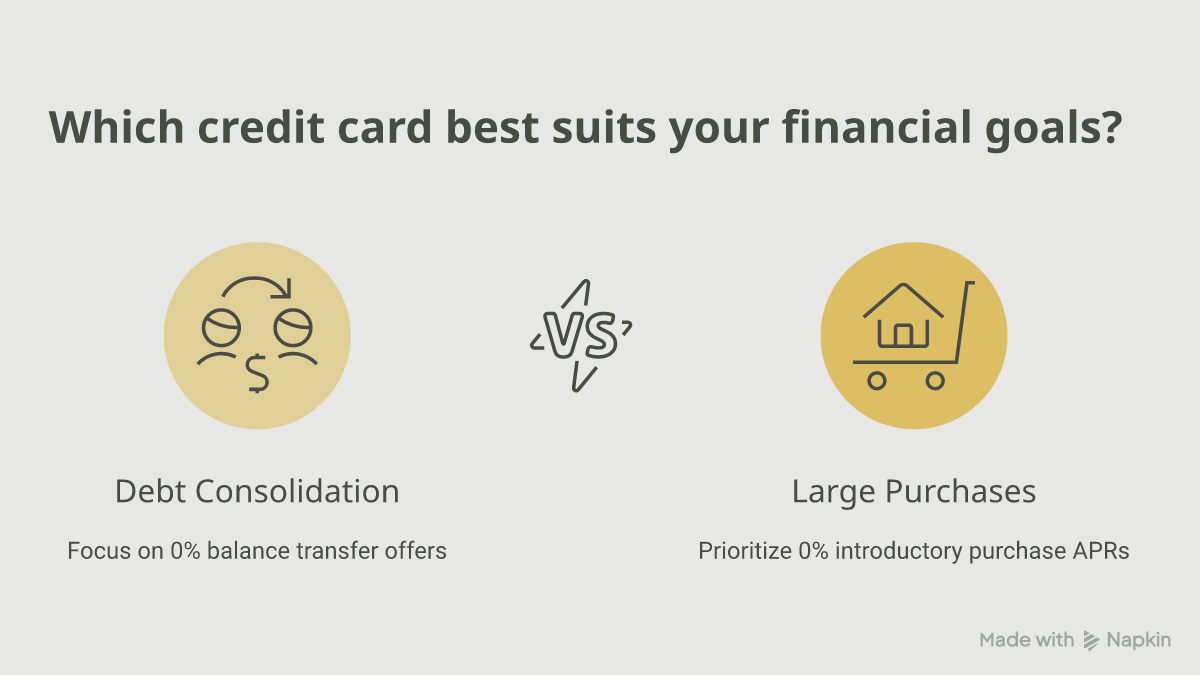
Before applying for a new card, a borrower should consider their primary goal. If the goal is debt consolidation, a card with a 0% balance transfer offer is worth comparing. If the goal is a large upcoming purchase, a card with a long 0% introductory purchase APR might be more appropriate.
For someone already carrying a balance, the difference between a 29% APR and a 19% APR is significant. On a $5,000 balance, that 10% difference represents roughly $500 in interest savings over a year. Comparing these terms side by side helps ensure that the chosen card aligns with the user's financial habits and goals.
Matching a card to your goal, and what a 10-point APR gap costs on a $5,000 balance
FAQ
Conclusion
Interest charges represent the real cost of credit card debt. By understanding the mechanics of the Daily Periodic Rate and the average daily balance, cardholders can take control of their finances rather than being surprised by their monthly statements.
Pay the full statement balance to utilize the grace period.
Avoid cash advances to bypass high rates and immediate interest.
Make payments early in the cycle to lower the average daily balance.
Compare APRs regularly to ensure the card's terms remain competitive.
The best way to lower interest costs is to ensure the card in your wallet matches your spending and repayment style. We provide updated reviews and side-by-side comparisons of hundreds of cards to help you find the most competitive rates available today. Use the MoneyAtlas credit card comparison tool to evaluate your current APR against other options on the market.
Ready to pick a card?
Compare the cards our editors rate highest right now, side by side, with the fees and rewards that matter.
Should I get an American Express Gold card? Explore the 4X rewards on dining and groceries vs. the $325 fee to see if this premium card fits your budget.
Learn how to get the American Express Gold Card with our guide on credit score requirements, income, and the 'Apply with Confidence' tool. Apply today!