How to Lower Credit Card APR and Reduce Interest Costs


Introduction
The annual percentage rate (APR) on a credit card determines how much it costs to carry a balance from month to month. With the average credit card APR currently hovering around 22%, interest charges can quickly snowball, making it difficult to pay down the principal debt. Many cardholders assume these rates are fixed, but they are often negotiable. Lowering a rate by even a few percentage points can save hundreds or thousands of dollars in interest over the life of a balance. MoneyAtlas makes it easier to compare current market rates and see how your current cards stack up against the competition. This guide explores practical methods for reducing interest costs, including negotiation tactics, balance transfer strategies, and debt consolidation options. Understanding the mechanics of interest is the first step toward regaining control over your monthly payments.
Understanding How Your APR Impacts Your Balance
The annual percentage rate (APR) is more than just a number; it is the daily cost of your debt. While it is expressed as an annual figure, credit card companies usually calculate interest on a daily basis. To find the daily periodic rate, the issuer divides the APR by 365. For example, a card with a 24% APR has a daily rate of approximately 0.065%.
Interest compounding means you pay interest on your interest. Each day, the issuer applies that daily rate to your average daily balance, including any interest that accrued on previous days. This is why a high APR makes it feel like a balance is barely budging despite regular payments. If a cardholder carries a $5,000 balance at 24% APR and only makes minimum payments, they could end up paying more in interest than the original amount borrowed. For a deeper breakdown, see how APR works on a credit card.
Most credit cards use variable rates tied to the prime rate. When the Federal Reserve adjusts interest rates, the prime rate typically follows, which in turn causes variable APRs to rise or fall. While a cardholder cannot control the Federal Reserve, they can influence the risk-based portion of their rate, which is determined by credit history and individual financial behavior. If you want a broader explanation of card pricing, read what APR means on a credit card.
Method 1: Negotiating with Your Credit Card Issuer
Calling a credit card company to ask for a lower rate is one of the most direct ways to save money. Many issuers are willing to lower rates for loyal customers who have a history of on-time payments. They would often rather keep a customer at a lower interest rate than lose that customer to a competitor.
Preparing for the Call
Before picking up the phone, gather data to strengthen the case for a reduction. Knowledge is leverage in a negotiation. A cardholder should know their current credit score, how long they have been a customer, and whether they have any recent late payments.
Researching competing offers is a critical part of preparation. If other banks are offering cards with 15% or 18% APR to people with similar credit profiles, that information serves as a powerful bargaining chip. MoneyAtlas tracks current rates across hundreds of issuers, which can provide the necessary context for what a fair rate looks like in the current market. A good place to start is the best credit cards comparison.
The Negotiation Process
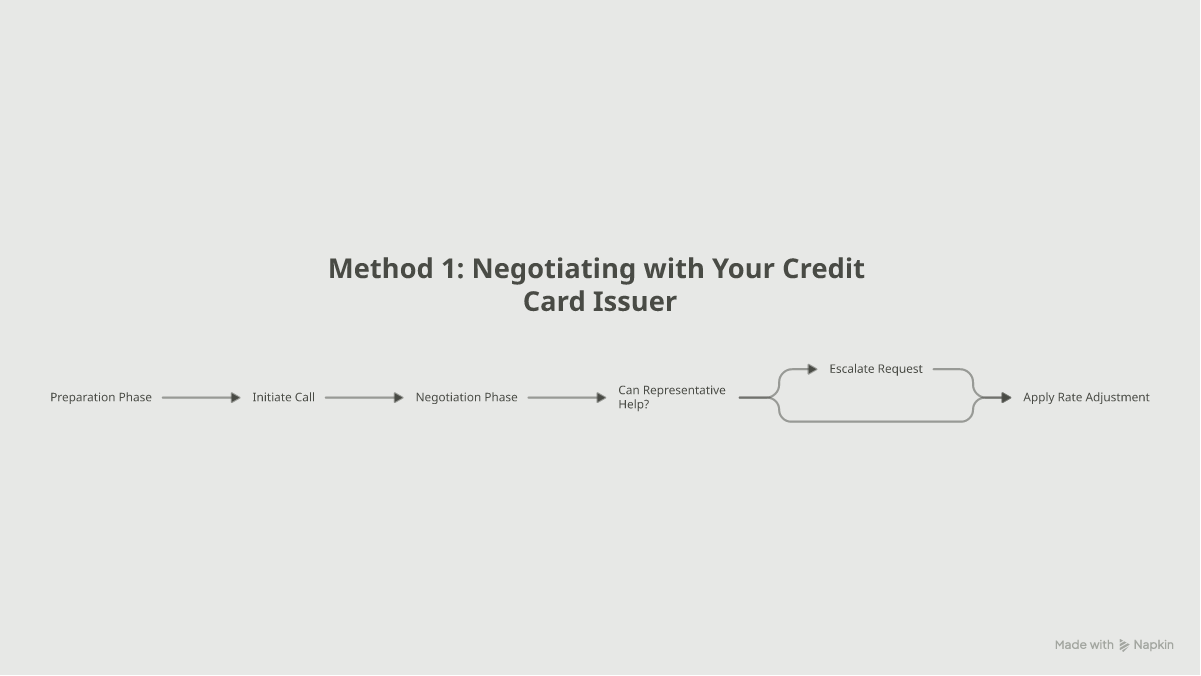
Start by calling the customer service number on the back of the card. Once connected to a representative, the request should be polite but firm. A simple script might involve stating how long the account has been open and noting a consistent history of on-time payments.
Mentioning competitor offers can prompt the representative to look for retention offers. If the first representative says they cannot help, asking to speak with a supervisor or the retention department is a standard next step. These departments often have more authority to apply manual rate adjustments or temporary promotional discounts. If you want to compare more cards before calling, browse MoneyAtlas product reviews.
Method 2: Utilizing Balance Transfer Credit Cards
A balance transfer card allows a borrower to move high-interest debt to a new card with a 0% introductory APR period. These promotional periods typically last between 12 and 21 months. This strategy effectively pauses interest growth, allowing 100% of every payment to go toward the principal balance.
Evaluating the Cost of a Transfer
Most balance transfer cards charge a one-time fee, usually between 3% and 5% of the total amount moved. For a $10,000 balance, a 3% fee would add $300 to the debt. While this fee is an upfront cost, it is often significantly lower than the interest that would accumulate on a high-APR card over several months.
The math must work in the borrower's favor for this to be a smart move. If the interest saved during the 0% period is greater than the transfer fee, the move is generally beneficial. However, if the balance cannot be paid off before the promotional period ends, the remaining debt will be subject to the card's standard variable APR, which may be just as high as the original rate. For a detailed overview, read how balance transfers work.
Steps to Execute a Balance Transfer
Steps to Execute a Balance Transfer
- 1
Compare available offers
Look for cards with the longest 0% intro periods and the lowest transfer fees. We provide side-by-side comparisons of these terms to help narrow down the options.
- 2
Check your credit score
Balance transfer cards with long intro periods typically require good to excellent credit, often defined as a score of 670 or higher.
- 3
Apply and request the transfer
Once approved, provide the account details of the high-interest cards to the new issuer. It may take several weeks for the transfer to complete, so continuing to make minimum payments on the old cards is essential to avoid late fees; if you are still learning the fine print, start with the 0 APR guide.
Method 3: Consolidating Debt with a Personal Loan
A personal loan can replace high-interest credit card debt with a fixed-rate installment loan. While credit cards have variable rates that can fluctuate, personal loans usually offer fixed rates. This provides a predictable monthly payment and a clear end date for the debt.
When a Personal Loan Makes Sense
For someone with a large amount of debt across multiple cards, a personal loan simplifies the repayment process. Instead of managing five different due dates and five different interest rates, the borrower has one monthly payment.
The APR on a personal loan is often lower than the APR on a credit card. For borrowers with good credit, personal loan rates might range from 10% to 15%, whereas credit card rates frequently exceed 20%. Moving a $20,000 balance from a 24% card to a 12% loan can save thousands of dollars over a three-year or five-year repayment term.
Comparing Loan Terms
Look closely at the origination fee and the repayment term. Some personal loans charge an upfront fee of 1% to 8%, which is deducted from the loan proceeds. Borrowers should factor this fee into their total cost calculation. A longer repayment term will result in lower monthly payments but will increase the total interest paid over the life of the loan.
MoneyAtlas allows users to compare personal loan rates and terms from various lenders. Using a comparison tool helps ensure that the new loan actually lowers the overall cost of debt rather than just spreading it out over a longer period. You can start with the personal loan comparison page.
Factors That Determine Your Interest Rate
Credit card companies use risk-based pricing to set APRs. This means the rate assigned to an account is a reflection of how likely the lender thinks the borrower is to pay back the debt. Several key factors influence this assessment.
Credit Score and History
The FICO score is the primary metric used by lenders. A higher score generally leads to a lower APR. Lenders look for a history of on-time payments, a mix of different types of credit, and a long credit history. If a credit score has improved significantly since a card was first opened, the cardholder has a strong case for requesting a rate reduction.
Credit Utilization Ratio
Credit utilization is the percentage of available credit currently being used. For example, if someone has a $10,000 limit across all cards and carries a $3,000 balance, their utilization is 30%. Lenders view high utilization (typically above 30%) as a sign of financial stress, which can lead to higher interest rates or a denial of a rate reduction request.
The Prime Rate
The prime rate serves as the base for most variable-rate credit cards. It is the interest rate that commercial banks charge their most creditworthy corporate customers. Most cards have an APR that is "Prime + X%." If the prime rate is 8.5% and the card's "margin" is 15%, the total APR will be 23.5%. While consumers cannot change the prime rate, knowing it helps them understand why their rates might have increased recently.
Managing the Penalty APR
A penalty APR is a significantly higher interest rate triggered by specific negative behaviors. The most common trigger is falling 60 days behind on payments. A penalty APR can be as high as 29.99% and may stay in effect indefinitely.
Federal law provides some protections regarding penalty rates. Under the Credit CARD Act of 2009, if a cardholder makes six consecutive on-time payments after a penalty APR is applied, the issuer must review the account and consider restoring the original interest rate. For another take on punitive rates, see the APR explainer for credit cards.
Avoiding the penalty APR is critical for long-term debt management. Setting up automatic minimum payments can ensure that a rate never spikes due to a simple oversight. If a payment is missed, calling the issuer immediately to ask for a one-time waiver can sometimes prevent the penalty rate from being triggered.
Long-Term Strategies to Maintain Lower Rates
Securing a lower APR is a significant win, but maintaining it requires ongoing effort. Financial habits directly impact the rates lenders are willing to offer over time.
Improving Your Credit Profile
Consistently paying bills on time is the single most important factor in a credit score. Even one 30-day late payment can cause a score to drop significantly, which may lead to rate increases across multiple accounts.
Lowering credit utilization can have an immediate positive impact on a credit score. As balances are paid down, the utilization ratio drops. This signals to lenders that the borrower is a lower risk, making them eligible for better rates on new cards or loans.
Periodic Account Reviews
Reviewing credit card statements every six months is a healthy financial habit. This is a good time to check the current APR on each account. If the market has changed or your credit score has risen, it might be time for another round of negotiation or a search for a better product.
MoneyAtlas provides tools to track how different financial products evolve. Using these resources periodically ensures that you are not stuck with an outdated high-interest card when better options have become available for your current credit profile.
Hardship Programs and Professional Help
When debt becomes unmanageable, standard negotiation might not be enough. In these cases, there are formal programs designed to help borrowers avoid default.
Issuer Hardship Programs
Many banks offer temporary relief through internal hardship programs. These programs are designed for people facing documented financial difficulties, such as job loss, medical emergencies, or divorce. A hardship program might involve a temporary interest rate reduction, a waiver of late fees, or a lower minimum monthly payment.
Enrolling in a hardship program often comes with conditions. The issuer may close the account or suspend charging privileges while the program is active. While this protects the credit score from the damage of a default, it does limit access to credit in the short term.
Non-Profit Credit Counseling
A credit counseling agency can negotiate a Debt Management Plan (DMP) on behalf of a borrower. These non-profit organizations work with creditors to lower interest rates and consolidate multiple payments into one.
A DMP typically lasts three to five years. Participants pay the agency a single monthly amount, which is then distributed to the creditors. While there is usually a small monthly fee for the service, the interest rate savings can be substantial. It is important to work with an accredited non-profit, such as those affiliated with the National Foundation for Credit Counseling (NFCC).
Choosing the Right Path Forward
The best method for lowering an APR depends on individual circumstances. There is no one-size-fits-all solution for high interest rates.
- For those with a long history and good credit: A simple phone call to negotiate the rate is the best first step. It is free, fast, and does not impact credit scores.
- For those with good credit and a clear payoff plan: A balance transfer card with a 0% intro period offers the most potential savings, provided the debt is paid off before the promo ends.
- For those with large balances across multiple cards: A personal loan provides the structure and predictability needed to eliminate debt over several years.
- For those in financial distress: Contacting the issuer's hardship department or a non-profit credit counselor is the most responsible course of action.
MoneyAtlas helps you evaluate these options by providing transparent data and expert ratings. Whether comparing the best balance transfer credit cards or looking for competitive personal loan reviews, having the right information makes the decision process clearer.
Summary of Action Steps
Lowering a credit card interest rate requires a proactive approach. Use this checklist to begin the process:
- Check your current APRs on all credit card statements.
- Verify your credit score to see if it has improved recently.
- Research competing credit card and loan offers using comparison tools.
- Call your current issuers and ask for a rate reduction or promotional offer.
- If negotiation fails, evaluate the math for a balance transfer or a consolidation loan.
- Monitor your credit utilization and keep it below 30%.
- Set up alerts for end dates on any 0% promotional periods.
FAQ
Ready to pick a card?
Compare the cards our editors rate highest right now, side by side, with the fees and rewards that matter.
Compare the best credit cardsMoneyAtlas Staff
Articles and reviews from the MoneyAtlas editorial team — independent research on credit cards, banking, loans, insurance, and investing.
Related Articles

The Fed just raised rates. Which of your debts will cost more?
The Fed made its first rate hike since 2023 on September 16. See which debts go up, which stay locked, and what the hike costs you each month.

Your credit card APR is going up. Here's what to do before your next statement
Learn how to lower credit card APR with 5 proven strategies. From negotiating with issuers to 0% transfers, discover how to offset rising interest rates.

Does Credit Card APR Go Down? How to Lower Your Interest Rate
Does credit card APR go down? Learn how market shifts, improved credit, or negotiation can lower your rate and save you money on interest today.