How to Calculate Interest Rate for Credit Card


# How to Calculate Interest Rate for Credit Card
Understanding how a bank arrives at the specific interest charge on a monthly statement is a common point of confusion for many cardholders. If you are still comparing offers, start with our best credit cards comparison. The calculation is not as simple as multiplying the total balance by the annual percentage rate. Instead, it involves a multi-step process that accounts for daily balances and the specific length of a billing cycle. MoneyAtlas helps individuals navigate these complexities by breaking down the fine print of financial products. This article provides a clear walkthrough of the formulas used by issuers to determine monthly costs. It covers how to find the daily periodic rate, how the average daily balance works, and how different types of transactions carry different costs. Mastering these calculations is essential for anyone comparing credit cards or looking to minimize the cost of borrowing.
The Core Components of Credit Card Interest
The Annual Percentage Rate, or APR, represents the yearly cost of borrowing money on a credit card. For a plain-English refresher, see our guide on how APR works on a credit card. While the APR is the most prominent number on a card agreement, it is not the rate applied directly to a monthly balance. Because most credit cards compound interest daily, the annual rate must be broken down into a smaller unit. This smaller unit is known as the daily periodic rate.
The daily periodic rate is the APR divided by the number of days in a year. Most issuers use 365 days for this calculation, though some may use 360 days. For example, if a card has a 24.99% APR, the daily periodic rate would be 0.2499 divided by 365. This results in a daily rate of approximately 0.0006846. This tiny decimal is what the bank uses to calculate the interest added to a balance every single day.
The average daily balance is the second critical piece of the interest puzzle. Banks do not just look at the balance on the last day of the billing cycle. They track the balance for every individual day. If someone starts the month with a $1,000 balance and pays off $500 halfway through, their interest will be lower than if they waited until the end of the month to make that same payment. The average daily balance reflects these fluctuations.
The billing cycle length determines how many times the daily rate is applied. Most billing cycles last between 28 and 31 days. A longer billing cycle means one or two extra days of interest charges, even if the APR and the average balance remain the same. It is necessary to check the specific start and end dates on a statement to confirm the exact number of days for that month.
Step-by-Step Interest Calculation
Step-by-Step Interest Calculation
- 1
Find the APR
This number is found on the monthly statement, usually in a section labeled interest charge calculation or something similar. Note that different APRs may apply to different types of balances, such as purchases, cash advances, or balance transfers. If you want to compare card terms side by side, browse our credit card reviews before you apply.
- 2
Convert to daily decimal
Take the APR and divide it by 100 to get a decimal. For an 18% APR, the decimal is 0.18. Then, divide that decimal by 365.
18% APR / 100 = 0.18
0.18 / 365 = 0.00049315
- 3
Calculate average daily balance
This is often the most time consuming part of the manual calculation. To do this, list the balance for every day of the month. Add all those daily totals together and divide by the number of days in the cycle. If the statement already provides the average daily balance, this step can be skipped.
- 4
Multiply by daily rate
Multiply the daily periodic rate by the average daily balance. This identifies the average amount of interest charged per day. If the average daily balance is $2,000 and the daily rate is 0.00049315, the daily interest charge is roughly $0.98.
- 5
Multiply by billing days
Multiply the daily interest charge by the number of days in the billing cycle. If the cycle was 30 days long, the total interest for the month would be $0.98 multiplied by 30, which equals $29.40.
Understanding the Average Daily Balance Method
The average daily balance method is the standard system used by nearly all major US credit card issuers. This method is more precise than simply looking at the beginning or ending balance. It ensures that the bank is compensated for the exact amount of money borrowed for the exact amount of time it was held. This is why credit card interest can feel more expensive than a flat installment loan.
Every transaction made during the month affects the average daily balance immediately. When a purchase is made, the daily balance increases for every remaining day in the cycle. Conversely, when a payment is credited to the account, the daily balance drops for the rest of the cycle. This creates a powerful incentive for cardholders to pay as early as possible rather than waiting for the due date.
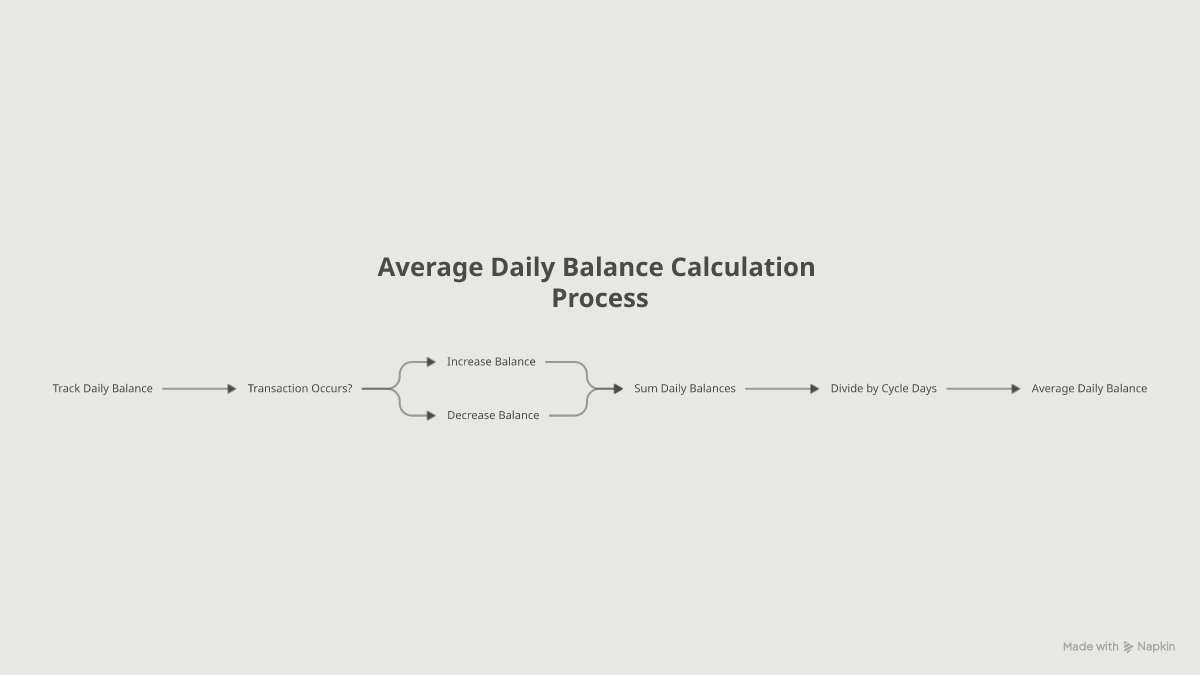
To calculate the average daily balance manually, one must track the daily "running" balance. For more context on how current rates fit into today’s market, review what interest rate consumers pay on their credit cards. For example, consider a 30 day billing cycle:
- Days 1 through 10: Balance is $1,000. (10 days * $1,000 = $10,000)
- Days 11 through 20: A $500 purchase is made, so the balance is $1,500. (10 days * $1,500 = $15,000)
- Days 21 through 30: A $700 payment is made, so the balance is $800. (10 days * $800 = $8,000)
- Total: $10,000 + $15,000 + $8,000 = $33,000.
- Average Daily Balance: $33,000 / 30 days = $1,100.
Even if the ending balance is only $800, the interest is charged on $1,100. This is because the cardholder spent a significant portion of the month with a much higher balance. This mechanic highlights the importance of understanding the timing of payments and purchases.
Different APRs for Different Transactions
Most credit cards do not have a single interest rate for everything. Instead, they utilize a tiered structure where different actions trigger different rates. The most common rate is the purchase APR, which applies to standard items bought at a store or online. However, other rates can be significantly higher or lower depending on the circumstances.
Cash advance APRs are frequently much higher than purchase APRs. To understand why these charges are so costly, read our guide on what cash advance APR on a credit card means. A cash advance occurs when a cardholder uses their card to get physical cash from an ATM or a bank teller. These rates often exceed 25% or 30%. Furthermore, cash advances usually do not have a grace period. Interest begins accruing the very moment the cash is received.
Balance transfer APRs apply to debt moved from one card to another. If you are considering this route, compare options in our balance transfer card comparison. These rates might be lower than purchase APRs as part of an introductory offer. Some cards offer a 0% introductory APR on balance transfers for a set period, such as 12 to 21 months. After that period ends, the remaining balance will begin accruing interest at the standard balance transfer rate.
Penalty APRs are the highest rates a cardholder might face. If a payment is more than 60 days late, an issuer may raise the APR to a penalty rate, which is often around 29.99%. This rate can stay in effect indefinitely, though some issuers will lower it if the cardholder makes several consecutive on-time payments.
The Power of the Grace Period
The grace period is the most effective tool for avoiding credit card interest entirely. For a deeper breakdown, see when APR kicks in on credit cards. A grace period is the window of time between the end of a billing cycle and the payment due date. If a cardholder pays their entire statement balance in full by the due date every month, the issuer does not charge any interest on purchases. This effectively makes the credit card a 0% interest loan for that period.
Carrying a balance from one month to the next usually eliminates the grace period. When a cardholder pays less than the full statement balance, they lose the grace period for the next billing cycle. This means interest will begin accruing on new purchases the moment they are made. This is known as "trailing interest" or "residual interest."
To regain the grace period, the balance must typically be paid in full for two consecutive billing cycles. This ensures that all trailing interest is cleared from the account. Once the grace period is restored, interest will not accrue on purchases as long as the full balance continues to be paid every month.
Not all transactions qualify for a grace period. As mentioned previously, cash advances and balance transfers often start accruing interest immediately. Even if the rest of the statement is paid in full, these specific items may still incur interest charges. Reviewing the terms and conditions of a card helps clarify which transactions are eligible for the grace period.
How Compounding Frequency Increases Costs
Credit card interest usually compounds daily, which is more expensive than monthly compounding. Daily compounding is one reason cash advances are so costly, as explained in what cash advance APR on a credit card is. Compounding means that the bank adds the daily interest charge to the balance at the end of each day. On the following day, the interest is calculated based on the new, slightly higher balance. This creates a cycle where the cardholder is paying interest on their interest.
The difference between simple interest and compound interest can be significant over time. While the daily difference might be measured in pennies, over a year, daily compounding can add several percentage points to the effective cost of a loan. The APR does not always reflect this daily compounding effect perfectly. This is why some people refer to the Effective Annual Rate (EAR), which accounts for the impact of compounding.
Frequent payments can counteract the effects of daily compounding. Because interest is calculated based on the balance each day, making multiple payments throughout the month reduces the amount of principal that can accrue interest. Some people choose to pay their credit card bill every week or every time they get a paycheck to keep their average daily balance as low as possible.
Issuers are required to disclose their compounding methods in the cardholder agreement. Most will state that they use a daily periodic rate and apply it to the balance each day. This information is usually found in the section explaining how interest charges are calculated. MoneyAtlas provides reviews that often highlight these specific terms for major credit card issuers.
Variables That Change Your Interest Rate
Most credit cards use variable interest rates rather than fixed ones. A variable rate is tied to an index, such as the US Prime Rate. When the Federal Reserve adjusts interest rates, the Prime Rate usually follows. This means that a cardholder's APR can go up or down even if their credit behavior remains exactly the same.
A credit score is the primary factor determining the initial APR offered by a bank. Borrowers with excellent credit scores, typically above 740, are more likely to qualify for the lowest available rates. Borrowers with fair or poor credit will likely be assigned an APR at the higher end of the issuer's range. This can result in a difference of 10% or more in the annual rate.
The type of credit card also influences the interest rate. If you are weighing rewards against lower costs, compare best cash back credit cards and best no annual fee credit cards. Rewards cards, which offer points, miles, or cash back, generally have higher APRs than "plain vanilla" cards that offer no rewards. The higher interest rates on rewards cards help the bank offset the cost of the perks they provide. For someone who plans to carry a balance, a low-interest card without rewards is often the more cost-effective choice.
Promotional offers can temporarily override a card's standard interest rate. Many cards offer a 0% intro APR for the first year or more. These offers are a powerful way to manage large purchases or consolidate debt, but it is essential to know when the promotion ends. Once the introductory period is over, the rate will jump to the standard APR, which could be 20% or higher.
Comparing Options to Reduce Interest Costs
If a current credit card's interest is too high, comparing other financial products can reveal better alternatives. For those carrying significant debt, a balance transfer credit card guide is a common strategy. This allows the cardholder to pay down the principal without new interest charges being added every month. However, these cards often charge a balance transfer fee, usually between 3% and 5% of the total amount moved.
A personal loan is another option for consolidating credit card debt. Compare fixed-rate borrowing with our personal loan comparison. Personal loans are installment loans that usually offer a fixed interest rate and a set repayment term. For many borrowers, the interest rate on a personal loan is significantly lower than the APR on a credit card. MoneyAtlas provides tools to compare personal loan rates side-by-side with credit card offers.
Negotiating with the current credit card issuer is sometimes successful. A cardholder with a long history of on-time payments can call the bank and request a lower APR. If the cardholder has received better offers from other banks, mentioning those can provide leverage. While banks are not required to lower the rate, they may do so to retain a loyal customer.
Using a credit card comparison tool helps identify cards specifically designed for low interest. If you want a broader view of rate benchmarks, review what the average credit card interest rate is right now. Some cards are marketed specifically to people who prioritize a low APR over rewards. By looking at dozens of cards at once, a consumer can find the most competitive rates currently available for their credit profile.
How to Check Your Math
Verifying the interest charge on a statement ensures the bank has not made an error. While automated systems are generally accurate, mistakes can happen, especially regarding promotional rates or the timing of payments. Performing a quick manual calculation once or twice a year provides peace of mind.
Keep a log of the daily balance if the calculation doesn't seem to match. If the bank's average daily balance is different from yours, it is likely due to the exact time a payment was credited. Payments made after a certain cutoff time, such as 5:00 PM, might not be credited until the following business day.
Use a credit card interest calculator for more complex scenarios. If you are trying to project how long it will take to pay off a balance while making regular purchases, a calculator is more efficient than a manual formula. These tools can show how much total interest will be paid over the life of the debt based on different monthly payment amounts.
Compare the calculated interest against the "Interest Charged" section of the statement. Most statements will list the specific APRs used and the balances they were applied to. If the numbers don't align, contact the issuer's customer service department for a detailed breakdown. They can explain the specific math used for your account.
Strategies for Managing High-Interest Debt
Prioritizing debt with the highest interest rate is known as the "avalanche method." By focusing extra payments on the card with the highest APR first, a borrower minimizes the total amount of interest paid over time. This is mathematically the fastest way to become debt-free.
Making multiple payments throughout the month reduces the average daily balance. Instead of waiting for the due date, consider making a payment every time you receive a paycheck. This lowers the balance subject to interest for the remaining days of the cycle. Even small, frequent payments can lead to noticeable savings over several months.
Avoiding new purchases while paying down a balance is critical. As long as a balance is carried, new purchases do not benefit from a grace period. They begin accruing interest immediately, which can make it feel like you are not making progress on the debt. Using cash or a debit card for daily expenses while paying off a credit card prevents the debt from growing further.
Explore debt consolidation if the interest feels unmanageable. If you want another option to reduce carrying costs, review balance transfer cards and compare them with a personal loan comparison. When interest charges exceed the amount of principal being paid off each month, the debt can become a "debt trap." Moving the balance to a lower-interest product provides the breathing room needed to make a real dent in the principal. MoneyAtlas offers guides on debt consolidation options for various credit scores and income levels.
FAQ
Ready to pick a card?
Compare the cards our editors rate highest right now, side by side, with the fees and rewards that matter.
Compare the best credit cardsMoneyAtlas Staff
Articles and reviews from the MoneyAtlas editorial team — independent research on credit cards, banking, loans, insurance, and investing.
Related Articles

The Fed just raised rates. Which of your debts will cost more?
The Fed made its first rate hike since 2023 on September 16. See which debts go up, which stay locked, and what the hike costs you each month.

Your credit card APR is going up. Here's what to do before your next statement
Learn how to lower credit card APR with 5 proven strategies. From negotiating with issuers to 0% transfers, discover how to offset rising interest rates.

Does Credit Card APR Go Down? How to Lower Your Interest Rate
Does credit card APR go down? Learn how market shifts, improved credit, or negotiation can lower your rate and save you money on interest today.