How Are Credit Card Interest Rates Determined: A Clear Breakdown


Introduction
Determining how credit card interest rates are set can feel like looking into a black box. You see a number on your statement, perhaps 22% or 29%, but the logic behind that specific figure is rarely explained in plain English. Understanding this process is a critical step for anyone looking to manage debt or choose a new financial product.
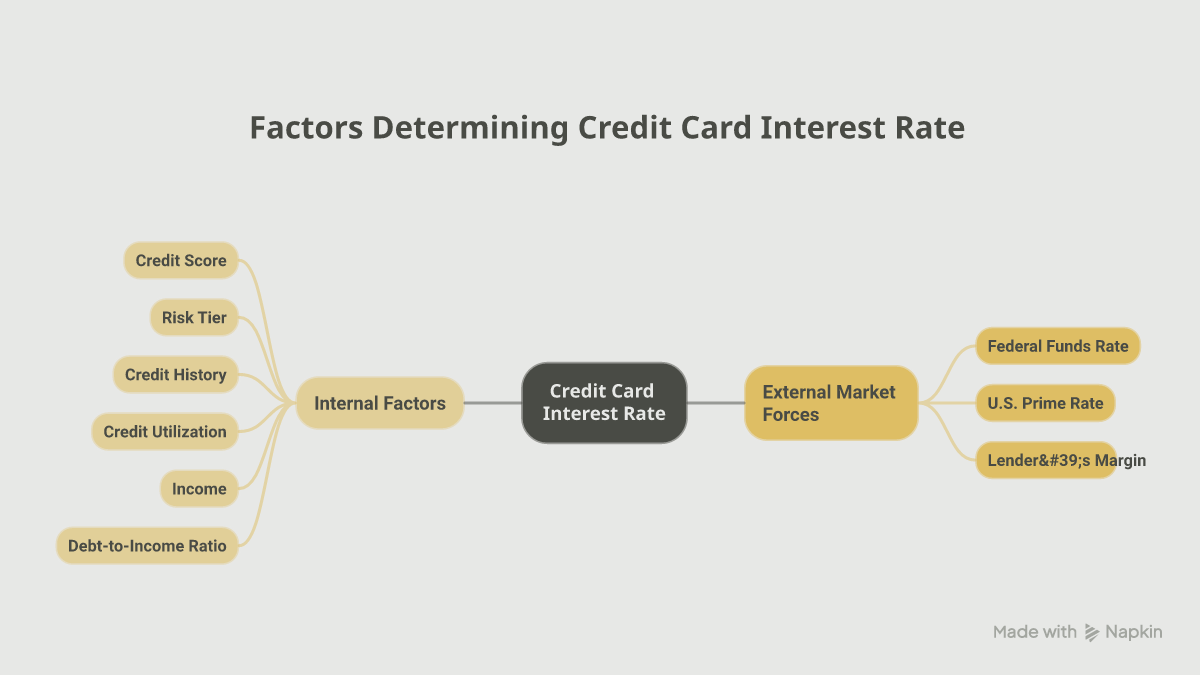
This article explores the internal and external factors that dictate your Annual Percentage Rate (APR). We look at how your credit history influences lender decisions, how the Federal Reserve impacts your monthly bill, and why different types of transactions carry different costs. MoneyAtlas compares over 1,500 financial products to help you see these variables side-by-side. By the end of this guide, you will understand the mechanics of interest determination and how to use that knowledge to compare your best credit cards more effectively.
The Foundation of Your Interest Rate: Your Credit Profile
When you apply for a credit card, the lender is essentially assessing the risk that you will not pay them back. The interest rate is the price of that risk. The primary tool lenders use for this assessment is your credit profile.
Credit Scores and Risk Tiers
Your credit score is often the single most important factor in the interest rate you are offered. Most lenders use the FICO score model, which ranges from 300 to 850.
Applicants with scores in the "Excellent" range, typically 800 and above, are usually offered the lowest available rates on a card's sliding scale. Those in the "Good" range, generally 670 to 739, may receive average rates. If a score falls into the "Fair" or "Poor" categories, the lender may still approve the application but will likely charge a much higher APR to offset the perceived risk of default.
Credit History Depth and Cleanliness
A score is a snapshot, but lenders also look at the details within your credit report. They look for a history of on-time payments, the length of your credit history, and your current credit utilization.
Credit utilization refers to the percentage of your available credit that you are currently using. If you have $10,000 in total credit limits and owe $5,000, your utilization is 50%. High utilization can signal financial stress, leading a lender to assign a higher interest rate even if your score is otherwise solid.
Income and Debt-to-Income Ratio
While your income is not part of your credit score, it is part of your credit application. Lenders use your stated income to calculate your debt-to-income (DTI) ratio. This is the percentage of your gross monthly income that goes toward paying debts. A lower DTI suggests you have more breathing room to handle new payments, which can favorably influence the terms a lender offers.

External Market Forces: The Prime Rate
Not every factor affecting your interest rate is within your control. Most credit cards in the United States have variable interest rates. This means the rate can change over time based on a public benchmark.
The Federal Funds Rate and the Prime Rate
The benchmark used by almost all credit card issuers is the U.S. Prime Rate. This rate is directly influenced by the Federal Reserve’s federal funds rate. When the Federal Reserve raises or lowers interest rates to manage inflation or economic growth, the Prime Rate usually moves in tandem.
When you see your credit card APR go up without a change in your credit behavior, it is almost always because the Federal Reserve increased rates.
The Margin or "Spread"
Lenders determine your specific APR by taking the Prime Rate and adding a "margin" or "spread" based on your creditworthiness. For example, if the Prime Rate is 8.5% and the lender determines your risk level warrants a 12% margin, your total APR will be 20.5%.
The formula looks like this:
Prime Rate + Margin = Your Variable APR
Because the margin is set when you are approved, it stays the same unless the lender notifies you of a change. However, because the Prime Rate moves, your total APR fluctuates.
Transaction Types and Different APRs
It is a common misconception that a credit card has only one interest rate. In reality, most cards have a suite of different APRs that apply depending on how you use the card.
Purchase APR
This is the standard rate you pay on most transactions. If you carry a balance from month to month, this is the rate used to calculate your interest charges.
Cash Advance APR
Taking cash out using a credit card is one of the most expensive ways to borrow. These rates are significantly higher than purchase rates, often exceeding 25% or 30%. Furthermore, cash advances usually do not have a grace period. Interest starts accruing the minute the cash is in your hand.
Penalty APR
If you miss a payment or a payment is returned, the lender may move you to a penalty APR. This rate can be as high as 29.99%. Under the Credit CARD Act of 2009, lenders must generally wait until you are 60 days late to apply this to existing balances, but they can apply it to new purchases sooner with proper notice.
Introductory and Promotional APRs
When you are looking for a new card, you may see 0% introductory offers. These are promotional rates designed to attract new customers. They typically last between 6 and 21 months. MoneyAtlas tracks these offers across hundreds of cards to help you identify which ones provide the longest interest-free windows. If that is your main goal, start with our balance transfer card comparison.
How Lenders Calculate Your Monthly Interest
Understanding how the rate is determined is one half of the equation. The other half is how that rate is applied to your balance. Most issuers use the Average Daily Balance method.
The Daily Periodic Rate (DPR)
Interest is not calculated once a month. It is usually calculated every single day. To find your daily rate, the lender divides your APR by 365.
For example, if your APR is 24%, your Daily Periodic Rate is approximately 0.0657%.
The Calculation Process
- Track Daily Balance: The lender looks at your balance at the end of every day in the billing cycle.
- Average the Balance: They add all those daily totals together and divide by the number of days in the cycle (usually 28 to 31).
- Apply the Rate: They multiply that average daily balance by the Daily Periodic Rate.
- Multiply by Days: Finally, they multiply that result by the number of days in the billing cycle to get your monthly interest charge.
This daily compounding means that if you make a payment early in your billing cycle, you reduce your average daily balance, which in turn reduces the amount of interest you pay for that month.
The Schumer Box: Where to Find Your Rates
Federal law requires credit card issuers to be transparent about their rates and fees. This information is contained in a standardized table known as the Schumer Box.
You can find the Schumer Box in your original cardmember agreement or on the "Terms and Conditions" page of any credit card application. It will clearly list:
- The APR for purchases, balance transfers, and cash advances.
- The Prime Rate used as a benchmark.
- The grace period (how long you have to pay before interest is charged).
- Annual fees and late payment fees.
When you use the comparison tools on MoneyAtlas, we pull this data directly so you can compare the "fine print" of different cards without digging through dozens of separate PDFs.
How to Influence the Interest You Pay
While you cannot control the Federal Reserve, you can influence the interest you actually pay by understanding the rules of the game.
Utilizing the Grace Period
The grace period is the time between the end of your billing cycle and your payment due date. If you pay your statement balance in full by the due date every month, the interest rate effectively becomes 0%. Most cards offer a grace period of 21 to 25 days, but this only applies if you are not currently carrying a balance from the previous month. For a deeper breakdown, see how to avoid APR fees on credit card balances.
Shopping for Better Terms
If you are currently paying a high interest rate, it may be worth comparing other options. A balance transfer card could allow you to move high-interest debt to a card with a 0% introductory APR for a year or longer. This "pauses" interest accumulation, allowing your entire payment to go toward the principal balance. You can also review the latest guidance on lowering your credit card interest rate.
Requesting a Rate Reduction
If your credit score has improved significantly since you first opened a card, you can call the issuer and ask for a lower APR. While they are not required to grant the request, they often will to retain a customer with a strong payment history.
Steps to Take Before Comparing Cards
How to Compare Credit Cards Before Applying
- 1
Check Your Credit Score
Know where you stand so you only apply for cards where you meet the "Good" or "Excellent" requirements.
- 2
Review Your Current Statements
Identify the APRs you are currently paying on existing cards to set a benchmark for a "better" deal.
- 3
Identify Your Priority
Decide if you need a low ongoing APR for purchases or a 0% introductory window for a balance transfer.
- 4
Use Comparison Tools
View cards side-by-side on MoneyAtlas to see which lenders offer the most competitive margins over the Prime Rate. If you want a broader starting point, browse our best credit cards rankings.
Conclusion
Credit card interest rates are determined by a combination of your personal financial history and the broader movements of the U.S. economy. By maintaining a high credit score and low utilization, you position yourself to receive the lowest possible margin from lenders.
While the Federal Reserve's decisions will cause your variable rate to fluctuate, your behavior is the ultimate factor in how much interest you actually pay. Paying in full during the grace period is the gold standard, but for times when a balance must be carried, knowing how these rates are determined helps you choose the most cost-effective tool for the job. If you are comparing products now, a balance transfer card comparison is a smart next step.
FAQ
MoneyAtlas Staff
Articles and reviews from the MoneyAtlas editorial team — independent research on credit cards, banking, loans, insurance, and investing.
Related Articles

Which Card Is Better: American Express Gold or Platinum?
Deciding which card is better: American Express Gold or Platinum? Compare fees, 4X dining rewards, and luxury travel perks to find your perfect match.

Should I Get an American Express Gold Card? Breaking Down the Value
Should I get an American Express Gold card? Explore the 4X rewards on dining and groceries vs. the $325 fee to see if this premium card fits your budget.

How to Get the American Express Gold Card: A Practical Guide
Learn how to get the American Express Gold Card with our guide on credit score requirements, income, and the 'Apply with Confidence' tool. Apply today!