How to Calculate Interest Rate on a Credit Card


Introduction
Understanding how a credit card issuer turns a single annual percentage rate into a specific monthly dollar amount is the first step toward managing debt effectively. Most people see a finance charge on their statement and assume the math is correct, but the underlying calculation is often more complex than simply multiplying a balance by a percentage. MoneyAtlas tracks over 1,500 financial products to help users compare options side by side, and our balance transfer credit card comparison can help you see how different APR offers affect real-world borrowing costs. This article breaks down the mechanics of the average daily balance, the daily periodic rate, and the compounding schedules that determine your monthly costs. By following these steps, you can verify the interest charges on your own statement and make more informed decisions about which balances to prioritize.
The Core Components of Credit Card Interest
Before diving into the math, it is necessary to identify the specific numbers required for the calculation. These figures are located on your monthly credit card statement, usually in a section labeled "Interest Charge Calculation" or "Account Summary."
Annual Percentage Rate (APR)
The Annual Percentage Rate, or APR, is the interest rate expressed as a yearly figure. Most credit cards have a variable APR, which means the rate can fluctuate based on the Prime Rate. Some cards also feature different APRs for different types of transactions. For example, your card might have a 19% APR for purchases but a 29% APR for cash advances. If you are comparing reward-heavy offers, our cash back credit card comparison is a useful way to see how higher earn rates can come with higher borrowing costs.
Daily Periodic Rate (DPR)
While APR is an annual figure, credit card companies actually calculate interest on a daily basis. The Daily Periodic Rate is the APR divided by the number of days in the year. Most issuers use 365 days, though some may use 360. If your APR is 24%, your daily periodic rate is 0.0657% (24% divided by 365).
Billing Cycle
A billing cycle is the period between your last statement closing date and your current statement closing date. This is not always a calendar month. It typically ranges from 28 to 31 days. The number of days in the cycle is a critical variable in the math because interest is charged for every day you carry a balance.

Step-by-Step Interest Calculation
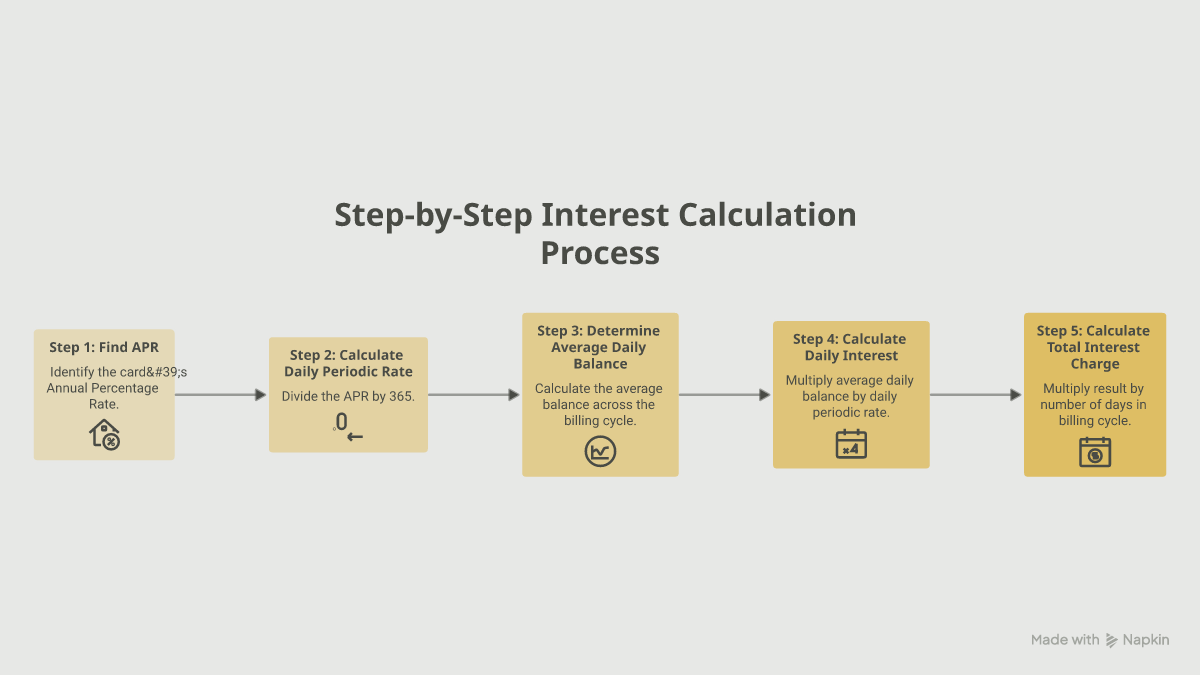
Calculating your interest charges manually helps reveal how much even a small balance can cost over time. Follow these steps to find the finance charge for a single billing cycle.
How to Calculate Credit Card Interest
- 1
Find Your Daily Periodic Rate
Divide your APR by 365.
For a card with a 21% APR, the math looks like this:
21% / 365 = 0.0575%
To use this in a calculation, you must convert the percentage to a decimal by dividing by 100.
0.0575 / 100 = 0.000575 - 2
Calculate Your Average Daily Balance (ADB)
Track your balance for each day of the billing cycle.
Credit card companies do not just look at your balance on the last day of the month. They look at what you owed every single day. If you start the month with a $1,000 balance and pay off $500 halfway through, your average daily balance will be lower than if you waited until the last day to pay.
To find your ADB:
Day Range
Balance
Calculation
Days 1 to 15
$2,000
15 days x $2,000 = $30,000
Days 16 to 30
$1,500
15 days x $1,500 = $22,500
Total Sum
$52,500
Average Daily Balance
$52,500 / 30 = $1,750List the balance for every day in the cycle.
Add all those daily balances together.
Divide the total by the number of days in the cycle.
- 3
Multiply the DPR by the ADB
Multiply your daily periodic rate (as a decimal) by your average daily balance.
Using the numbers from the previous steps:
0.000575 (DPR) x $1,750 (ADB) = $1.00625
This result represents the amount of interest you are charged per day on average. - 4
Multiply by the Number of Days in the Cycle
Multiply the daily interest amount by the total days in the billing period.$1.00625 x 30 days = $30.19In this scenario, your interest charge for the month would be $30.19.
The Role of Compounding Interest
Most credit card issuers use daily compounding. This means the interest you earn today is added to your balance tomorrow, and the next day's interest is calculated based on that new, slightly higher balance.
While the manual calculation above gets you very close to the actual number, daily compounding can make the real charge slightly higher. Because the interest is added to the principal balance every day, you are essentially paying interest on your interest. Over a single month, the difference might only be a few cents, but over a year, compounding significantly increases the total cost of the debt.
Why the Average Daily Balance Matters
The average daily balance method is the most common way issuers calculate interest. It is designed to be fairer than charging interest on the highest balance of the month, but it also means that the timing of your payments is vital.
If you have the funds to make a payment, doing so earlier in the billing cycle reduces your average daily balance for the remainder of that cycle. This results in a lower interest charge, even if the total amount paid by the due date is the same.
For someone carrying a $5,000 balance at 24% APR, making a $1,000 payment on the first day of the cycle versus the last day could save roughly $20 in interest for that month alone. Over time, these small savings help pay down the principal faster. If you want a broader benchmark for rate shopping, what APR is good for credit card purchases and balances can help you compare your current rate with common market ranges.
Different APRs and Their Impact
Many cardholders do not realize that a single credit card can have four or five different interest rates active at once. MoneyAtlas makes it easier to compare these rates when shopping for a new card, but you must still monitor your statement to see which rates are currently being applied to your debt.
- Purchase APR: This is the standard rate applied to things you buy at a store or online.
- Balance Transfer APR: This is the rate for debt moved from another card. It is often lower than the purchase APR for an introductory period.
- Cash Advance APR: This is almost always significantly higher than the purchase APR. It also usually lacks a grace period, meaning interest starts accruing the moment you take the cash.
- Penalty APR: If you make a late payment, the issuer may increase your rate to a penalty APR, which can be as high as 29.99%.
When you make a payment that is higher than the minimum required, federal law requires the issuer to apply the excess amount to the balance with the highest interest rate. This helps consumers pay down the most expensive debt first. If you want to compare actual card products side by side, start with MoneyAtlas product reviews to see how different cards handle APRs, fees, and rewards.
How to Avoid Interest Entirely: The Grace Period
The most effective way to manage credit card interest is to avoid it altogether. Most credit cards offer a "grace period," which is the gap between the end of a billing cycle and your payment due date.
If you pay your statement balance in full by the due date every single month, the issuer will not charge interest on your purchases. In this case, the APR on the card becomes irrelevant to your daily finances. However, the grace period usually only applies if you started the month with a zero balance. If you carry even $1 of debt over from the previous month, you "lose" the grace period for the next month, and interest begins accruing on new purchases immediately.
Losing and Regaining the Grace Period
- Carrying a Balance: Once you fail to pay the full statement balance, interest starts accruing on the remaining amount and all new purchases.
- Trailing Interest: You might see a small interest charge on the statement after you finally pay off your full balance. This is "trailing interest" that accrued between the time the statement was printed and the time your payment was received.
- Resetting: To regain your grace period, you typically need to pay your balance in full for two consecutive billing cycles.
If you are trying to understand why interest can begin so quickly, when credit card APR is applied breaks down how purchases, cash advances, and balance transfers are treated differently.
Factors That Influence Your Interest Rate
Credit card interest rates are not static. Several external and internal factors determine what you pay.
The Prime Rate
Most credit cards have variable rates tied to the Prime Rate, which is influenced by the Federal Reserve. When the Fed raises interest rates, your credit card APR will likely increase by the same amount within one or two billing cycles.
Credit Score
Your creditworthiness is the primary factor used by issuers to set your initial APR. Those with excellent credit scores, generally 740 or higher, often qualify for cards with the lowest available rates. If your credit score has improved significantly since you opened your card, you might find it beneficial to compare current offers on MoneyAtlas to see if you qualify for a more competitive rate. For a deeper look at whether rates are moving, are credit card interest rates going down in 2026 is a helpful market check.
Type of Card
Rewards cards and premium travel cards often have higher APRs than basic, no-frills credit cards. The higher interest rates help offset the cost of the points, miles, or cash back provided to cardholders. For someone who consistently carries a balance, a low-interest card without rewards may be a more cost-effective choice than a high-interest rewards card.
Strategies for Lowering Interest Costs
If you find that your monthly interest charges are making it difficult to reduce your principal balance, several strategies can help change the math in your favor.
- Check for 0% APR Offers: Many cards offer a 0% introductory APR on balance transfers for 12 to 21 months. Moving high-interest debt to one of these cards can stop interest from accruing entirely, allowing 100% of your payment to go toward the principal.
- Request a Rate Reduction: If you have a long history of on-time payments, you can call your issuer and ask for a lower APR. While not guaranteed, issuers sometimes lower rates to keep loyal customers from moving to a competitor.
- Prioritize High-Interest Debt: If you have multiple cards, focus your largest payments on the card with the highest APR while making minimum payments on the others. This "avalanche method" minimizes the total interest paid over time.
- Use a Personal Loan: For large amounts of credit card debt, a personal loan often provides a lower fixed interest rate than a variable-rate credit card. This can simplify your debt into a single monthly payment with a clear end date.
If you want a step-by-step overview of negotiating for a lower rate, how to lower credit card APR explains the main options consumers use.
Comparing Your Options
The math behind credit card interest proves that even a few percentage points can mean hundreds of dollars in difference over a year. Because rates and terms change frequently, it is helpful to periodically evaluate whether your current cards still serve your needs.
MoneyAtlas provides tools to compare credit cards based on more than just the headline APR. You can look at fee structures, grace period terms, and how different cards handle balance transfers side by side. When you are equipped with the knowledge of how interest is calculated, you can better identify which card features will actually save you money based on your specific spending and payment habits. If you want to focus on no-fee products, best no annual fee credit cards is a natural next step.
Conclusion
Calculating credit card interest is a straightforward process once you break it down into daily increments. By finding your daily periodic rate and your average daily balance, you can see exactly how your spending and payment timing affect your monthly costs. Remember that the grace period is your most valuable tool for avoiding these costs entirely. If you are currently carrying a balance, use the formulas provided here to track your progress and consider whether a lower-interest alternative might be a better fit for your situation. Exploring the comparison tools and expert reviews available through MoneyAtlas can help you find a product that aligns with your financial goals, whether that involves maximizing rewards or minimizing interest expenses.
FAQ
MoneyAtlas Staff
Articles and reviews from the MoneyAtlas editorial team — independent research on credit cards, banking, loans, insurance, and investing.
Related Articles

Which Card Is Better: American Express Gold or Platinum?
Deciding which card is better: American Express Gold or Platinum? Compare fees, 4X dining rewards, and luxury travel perks to find your perfect match.

Should I Get an American Express Gold Card? Breaking Down the Value
Should I get an American Express Gold card? Explore the 4X rewards on dining and groceries vs. the $325 fee to see if this premium card fits your budget.

How to Get the American Express Gold Card: A Practical Guide
Learn how to get the American Express Gold Card with our guide on credit score requirements, income, and the 'Apply with Confidence' tool. Apply today!