Do Debit Cards Have Higher Interest Rates Than Credit Cards?


Introduction
The question of whether debit cards have higher interest rates than credit cards often stems from a misunderstanding of how these two financial tools function. In the simplest terms, debit cards do not have interest rates in the same way credit cards do because they do not involve borrowing money. Instead, debit cards draw directly from your own bank account. Credit cards involve revolving debt, which carries an Annual Percentage Rate (APR) that can be quite high if a balance is not paid in full each month. MoneyAtlas provides comparison tools to help you evaluate the costs and benefits of both card types, starting with our best credit cards comparison. This article covers the mechanics of interest for each card, the costs of carrying a balance, and how to decide which tool fits your spending habits.
The Fundamental Difference Between Credit and Debit
To understand why interest rates apply differently to these cards, it is necessary to look at where the money comes from during a transaction. A debit card is a direct pipeline to your checking or money market account. When you swipe a debit card, the bank verifies you have the funds and deducts them almost immediately. Because you are using your own cash, there is no loan, and therefore no interest rate is charged on your purchases.
Credit cards operate on a borrow and repay model. When you use a credit card, the card issuer pays the merchant on your behalf. You are then required to pay the issuer back. This creates a revolving line of credit. If you pay the full balance by the due date, most cards offer a grace period where no interest is charged. However, if you carry even a small portion of that balance into the next month, the issuer charges interest on the total amount. If you want to compare how different cards handle this, our credit card reviews are a useful place to start.
Understanding Credit Card Interest Rates (APR)
Credit card interest is expressed as an Annual Percentage Rate, or APR. This is the cost of borrowing money over the course of a year. Because credit cards are typically unsecured loans, meaning they are not backed by collateral like a house or a car, they carry higher risks for the lender. To compensate for this risk, credit card interest rates are often significantly higher than those for mortgages or personal loans.
If you want a deeper look at current borrowing costs, read how much the credit card interest rate is for US consumers.
Factors that influence your credit card interest rate include:
- Credit Score: Borrowers with higher credit scores generally qualify for lower APRs because they are viewed as less likely to default.
- The Prime Rate: Most credit card rates are variable, meaning they move up or down based on a benchmark called the prime rate.
- Card Type: Rewards cards and premium travel cards often have higher APRs than "low-rate" cards designed specifically for those who may need to carry a balance.
The Cost of Carrying a Balance
If you do not pay your credit card in full, the interest can accumulate quickly. For example, carrying a $5,000 balance on a card with a 24% APR would result in roughly $100 in interest charges in a single month. If you only make the minimum payment, a large portion of that payment goes toward interest rather than reducing the principal balance.
MoneyAtlas tracks current trends in credit card rates, and it is common to see APRs on rewards cards exceeding 20% or 25% for many consumers. For someone who frequently carries a balance, a card with a lower interest rate is worth comparing against a card that offers high rewards but a much higher APR. If debt payoff is the main goal, our balance transfer credit cards can help you compare lower introductory APR options.
Do Debit Cards Ever Have Interest?
While debit cards do not charge interest on purchases, the accounts they are linked to can earn interest. This is known as Annual Percentage Yield (APY). High-yield savings accounts or money market accounts may pay you a small percentage back on the money you keep in the account. In this context, a debit card is associated with a positive interest rate (earnings) rather than a negative one (costs).
However, debit cards can have costs that function similarly to interest if you spend more than you have. These are called overdraft fees. If a bank allows a transaction to go through when your balance is zero, they may charge a flat fee, often ranging from $25 to $35. While this is not technically an interest rate, the cost relative to the amount "borrowed" can be much higher than any credit card APR.
Comparing the Costs: Credit vs. Debit
When evaluating which card to use, it is helpful to look at the potential fees and charges side by side. MoneyAtlas makes it easier to compare these factors across different providers, but the general breakdown typically looks like this:
If you are trying to keep costs low, it can also help to compare no annual fee credit cards before you commit to a card with recurring charges.
Why Credit Card Rates are So High
The SERP data indicates that credit card rates have risen significantly over the last several years. Banks justify these high rates because credit cards are "unsecured" debt. If you stop paying your car loan, the bank repossesses the car. If you stop paying your credit card, the bank has no physical asset to take back.
Common reasons for high credit card APRs include:
- Risk of Default: A certain percentage of cardholders will never pay back their balances. High interest from other users covers these losses.
- Uncertainty: Unlike a personal loan for a specific amount, a credit card is a "revolving" line. The bank doesn't know if you will borrow $5 or $5,000, making it harder for them to manage their cash reserves.
- Funding Rewards: The 2% cash back or travel points users love are partially funded by the interest paid by those who carry a balance.
If you want to understand whether rates are easing, see are credit cards interest rates going down in 2026.
The "Hidden" Interest of Debit Cards: Overdrafts
While a debit card does not have an interest rate, it can become the most expensive way to borrow money if you rely on overdraft protection. If you spend $10 more than you have and your bank charges a $35 overdraft fee, you have effectively paid a 350% "interest rate" for a one-day loan.
To avoid these costs, many consumers choose to link their checking account to a savings account for overdraft protection. Some banks also offer "no overdraft" checking accounts that simply decline the transaction if funds are insufficient. When choosing a banking partner, it is worth comparing these fee structures to ensure you aren't paying more than necessary for simple mistakes.
Fraud Protection and Security Differences
Interest is not the only cost to consider. Fraud protection can save you significant money in the event of a stolen card.
- Credit Cards: Under the Fair Credit Billing Act, your liability for unauthorized charges is capped at $50. Many issuers offer zero-liability policies. Because the money hasn't left your bank account yet, you aren't out of pocket while the bank investigates.
- Debit Cards: These are governed by the Electronic Fund Transfer Act. Your liability can be higher depending on how quickly you report the loss. If you wait too long, you could be responsible for the full amount. Furthermore, the money is missing from your checking account immediately, which can cause issues with paying other bills like rent or utilities.
Impact on Credit Scores
A debit card has no impact on your credit score. Because you aren't borrowing money, there is no "repayment history" to report to the credit bureaus. For someone looking to build credit history to qualify for a mortgage or auto loan, a credit card is the necessary tool.
Using a credit card responsibly involves keeping your balance low relative to your credit limit (known as credit utilization) and making every payment on time. This demonstrates to lenders that you can handle debt, which may lead to lower interest rates on future loans. If you are concerned about your credit score, comparing secured credit cards is a good starting point. These cards require a deposit that serves as your credit limit, making them easier to get if you have limited credit history.
When to Choose Credit vs. Debit
The decision of which card to use depends on your financial discipline and your specific goals for that purchase.
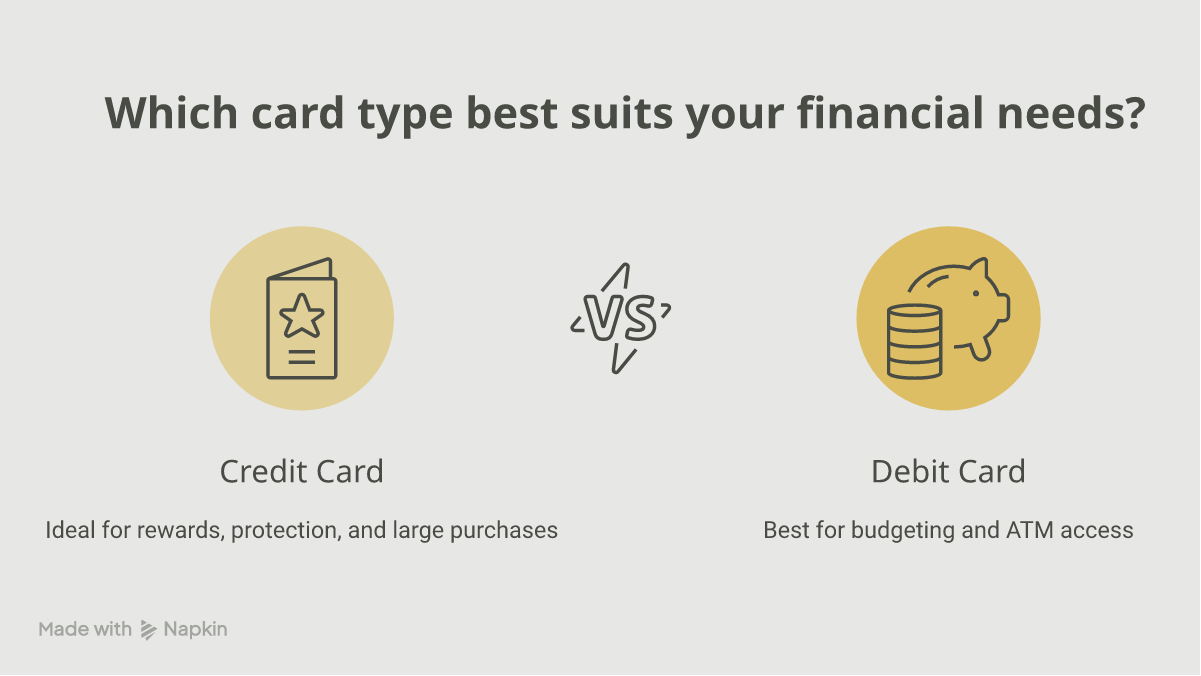
A credit card is worth comparing if:
- You can pay the balance in full every month to avoid interest.
- You want to earn rewards like cash back or travel points.
- You are making a large purchase and want extra consumer protection or an extended warranty.
- You are traveling or booking a hotel (most require a card for a security deposit).
A debit card is worth comparing if:
- You want to stick to a strict budget and only spend money you already have.
- You have a history of carrying credit card debt and want to avoid high interest charges.
- You need to withdraw cash from an ATM without paying cash advance fees.
- You want to earn a small amount of interest (APY) on your balance in a high-yield checking account.
How to Compare Your Options
The financial market is constantly changing, with banks adjusting both their APRs for credit cards and their APYs for deposit accounts. Using tools to compare these products side-by-side allows you to see the real cost of ownership.
If you want a practical breakdown of how APR is calculated, read how to figure out interest rate on credit card.
Steps to evaluate a new card:
How to Evaluate a New Card
- 1
Check APR
Look for the "Purchase APR" and see if it is a fixed or variable rate.
- 2
Review Fee Schedule
Look for annual fees, late fees, and foreign transaction fees.
- 3
Compare Rewards
If you spend $1,000 a month, how much cash back or how many points will you earn?
- 4
Assess Your Habits
Be honest about whether you will pay the balance in full or if the interest will eat up your rewards.
MoneyAtlas tracks over 1,500 products to help you find the right fit for your credit profile and spending needs. Whether you are looking for a high-yield savings account to pair with a debit card or a low-interest credit card for a large upcoming purchase, comparing the fine print is the best way to save money.
Conclusion
Debit cards do not have higher interest rates than credit cards. In fact, they usually have no interest rate at all because you are using your own funds. Credit cards, by contrast, often carry high interest rates that only apply if you carry a balance month to month. While debit cards are safer for budgeting and avoiding debt, credit cards offer better fraud protection and the ability to build a credit history. The best choice depends on whether you prioritize the simplicity of spending your own cash or the rewards and protections that come with using a lender's money. To find the best rates currently available, use the credit card reviews and comparison tools at MoneyAtlas to see which cards and accounts align with your financial goals.
MoneyAtlas Staff
Articles and reviews from the MoneyAtlas editorial team — independent research on credit cards, banking, loans, insurance, and investing.
Related Articles

Which Card Is Better: American Express Gold or Platinum?
Deciding which card is better: American Express Gold or Platinum? Compare fees, 4X dining rewards, and luxury travel perks to find your perfect match.

Should I Get an American Express Gold Card? Breaking Down the Value
Should I get an American Express Gold card? Explore the 4X rewards on dining and groceries vs. the $325 fee to see if this premium card fits your budget.

How to Get the American Express Gold Card: A Practical Guide
Learn how to get the American Express Gold Card with our guide on credit score requirements, income, and the 'Apply with Confidence' tool. Apply today!