Yes, many credit card issuers currently offer cards with a 0% introductory Annual Percentage Rate (APR). If you want to compare the broadest set of options, start with best credit cards and then narrow into the card type that matches your goal. These cards allow you to carry a balance without accruing interest for a specific period, typically ranging from 12 to 21 months. MoneyAtlas tracks these offers across major banks to help you understand which promotions suit different financial needs, whether you are financing a large purchase or consolidating high-interest debt. This guide explores the mechanics of these offers, the criteria required to qualify, and the potential pitfalls to watch for in the fine print. Understanding how to compare these interest-free periods is the first step toward making a more informed financial decision.
Understanding How 0% APR Credit Cards Work
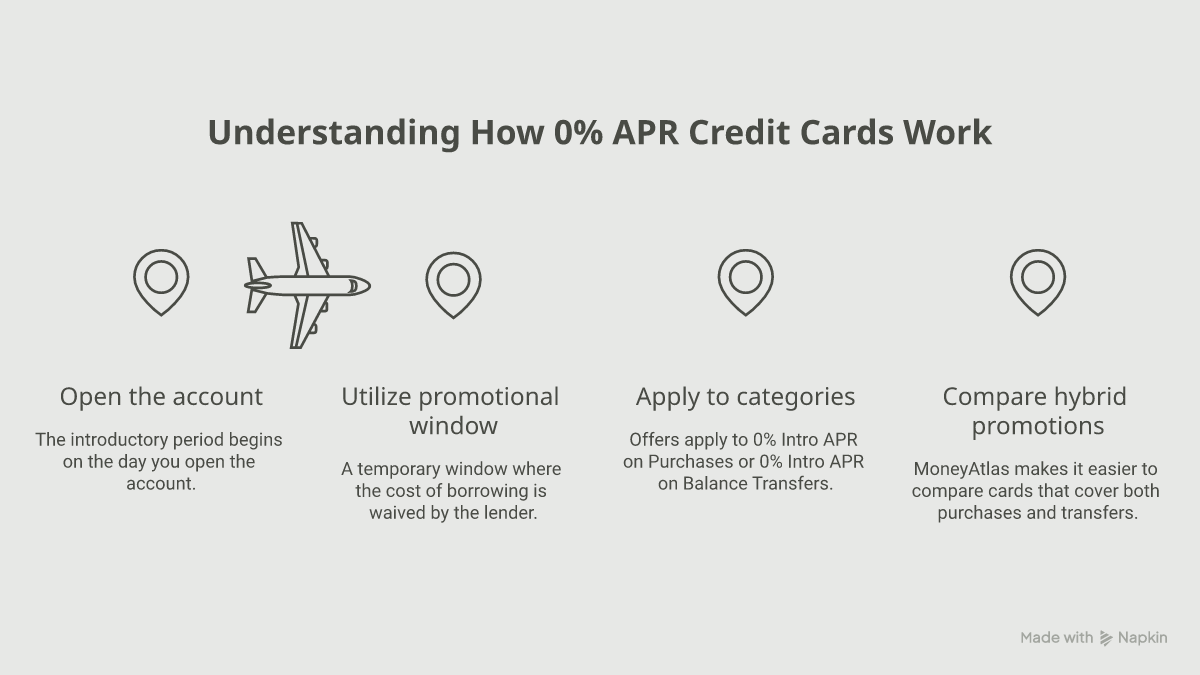
A 0% introductory APR is a promotional tool used by credit card companies to attract new customers. While the headline says 0%, this rate is not permanent. It is a temporary window where the cost of borrowing is waived by the lender.
The introductory period begins on the day you open the account. It is a common misconception that the clock starts when you make your first purchase. If you wait three months to start using the card, you have effectively lost three months of your interest-free window. Most offers apply to one of two categories, or sometimes both:
0% Intro APR on Purchases: This applies to new items you buy with the card. It is often used for financing big-ticket items like appliances, furniture, or emergency car repairs.
0% Intro APR on Balance Transfers: This applies to debt you move from an existing high-interest credit card to the new card. For a deeper breakdown, see how balance transfers work.
MoneyAtlas makes it easier to compare side by side which cards offer "hybrid" promotions that cover both purchases and transfers. Some cards prioritize one over the other, offering a longer window for transfers but a shorter one for new spending.
How a 0% intro APR period actually works
Different Types of 0% Interest Offers
Not all interest-free offers are created equal. Depending on your goal, you might find that certain categories of cards serve you better than others.
Purchase-Focused Cards
These cards are designed for people who want to spread out the cost of a new expense. They often come with rewards programs, such as cash back or travel points. For example, a card might offer 0% APR for 15 months while also giving you 1.5% to 5% cash back on your spending. This allows you to earn rewards while paying off the purchase over time. If rewards matter, compare the options in cash back credit cards.
Balance Transfer Specialist Cards
Some cards are built specifically for debt consolidation. These utility cards often skip the rewards programs in exchange for the longest possible 0% APR windows. You might find offers that extend to 18 or 21 months. The goal here is to give the cardholder the maximum amount of time to pay down a principal balance without interest getting in the way. If that is your goal, use our balance transfer card comparison.
Hybrid Rewards Cards
Many of the most popular cards on the market offer a middle ground. They might provide a 15-month 0% APR window on both purchases and balance transfers. These are versatile options for someone who wants to move a small amount of debt and also use the card for daily expenses while earning rewards. If you want a broader look at cards that combine perks and intro offers, browse travel rewards cards.
Critical Factors When Comparing 0% APR Cards
When you are looking at different offers, the headline "0%" is just the starting point. To truly compare options, you need to look at the terms that will apply during and after the promotion.
The Length of the Promotional Window
The duration of the offer is usually expressed in months or billing cycles. A 12-month offer is standard, but many competitive cards offer 15, 18, or 21 months. Even a three-month difference can significantly change your required monthly payment. For a $3,000 balance, a 15-month window requires a $200 monthly payment to hit zero. A 12-month window requires $250.
Balance Transfer Fees
While the interest rate might be 0%, moving money isn't always free. Most cards charge a balance transfer fee, typically 3% to 5% of the amount transferred. If you move $5,000 to a card with a 3% fee, $150 is added to your balance immediately. You must calculate if the interest you save over 15 or 18 months outweighs this upfront cost.
The Ongoing Variable APR
Every 0% offer eventually ends. When it does, any remaining balance will begin accruing interest at the card's standard variable rate. This rate is often determined by your creditworthiness at the time of application. It is worth checking the Schumer Box on a provider's site for current rates before applying. For a broader explanation of how APR affects borrowing costs, read what APR means on a credit card.
Penalty APRs
Some card issuers include a clause that voids your 0% APR if you make a late payment. If you miss a due date, the bank may immediately jump your rate from 0% to a penalty APR, which can be as high as 29.99%. Maintaining an on-time payment history is essential to keeping your promotion active.
The Difference Between 0% APR and Deferred Interest
It is vital to distinguish between a true 0% intro APR and "deferred interest," which is common with store credit cards.
True 0% Intro APR: If you have a balance remaining when the promotion ends, you only pay interest on that remaining balance going forward.
Deferred Interest: If you do not pay off the entire balance by the end of the promotional period, the issuer charges you interest on the full purchase amount, retroactively, from the date of purchase. This can result in a massive interest charge hitting your account all at once.
Who Qualifies for 0% APR Credit Cards?
Because 0% APR offers represent a risk to the bank, they are generally reserved for applicants with stronger credit profiles.
Credit Score Requirements: Most 0% APR cards are geared toward those with good to excellent credit. This typically means a FICO score of 670 or higher. While some cards exist for those with average credit, they often come with shorter promotional windows or higher fees.
Income and Debt-to-Income Ratio: Banks also look at your ability to repay the debt. They will evaluate your annual income against your existing monthly debt obligations. If your debt-to-income ratio is too high, a lender might deny the application even if your credit score is high.
Recent Inquiries: If you have applied for several credit cards in the last six months, a bank might see this as a sign of financial distress. Spacing out applications can improve your chances of approval.
How to Compare 0% APR Offers Step-by-Step
How to Compare 0% APR Offers
1
Identify your primary goal
Determine if you need to pay off existing debt or if you are planning a large purchase in the near future.
2
Calculate your payment
Take the total amount you plan to spend or transfer and divide it by the number of months in the promotional offer.
3
Check for fees
Compare the balance transfer fees and annual fees. Most top-tier 0% APR cards have no annual fee, but the balance transfer fee is common. If you want fee-free options, compare no annual fee credit cards.
4
Review the rewards
If the promotional lengths are similar, choose the card that offers the best rewards for your typical spending habits, such as groceries or gas.
5
Use a comparison tool
MoneyAtlas makes it easier to compare side by side the specific terms, fees, and lengths of currently available 0% offers.
The Impact on Your Credit Score
Applying for a new 0% APR card will affect your credit score in several ways. Initially, the bank will perform a hard inquiry, which may cause a temporary dip of a few points in your score.
However, a new card also increases your total available credit. If you keep your spending the same, this lowers your credit utilization ratio, which is a major factor in your credit score. For a deeper look at that tradeoff, read how closing a credit card can affect your score.
Common Pitfalls to Avoid
While 0% APR cards are powerful tools, they can lead to financial trouble if used incorrectly.
Treating 0% as "No Payment": You must still make at least the minimum monthly payment. Failure to do so can result in late fees and the loss of your 0% rate.
Overspending: The lack of interest can create a false sense of security. It is easy to spend more than you can realistically pay back before the promotion ends. Always stick to a strict repayment budget.
The Balance Transfer Deadline: Most cards require you to complete a balance transfer within a specific window, such as 60 or 90 days from account opening, to qualify for the 0% rate. If you wait too long, you might be stuck with the standard interest rate.
Transferring Between the Same Bank: You generally cannot transfer a balance between two cards issued by the same bank. For example, you cannot move debt from one card to another card from the same issuer to get a 0% rate.
When Does a 0% APR Card Make Sense?
A 0% APR card is an effective tool in specific scenarios. It is worth comparing these options if you fall into one of the following categories:
Planned Large Expenses: If you are buying a $2,000 engagement ring or a new HVAC system, a 15-month 0% APR card allows you to pay roughly $134 a month without any interest costs.
High-Interest Debt Consolidation: If you are currently paying 24% interest on a $5,000 balance, you are losing over $100 a month just to interest. Moving that to a 0% card stops the bleeding and applies every dollar of your payment to the principal.
Emergency Buffer: If you lack a full emergency fund, a 0% card can act as a temporary safety net for unexpected repairs, though it should not replace long-term savings.
Managing the End of the Promotional Period
As your 0% window approaches its end, you have a few choices. If you still have a balance, you can try to pay it off aggressively in the final two months. If the balance is still significant, you might consider another balance transfer to a different 0% card, though this is subject to credit approval and additional fees.
Most people find success by setting up autopay for the target amount. If you have 18 months to pay off $3,600, setting up an autopay for $200 ensures you are not surprised when the standard APR kicks in.
MoneyAtlas helps you track when these periods end by providing clear breakdowns of the terms during the comparison process. Monitoring your statement for the promotional expiration date is a healthy financial habit.
Summary of 0% APR Benefits and Risks
Feature
Benefit
Risk
0% Interest
Saves money on interest charges.
Can encourage overspending.
Balance Transfers
Consolidates debt for easier tracking.
Upfront fees of 3% to 5%.
New Purchases
Spreads out the cost of large items.
High interest if not paid by the deadline.
Credit Limit
Lowers credit utilization ratio.
Hard inquiry may slightly lower score initially.
FAQ
Ready to pick a card?
Compare the cards our editors rate highest right now, side by side, with the fees and rewards that matter.
Learn how to lower credit card APR with 5 proven strategies. From negotiating with issuers to 0% transfers, discover how to offset rising interest rates.