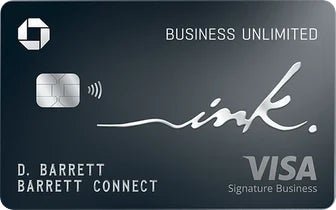
Ink Business Unlimited® Credit Card
Simple, flat-rate cash back on every business purchase
Updated October 20, 2026 · By the MoneyAtlas Editorial Team
Category Ratings
Pros
1.5% unlimited cash back with no category restrictions or spending caps: Every dollar earns the same rate whether you spend on office supplies, software subscriptions, or client dinners.
$0 annual fee eliminates cost concerns: There is no break-even threshold to worry about. The card pays for itself from the first swipe, making it a low-risk addition to any business wallet.
0% intro APR for 12 months on purchases: Established businesses can finance equipment upgrades, inventory, or operational expenses interest-free during the introductory period.
Cons
3% foreign transaction fee limits international use: Businesses with overseas vendors or frequent international expenses will lose money on every cross-border transaction.
No bonus categories means lower earning potential in specific areas: Competitors offer 5% on office supplies and telecom. High spenders in those categories earn significantly more elsewhere.
Standalone redemption value is limited without a premium Chase card: Without pairing, points redeem at 1 cent each for statement credits. You miss the 1.25x-1.5x travel portal multiplier and transfer partner access.
Why we rate it 4.5/5
A $0-fee foundation card: the flat 1.5% never runs out, but the points only get interesting paired with a Sapphire or Ink Preferred.
A flat 1.5% on everything is dependable but unremarkable next to category cards that pay 5% where your business actually spends, and the points only reach travel value through a premium companion card.
There is no annual fee, so the card costs nothing to hold and every dollar of rewards is net positive. On a value-per-dollar-of-fee basis nothing in the Ink family beats it.
Free employee cards with spending controls and auto rental collision coverage are useful, but there is no cell phone protection and a 3% foreign transaction fee rules the card out for cross-border spending.
Nothing to activate, no categories to track and no caps to watch. The only real friction is Chase's 5/24 rule at the application stage.
Card Overview — Who Is the Ink Business Unlimited For?
The Chase Ink Business Unlimited is designed for established businesses and LLCs that want a simple, predictable rewards structure without paying an annual fee. It is not a flashy card with rotating categories or tiered earning rates. Instead, it delivers a flat 1.5% cash back on every purchase, period. That simplicity is its greatest strength and the reason it remains one of the most widely held business credit cards in the Chase portfolio.
Think of it as the business counterpart to the Chase Freedom Unlimited. If your company has consistent monthly expenses across multiple categories — advertising, shipping, software, utilities, supplies — and you do not want to micro-manage which card to use for which purchase, the Ink Business Unlimited belongs in your wallet. It is particularly well-suited for LLCs, S-Corps, and sole proprietorships with annual revenue that supports regular operational spending.
This is not a card aimed at hobbyists or speculative ventures. Its strength lies in serving businesses with predictable, repeating expenses where the consistency of a flat reward rate outweighs the theoretical upside of chasing bonus categories.
Sign-Up Bonus and Welcome Offer
The current sign-up bonus is $1,000 in cash back after you spend $8,000 on purchases in the first 4 months from account opening. Chase adjusts this offer periodically, so always confirm the live terms before applying.
For most established businesses, meeting the minimum spend requirement is straightforward. Monthly operating expenses like software subscriptions, shipping costs, advertising spend, and office supplies add up quickly. A business spending $2,000 to $2,500 per month on operations will clear the threshold without altering its normal purchasing behavior. The key is to time your application around a period of naturally higher spending — such as the start of a new quarter or a planned equipment purchase — rather than forcing purchases you would not otherwise make.
It is worth noting that Chase sometimes runs elevated offers through targeted mailers or specific referral links. Checking multiple channels before applying can occasionally net a higher bonus. However, these offers are not guaranteed and should not delay an application if the standard offer already provides strong value relative to your expected spending.
Rewards Structure — 1.5% Unlimited Cash Back
Every purchase on the Ink Business Unlimited earns 1.5 Chase Ultimate Rewards points per dollar. There are no bonus categories, no quarterly activation requirements, and no spending caps. A dollar spent on raw materials earns the same rate as a dollar spent on a business lunch or a SaaS subscription.
This flat-rate approach has a clear advantage: predictability. You always know exactly what you are earning. For businesses that spread spending across many categories — and most do — a flat 1.5% often outperforms cards with higher bonus rates in narrow categories because the bulk of real-world spending falls outside those bonuses. Consider a business that spends $8,000 per month across ten different expense types. A card earning 5% on two categories but 1% on everything else may yield less total rewards than a card earning 1.5% on the entire $8,000.
The real unlock happens when you pair the Ink Business Unlimited with a premium Chase card. Combined with the Chase Sapphire Preferred or Chase Sapphire Reserve, your flat-rate points become transferable to over a dozen airline and hotel partners including Hyatt, United, Southwest, and Marriott. That transforms a simple 1.5% cash back card into a legitimate points-earning engine. A business spending $100,000 annually on the Ink Business Unlimited generates 150,000 Ultimate Rewards points, which could be worth $2,250 or more through transfer partners.
Annual Fee and Cost Analysis
The Ink Business Unlimited carries a $0 annual fee, which makes it one of the easiest business cards to justify keeping long-term. There is no break-even calculation here. Even if your business spending is modest during a slow month, the card costs nothing to hold and resumes earning as soon as activity picks up.
The 0% intro APR on purchases for 12 months is a meaningful benefit for businesses planning a large purchase or looking to spread out a significant expense. Whether you are outfitting a new office, purchasing inventory ahead of a busy season, or investing in equipment, the ability to finance interest-free for a full year provides genuine operational flexibility. After the introductory period, the variable APR ranges from 16.74% to 24.74%, which is competitive but not exceptional. Carrying a balance long-term is never advisable and should be avoided.
The one cost to watch is the 3% foreign transaction fee. If your business regularly pays international suppliers, purchases from foreign-based SaaS providers, or operates across borders, this card is not the right fit for those transactions. Domestic-only businesses will never encounter this charge, but companies with even occasional international spending should designate a different card for cross-border purchases.
Ink Business Unlimited Credit Limit
Chase doesn't publish a fixed credit limit for the Ink Business Unlimited. It sets the line per application, weighing your personal credit, the revenue and time in business you report, and any existing Chase relationship. Cardholders commonly report approvals starting at $3,000 and running to $25,000 or more for businesses with strong personal credit and steady revenue. Treat any figure you see online as anecdote, not a promise.
If the line comes in low, you have two levers. You can request a credit line increase by calling the number on the back of the card, ideally after a few months of on-time payments and rising spend. Or, if you already hold another Chase card, you can ask Chase to move part of that card's limit over, which doesn't require a new application. One upside: Chase business cards generally don't show up on your personal credit reports unless the account goes delinquent, so a tight limit here won't drag on your personal utilization.
Benefits and Protections
The Ink Business Unlimited includes several underrated protections that many business owners overlook. While it does not match the insurance suite of premium cards, the included benefits are solid for a no-annual-fee product:
- Purchase Protection: Covers new purchases against damage or theft for 120 days, up to $10,000 per claim and $50,000 per account. This is particularly useful for electronics, office furniture, and other high-value business purchases.
- Extended Warranty: Adds one extra year to eligible manufacturer warranties of three years or less. For business equipment with standard one-year warranties, this effectively doubles your coverage at no cost.
- Fraud Protection: Zero liability for unauthorized charges, plus real-time purchase alerts through the Chase mobile app. You can instantly lock or unlock your card if suspicious activity occurs.
- Auto Rental CDW: Collision damage waiver when you rent a car for business purposes and decline the rental company's coverage. This provides primary coverage in the U.S. and saves your business the $15 to $30 per day rental companies charge for their own CDW.
What is notably absent compared to the Chase Sapphire Preferred is travel insurance. There is no trip cancellation coverage, no trip delay reimbursement, and no lost baggage insurance. If those protections matter to your business travel, you will need a separate premium card in your wallet to cover those situations.
Travel Benefits Deep-Dive
On its own, the Ink Business Unlimited is not a travel card. It does not offer airport lounge access, Global Entry or TSA PreCheck credits, or travel insurance. However, it becomes significantly more valuable for business travel when paired with a premium Chase card.
When combined with the Chase Sapphire Reserve, your Ink Business Unlimited points can be redeemed through the Chase travel portal at 1.5 cents per point — a 50% uplift over the standard 1 cent. With the Sapphire Preferred, that multiplier is 1.25x. Even better, you gain access to Chase's full suite of transfer partners, where savvy redemptions can yield 2 cents or more per point. A Hyatt transfer, for example, can deliver 2 to 4 cents of value per point on premium redemptions.
The auto rental collision damage waiver is the one travel-adjacent benefit that comes standard. It provides primary coverage for business car rentals in the U.S. and secondary coverage internationally, which can save your business hundreds of dollars per rental by declining the rental company's insurance. For businesses that require frequent car rentals for client visits, site inspections, or sales territory coverage, this benefit alone provides tangible annual savings.
Employee Cards and Authorized Users
You can add employee cards at no additional cost, and there is no limit on the number you can request. Each employee card earns the same 1.5% unlimited cash back, and all rewards flow into your primary account. Chase provides spending controls that let you set individual limits for each card, monitor transactions in real time through the Chase business dashboard, and revoke access instantly if an employee leaves or spending patterns raise concerns.
For businesses with multiple employees making regular purchases — field teams buying supplies, sales staff entertaining clients, operations managers ordering inventory — this feature consolidates spending onto a single account, simplifies month-end expense tracking, and maximizes rewards. Every dollar your team spends earns 1.5% back into your account. Over the course of a year, a team of five employees each spending $1,000 per month generates an additional 90,000 Ultimate Rewards points at no extra cost.
The spending controls are particularly valuable for maintaining oversight without micromanaging day-to-day purchases. You set the guardrails and your team operates within them, while you retain full visibility into where every dollar goes.
Points Redemption Options
How much your Ink Business Unlimited points are worth depends entirely on how you redeem them. The same 150,000 points can be worth anywhere from $1,500 to $4,500 depending on your redemption strategy.
The gap between standalone and paired redemption is significant. At 1 cent per point, $10,000 in annual spending earns $150 in value. Pair that with a Sapphire Reserve and the same points are worth $225 through the portal, or potentially $300 or more through transfer partners. Over multiple years of business spending, that difference adds up to thousands of dollars. That multiplier effect alone can justify the annual fee of a premium companion card many times over.
One important note: avoid redeeming points through Amazon or for gift cards, as these options typically deliver 0.7 to 0.8 cents per point. Statement credits at 1 cent per point are the floor for reasonable value. Transfer partners represent the ceiling, but require more effort and planning to execute well.
Compare
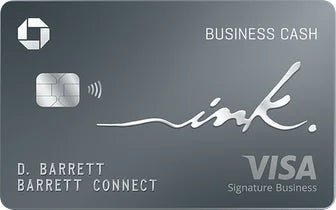


Ink Business Unlimited vs. Ink Business Cash
This is the most common comparison for businesses evaluating Chase's no-fee business card options. Both carry a $0 annual fee and earn Ultimate Rewards points, but they take fundamentally different approaches to rewards.
The decision comes down to your spending patterns. If your business spends heavily on office supplies, internet service, and phone bills, the Ink Business Cash can earn meaningfully more in those categories — 5% versus 1.5% is a substantial difference. On $25,000 of annual bonus-category spending, the Ink Cash earns $1,250 versus $375 from the Unlimited. But once you exceed the $25,000 combined annual cap on bonus categories, the Ink Cash rate drops to 1%. The Ink Business Unlimited never drops — it earns the same 1.5% whether you spend $5,000 or $500,000 per year.
For many established businesses, the optimal strategy is to carry both cards. Use the Ink Business Cash for its 5% categories until you approach the cap, then shift all remaining spending to the Ink Business Unlimited. Both cards pool points into the same Ultimate Rewards account, so there is no administrative complexity in managing two balances.
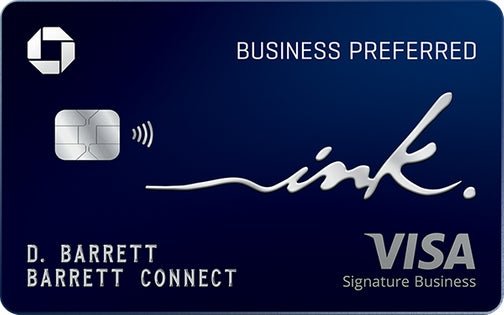
Ink Business Unlimited vs. Ink Business Preferred
The Ink Business Preferred carries a $95 annual fee but unlocks the full Ultimate Rewards ecosystem on its own, without needing a personal Sapphire card. This comparison is less about which card to choose and more about whether you need one or both.
The Ink Business Preferred is the gateway to transfer partners for businesses that do not want a personal Sapphire card. If you spend significantly on advertising, shipping, or travel, its 3x bonus categories can substantially outpace the Ink Business Unlimited's flat 1.5%. A business spending $50,000 annually on digital advertising alone earns 150,000 points at 3x on the Preferred versus 75,000 points at 1.5x on the Unlimited — a difference worth at least $750.
But for general spending that falls outside the Preferred's bonus categories, the Unlimited still earns more per dollar: 1.5 points versus 1 point. The strongest play for established businesses is pairing the Ink Business Preferred with the Ink Business Unlimited. The Preferred handles bonus-category spending and provides transfer partner access, while the Unlimited captures everything else at 1.5%. Together, they cover virtually every business expense at an optimal rate for a combined cost of just $95 per year.
Ink Business Unlimited vs. Ink Business Premier
The Ink Business Premier is the one Ink card that plays the same game as the Unlimited and plays it with bigger numbers. It earns 2.5% back on any single purchase of $5,000 or more and 2% on everything else, against a $195 annual fee. Both rates beat the Unlimited's flat 1.5%, so the only question is whether your spending clears the fee.
The math is simple. At a 2% baseline versus 1.5%, you need roughly $39,000 of annual card spending to recover the $195 fee, and less than that if large invoices push you into the 2.5% tier. Below that line the Unlimited wins on cost alone. Credit cards remain one of the most common financing tools for small firms, according to Federal Reserve small business credit data, so this threshold decides the choice for a lot of owners.
There is one thing the Premier does not do. Its rewards are cash back, so they do not pool with Ultimate Rewards points for transfer to airline and hotel partners. If travel redemptions are the reason you are in the Chase ecosystem, the Unlimited paired with a premium Sapphire card keeps that door open and the Premier closes it. If you simply want the highest plain cash return on large purchases, the Premier is the better instrument. Outside Chase, Capital One Spark Miles is the closest flat-rate alternative, trading the cash-back framing for transferable miles.
Across the family the roles are clean: the Ink Business Cash takes bonus categories, the Ink Business Preferred takes travel and advertising with transfer access, the Premier takes large-ticket spend, and the Unlimited takes everything none of them handle well.
How to Apply — Requirements and 5/24 Rule
Applying for the Ink Business Unlimited requires a legitimate business. This includes sole proprietorships, LLCs, S-Corps, C-Corps, and partnerships. You will need your business name, EIN or Social Security number, estimated annual revenue, number of employees, and years in business. Chase may also ask about your business category and monthly expenses.
Chase's 5/24 rule is the single most important factor to understand before applying. If you have opened five or more personal credit cards across all issuers in the past 24 months, Chase will automatically decline your application regardless of your credit score or income. Business cards from most other issuers do not count toward 5/24, but Chase's own business cards do count when opened. Check your credit report before applying to confirm you are under the threshold.
Chase generally looks for a good to excellent credit score, though applicants with stronger credit profiles have the best approval odds. Existing Chase banking relationships — particularly a Chase Business Complete Checking account — can strengthen your application. If your business already banks with Chase, the application process is often faster because Chase can verify your revenue and cash flow from existing account data.
One additional consideration: Chase typically limits applicants to one business card approval every 90 days. If you recently opened another Chase business card, it may be worth waiting before submitting your Ink Business Unlimited application to maximize your approval chances.
Approval Odds and Who Qualifies
Chase doesn't publish a minimum credit score for this card, but approvals skew toward applicants with good to excellent personal credit, because you personally guarantee the account. You don't need an LLC or a corporation. Sole proprietors, including freelancers and side businesses, can apply with a Social Security number and list themselves as the owner, and a young business with modest revenue can still qualify.
Expect a hard inquiry on your personal credit report. Chase most often pulls Experian, though applicants report Equifax and TransUnion pulls depending on their state, so unfreeze all three bureaus before you apply. If you're denied, call reconsideration: Chase sometimes approves after a conversation that clarifies your revenue or shifts credit from a card you already hold.
The Bottom Line
The Chase Ink Business Unlimited is not the most exciting credit card you will ever carry. It does not have rotating bonus categories like the Chase Freedom Flex, premium travel perks, or a metal build. What it does offer is consistent, reliable value on every single purchase your business makes — and it costs nothing to hold. That combination of simplicity, reliability, and zero cost makes it one of the strongest foundation cards in the business credit card market.
For established businesses and LLCs with diverse spending, the flat 1.5% rate often outperforms category-based cards in practice because most real-world business spending does not fit neatly into bonus buckets. Office rent, professional services, insurance premiums, miscellaneous supplies — these everyday expenses all earn 1.5% on the Unlimited where they would earn just 1% on most category-based alternatives.
Add in the 0% intro APR for 12 months, free employee cards with spending controls, and the ability to pool points with premium Chase cards for transfer partner access, and you have a foundation card that belongs in virtually every business card strategy. The ideal setup is pairing the Ink Business Unlimited with the Ink Business Preferred and, optionally, the Ink Business Cash. That three-card combination covers every business expense at an optimized rate while unlocking the full power of Chase Ultimate Rewards. Start with the Unlimited if you want simplicity, then expand as your business needs evolve.
If you like the flat-rate idea but would pay an annual fee for a higher base rate, run the numbers against the Capital One Spark Cash Plus before you apply. For lower-spending businesses, the Ink's $0 fee usually comes out ahead.