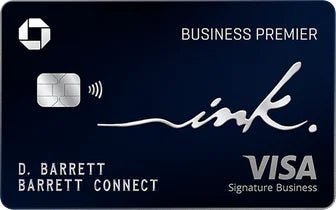
Ink Business Premier Credit Card
Highest flat-rate cash back on big-ticket business spend
Updated October 20, 2026 · By the MoneyAtlas Editorial Team
Pros
2.5% cash back on $5,000+ purchases: The highest flat-rate cash-back tier in the Chase business lineup rewards owners who batch large equipment, inventory, or vendor payments into single transactions.
2% on everything else with no caps: The universal 2% baseline beats most flat-rate business cards and applies to every purchase below the $5,000 threshold without category restrictions or annual limits.
Strong protection package included: Cell phone protection up to $1,000 per claim, purchase protection, extended warranty, and zero foreign transaction fees add real dollar value beyond the cash-back math.
Cons
$195 annual fee is steep: Businesses spending less than roughly $20,000 a year in qualifying $5,000+ transactions may earn more total rewards on the no-fee Ink Business Unlimited or the lower-fee Ink Business Preferred.
Cash back instead of transferable points: Rewards cannot be moved to Chase Ultimate Rewards travel partners like Hyatt or United, capping redemption value at 1¢ per dollar versus the 2¢+ that transfer partners can deliver.
No airport lounge access: Unlike premium personal cards or the Amex Business Platinum, the Ink Business Premier does not include lounge benefits — frequent business travelers may want to pair it with a separate travel card.
Why we rate it 4.3/5
Worth the $195 only if you regularly put single purchases of $5,000 or more on it; below roughly $30,000 a year, a no-fee card wins.
2.5% on purchases of $5,000 or more and 2% on everything else is the strongest flat-rate cash-back pair Chase puts on a business card.
The $195 fee only clears its own cost above roughly $30,000 of annual spend, and only if a real share of that lands in $5,000-plus transactions.
Cell phone protection, purchase protection, extended warranty and no foreign transaction fees carry genuine dollar value. No lounge access.
No rotating categories, nothing to activate, no caps. Employee cards are free and roll into a single balance.
The Chase Ink Business Premier credit card sits at the top of Chase's small-business cash-back lineup, designed for owners who routinely make large purchases of $5,000 or more. With a $195 annual fee, a flat 2% return on most spending, and an outsized 2.5% rate triggered by qualifying $5,000-plus transactions, it targets businesses that buy equipment, inventory, or services in bulk. Compared to Chase's other Ink products — including the Ink Business Cash, Ink Business Unlimited, and Ink Business Preferred — the Premier rewards higher overall spending without forcing you to track rotating bonus categories.
Card Overview — Who Is the Ink Business Premier For?
The Ink Business Premier is built for established small businesses that regularly transact in five-figure increments. Think construction firms paying suppliers, marketing agencies running large media buys, or e-commerce operators replenishing inventory. The card's defining feature is the 2.5% cash-back tier on every purchase of $5,000 or more — a single transaction threshold that tilts the card toward bigger spenders rather than businesses with steady micro-transactions.
Below that threshold, all other purchases earn a flat 2% cash back with no category restrictions or annual caps. This makes the Ink Business Premier the highest flat-rate cash-back card in the Chase Ink family, beating the Ink Business Unlimited's 1.5% baseline. The trade-off is the $195 annual fee and the requirement to pay your balance in full each statement, with the optional Flex for Business feature available for qualifying purchases that need to be paid over time at a variable APR.
Sign-Up Bonus and Welcome Offer
New cardholders earn $1,000 bonus cash back after spending $10,000 on purchases in the first three months from account opening. Compared to the Ink Business Preferred's 100,000-point welcome offer, the Premier's reward is denominated as straight cash back rather than transferable Chase Ultimate Rewards points. For businesses that prefer simplicity over redemption optimization, the cash-back framing is a feature, not a flaw.
The $10,000 spending requirement is meaningful but achievable for most established businesses — that's roughly $3,334 per month in regular operating expenses. If the bonus cash back lands in your account before the first $195 annual fee posts, you're effectively in the black on the card from day one and have nearly five years of fee runway funded by the welcome offer alone.
Rewards Structure — 2.5% and 2% Cash Back
The Ink Business Premier's earning structure is intentionally simple. Every purchase of $5,000 or more — measured per transaction, not in monthly aggregate — earns 2.5% total cash back. Every other purchase earns 2% cash back. There are no rotating categories to activate, no caps on rewards, and no foreign transaction fees if your business operates internationally.
The 2.5% tier is what differentiates the card. A single $7,500 piece of equipment generates $187.50 in cash back, while the same purchase split across smaller orders would only earn the 2% baseline. Knowing this, owners with discretion over how purchases are batched can sometimes restructure orders to qualify for the 2.5% tier. Travel booked through Chase Travel earns a separate 5% cash-back rate, and the card includes Trip Cancellation and Trip Interruption Insurance for covered events.
Annual Fee and Cost-Benefit Analysis
The $195 annual fee is the main hurdle. To break even versus the no-fee Ink Business Unlimited (1.5% flat), a business needs roughly $39,000 in annual spend on the Premier just to recoup the fee through the higher 2% baseline. To break even versus the Ink Business Preferred at $95, you'd need to spend about $20,000 annually on $5,000-plus transactions to earn enough additional cash back from the 2.5% tier.
For larger businesses, the math gets more favorable. A business spending $100,000 a year, with $30,000 of that in $5,000-plus purchases, earns roughly $1,955 in cash back (after netting the fee) — meaningfully more than the equivalent take on the Ink Business Unlimited or Ink Business Preferred. According to the Small Business Administration, small businesses devote a significant share of operating budgets to large recurring expenses, exactly the spending pattern this card is designed to reward.
Breakeven depends entirely on how much of your spending clears $5,000 in a single transaction. The table below assumes 30% does, which blends the Premier to 2.15% against a flat 1.5% no-fee card. At that mix the crossover sits at $30,000 of annual spend. If nothing you buy clears the threshold, you are earning a flat 2% and the crossover moves out to about $39,000. Spending patterns differ sharply by industry, so it is worth checking yours against the Federal Reserve Small Business Credit Survey before assuming the mix holds.
Benefits and Protections
Beyond cash back, the Ink Business Premier includes a meaningful protection package. Cell phone protection covers up to $1,000 per claim against damage or theft when you pay your monthly wireless bill with the card, with a $100 deductible and up to three claims per 12-month period. For a small business with three or four employees on company-paid phone plans, that benefit alone can offset a meaningful share of the annual fee in any year a screen breaks or a device is stolen.
Purchase protection covers eligible new purchases for 120 days against damage or theft, and extended warranty coverage adds an extra year onto eligible manufacturer warranties of three years or less. Travel benefits include Trip Cancellation and Trip Interruption Insurance, baggage delay reimbursement, and zero foreign transaction fees — useful for businesses with vendors abroad. The card runs on the Visa network, which means broad acceptance across U.S. and international merchants.
Notably, the Ink Business Premier does not include airport lounge access, which is one of the headline benefits of premium personal cards like the Chase Sapphire Reserve. Cardholders who run into problems with a charge — a duplicate billing, a chargeback dispute, or an unrecognized transaction — can also escalate complaints through the CFPB Consumer Complaint Database, which provides a public record and federal mediation channel for credit-card disputes that the issuer cannot resolve internally.
Transfer Partners and Points Flexibility
Unlike the Ink Business Preferred, the Premier earns cash back rather than transferable Chase Ultimate Rewards points. That means rewards cannot be moved to airline and hotel partners like Hyatt, United, or Southwest for outsized redemption value. Cash back redeems at a flat 1¢ per dollar — straightforward and predictable, but without the upside that travel hackers chase.
If maximizing point value matters more than simplicity, pairing the Premier with a points-earning card like the Chase Sapphire Preferred or Chase Sapphire Reserve is one path — though the Sapphire products are personal cards, not business cards, and have their own annual fees. For purely business spending, owners who want transfer-partner access typically choose the Ink Business Preferred over the Premier and accept the lower base earn rate. Chase does issue a business-side version, the Chase Sapphire Reserve for Business, if you want transfer partners on a card that is actually underwritten to the business.
Employee Cards and Authorized Users
Chase issues employee cards at no additional cost on the Ink Business Premier. Spending on employee cards earns the same 2.5% and 2% rewards rates and rolls into a single account balance, simplifying expense tracking. You can set individual spending limits per employee through the Chase business banking portal, receive real-time purchase alerts on flagged transactions, and shut off any employee card immediately if a phone is lost or an employee leaves the company.
These controls matter more than they sound. Many small-business owners end up reimbursing employees for personal-card purchases, which forfeits the 2% to 2.5% rewards and adds bookkeeping overhead at month-end. Centralizing spending on no-fee employee cards and simply paying the balance off each month captures rewards on every dollar of the business's spending — including travel, fuel, and supplies — without commingling personal and business finances. The transaction-level reporting that posts to the Chase business portal also makes year-end accounting and tax categorization noticeably faster, since every charge is already tagged by employee, merchant, and amount.
Ink Business Premier vs. Ink Business Preferred
The most common question prospective applicants ask is which Ink card is best for them — the Ink Business Preferred or the Premier. The Preferred carries a $95 annual fee and earns 3 Ultimate Rewards points per dollar on travel, shipping, internet, cable, phone, and online advertising (capped at $150,000 per year), plus 1 point per dollar everywhere else. Its welcome offer is currently 100,000 points after $8,000 in three months — points that can be transferred to airline and hotel partners.
The Premier costs $100 more annually but earns flat 2% cash back universally and 2.5% on $5,000-plus purchases. Choose the Preferred if you want maximum flexibility through transfer partners and your business spending is concentrated in the 3x bonus categories. Choose the Premier if you make frequent large purchases, prefer cash over points, or routinely exceed the Preferred's $150,000 annual category cap. For some businesses, holding both cards makes sense — earning 3x on bonus categories and 2.5% on $5,000-plus purchases that don't fit a category.
Ink Business Premier vs. Amex Business Platinum
The American Express Business Platinum is the closest premium business comparison, though the cards target different jobs. The Amex Business Platinum charges a $695 annual fee and emphasizes travel — airport lounge access through the Centurion network and Priority Pass, an annual airline incidental credit, and 5x Membership Rewards points on flights and prepaid hotels booked through Amex Travel. It earns just 1.5x points on most other business purchases.
The Ink Business Premier is the better straight-cash card. Where the Amex Business Platinum's value depends on extracting full value from travel credits and lounge perks, the Premier's value comes from straightforward earn-and-redeem on bulk operating spend. Acceptance also differs — Visa is more broadly accepted than American Express, particularly with smaller suppliers and international vendors. For businesses that travel frequently and can monetize the perks, the Amex Business Platinum can be worth its higher fee. For everyone else, the Premier's lower fee and simpler structure are the easier value.
How to Apply — Requirements and the 5/24 Rule
Applicants generally need good to excellent personal credit and a legitimate business — sole proprietorship, LLC, corporation, or partnership all qualify. Chase will pull your personal credit, and approval also factors in business revenue and time in operation. JPMorgan Chase issues the card under the Visa network and reports activity to commercial credit bureaus. The IRS treats most ordinary and necessary business expenses as deductible, so charging large equipment or supply purchases to a business card simplifies year-end recordkeeping.
Chase does not publish a minimum credit score for the card. In practice approvals cluster in the good to excellent range, roughly 690 and up on the FICO scale, with the strongest odds above 740. Business revenue and time in operation are weighed alongside it, and a sole proprietor can apply using either an EIN or a Social Security number. One thing worth knowing before you ever carry a balance: business cards sit outside most of the Regulation Z consumer protections that cover personal cards, including the CARD Act limits on rate increases and fee changes.
The Chase 5/24 rule applies: if you've opened five or more credit cards across all issuers in the past 24 months, your application will likely be denied. Business cards from most issuers (including Chase business cards themselves) typically don't appear on personal credit reports, so they don't count against your 5/24 total — but personal cards do, and the rule looks at all opened accounts on your personal credit file. Applicants close to the 5/24 threshold often time business-card applications carefully to preserve eligibility for high-value Chase cards.
The Bottom Line
The Chase Ink Business Premier earns its place in a small-business owner's wallet for one reason: businesses with regular $5,000-plus transactions extract value here that other Ink cards can't match. The 2.5% tier on large purchases and 2% on everything else is the highest flat-rate cash-back combination Chase offers on a business card, and the $1,000 welcome bonus eclipses the $195 annual fee for years. If your business doesn't routinely make large transactions, a no-fee card like the Ink Business Unlimited or Ink Business Cash is likely the better fit. Compare alternatives in our best credit cards roundup before applying.