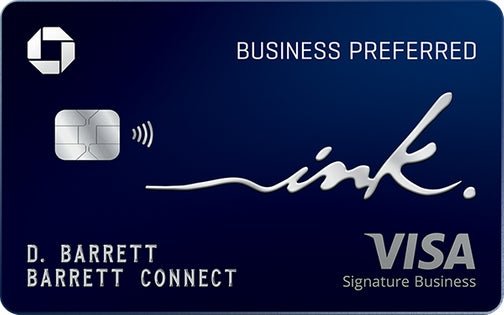
Ink Business Preferred® Credit Card
Flexible travel rewards on your top business expenses
Updated October 20, 2026 · By the MoneyAtlas Editorial Team
Pros
3x earning on key business categories: Travel, shipping, internet, advertising, and phone services cover most business overhead without requiring you to think about rotating categories.
Access to Ultimate Rewards transfer partners: Hyatt, United, Southwest, and more give your points outsized value — often 2¢+ per point — compared to statement credits.
Cell phone protection covers up to $1,000 per claim: Pay your wireless bill with this card and get coverage for damage or theft with a $100 deductible, up to 3 claims per year.
Cons
No intro APR offer for purchases or balance transfers: If you need to finance a large purchase, you will pay the full variable APR from day one.
3x bonus categories capped at $150,000 annually: High-spending businesses that exceed this threshold earn only 1x on the overage, which limits the card's value at scale.
Not ideal without significant travel, shipping, or advertising spend: The 3x categories are specific, and businesses that primarily spend on inventory or payroll will earn mostly 1x.
Card Overview — Who Is the Ink Business Preferred For?
The Ink Business Preferred® Credit Card is Chase’s flagship small-business rewards card, built for owners and freelancers who spend meaningfully on travel, shipping, internet services, phone plans, and digital advertising. It sits at the intersection of strong earning rates and access to one of the most valuable points currencies in the market: Chase Ultimate Rewards.
Here is a quick snapshot of the card’s key terms:
This is not a card for every business. If your spending is concentrated in areas like inventory, raw materials, or payroll, the 1x base rate will not impress you. But for service-based businesses, consultants, e-commerce sellers, and anyone running paid ads, the Ink Business Preferred is purpose-built for your expense profile.
Sign-Up Bonus and Welcome Offer
New cardholders can earn 100,000 bonus Ultimate Rewards points after spending $8,000 on purchases in the first 3 months from account opening. That spend requirement is higher than most personal cards, but it is reasonable for a business card—many owners can reach it through normal operating expenses like ad spend, software subscriptions, or a single business trip.
At a minimum, those 100,000 points are worth $1,000 as a statement credit. But the real value comes from transfer partners. Transferred to Hyatt, those points can deliver $2,000 or more in hotel stays. Transferred to United or Southwest, they can cover multiple domestic round trips. The sign-up bonus alone justifies the $95 fee for more than a decade at face value.
Keep in mind that Chase typically restricts the sign-up bonus to new cardholders who have not received a bonus on the same product in the past 48 months. If you previously held the Ink Business Preferred and earned the bonus, check whether the waiting period has elapsed before applying again.
Rewards Categories and Points Earning
The Ink Business Preferred earns 3x points per dollar on the first $150,000 spent annually across these combined categories:
- Travel (flights, hotels, car rentals, trains, tolls, parking)
- Shipping purchases
- Internet, cable, and phone services
- Advertising purchases made with social media sites and search engines (Google Ads, Meta Ads, LinkedIn Ads, etc.)
Everything else earns 1x per dollar with no cap.
The $150,000 annual cap is generous for most small businesses. To hit it, you would need to average $12,500 per month across the bonus categories. Businesses spending above that threshold should consider whether a flat-rate card on the overage makes more sense for the incremental spend.
One important detail: the 3x advertising category is unusually broad. It covers not just Google and Meta but also platforms like TikTok Ads, Amazon Advertising, and Bing Ads. For businesses running significant paid media, this single category can generate tens of thousands of points per year.
The travel category is equally flexible. It includes not only traditional travel purchases like flights and hotels but also ride-sharing services, tolls, and parking meters. If your business involves any regular travel, these everyday expenses add up quickly at the 3x rate.
Ultimate Rewards Transfer Partners
The Ink Business Preferred unlocks 1:1 point transfers to Chase’s airline and hotel partners. This is the same partner list available on the Chase Sapphire Preferred® and Sapphire Reserve®, making the Ink Business Preferred one of only a few business cards that provide this level of transfer flexibility.
Key transfer partners include:
- World of Hyatt — consistently delivers 2¢+ per point, often considered the highest-value transfer option
- United Airlines — strong for domestic and short-haul international flights
- Southwest Airlines — excellent for domestic travelers, especially with Companion Pass
- British Airways Avios — useful for short-haul partner awards on American Airlines
- Air France/KLM Flying Blue — periodic promo awards offer outsized value to Europe
- IHG One Rewards, Marriott Bonvoy — hotel options for different price points
- Virgin Atlantic Flying Club — sweet spots for ANA first class and Delta One redemptions
The transfer partner ecosystem is what separates the Ink Business Preferred from flat-rate business cards. A $95 annual fee for access to Hyatt and United alone would be a fair deal. Combined with 3x earning on business categories, the value proposition is hard to beat.
Transfers are instant to most partners, which means you can book award flights or hotel stays within minutes of initiating the transfer. Points can also be pooled across multiple Chase cards under the same household, so your business earning can feed into a personal Sapphire Reserve account for even higher portal redemption rates.
Annual Fee and Cost-Benefit Analysis
The Ink Business Preferred charges a $95 annual fee with no fee waiver for the first year. Here is a simple break-even calculation:
If you value Ultimate Rewards points at a conservative 1.5¢ each (the approximate value when transferred to partners), you need to earn roughly 6,334 bonus points above what a no-annual-fee card would give you. Spending just $3,167 in 3x categories generates that surplus (3x minus 1x = 2 bonus points per dollar, times $3,167 = 6,334 points).
Most businesses that fit the card’s target profile spend far more than $3,167 per year in the bonus categories. A business spending $2,000 per month on advertising and $500 per month on shipping alone would earn roughly 90,000 bonus points per year from those two categories—worth $1,350+ when transferred to partners. After subtracting the $95 fee, that is over $1,200 in net annual value before factoring in the sign-up bonus or any travel benefits.
For businesses with lower spending volumes, the math still works in most cases. Even $500 per month in total 3x spend generates 18,000 points per year, worth $270 at 1.5¢ each—a $175 net return after the annual fee. The break-even threshold is genuinely low for this card.
Benefits and Protections
The Ink Business Preferred includes a benefit package that punches above its $95 price tag:
- Cell phone protection: Up to $1,000 per claim with a $100 deductible when you pay your monthly wireless bill with the card. Covers damage and theft for you and employees listed on your phone plan. Up to 3 claims per 12-month period.
- Trip cancellation/interruption insurance: Up to $5,000 per person and $10,000 per trip for prepaid, non-refundable travel expenses.
- Purchase protection: Covers new purchases against damage or theft for 120 days, up to $10,000 per claim.
- Extended warranty: Adds one extra year to the manufacturer’s warranty on eligible items (original warranty of 3 years or less).
- No foreign transaction fees: International purchases incur no extra cost, a genuine advantage for businesses sourcing overseas.
- Auto rental collision damage waiver: Primary coverage when renting for business purposes.
The cell phone protection benefit alone can save hundreds of dollars per year compared to carrier insurance plans, which typically cost $10–15 per month per device. For a business owner with two or three phones on the plan, this single benefit can offset the entire annual fee.
The primary auto rental CDW is another standout. Unlike most personal cards that offer secondary coverage, the Ink Business Preferred’s rental coverage is primary for business rentals, meaning it pays before your personal auto insurance. This can save you $15–30 per day that rental companies charge for their own coverage.
Employee Cards and Authorized Users
You can add employee cards at no additional cost. Each employee card earns points at the same rate as the primary card, and all spending counts toward the sign-up bonus. There is no limit to the number of employee cards you can issue.
You maintain full control over employee spending through Chase’s online business dashboard, which allows you to set individual spending limits, track transactions, and download expense reports. Points from all cards pool into a single account under the primary cardholder.
This is a significant advantage for businesses with employees who travel or make purchases on the company’s behalf. Rather than reimbursing employee expenses on personal cards, you capture 3x points on their eligible purchases while maintaining visibility into spend. For a business with three employees each spending $1,000 per month in bonus categories, that is an extra 72,000 points per year that would otherwise go uncaptured.
Points Redemption Strategies
Ultimate Rewards points earned with the Ink Business Preferred can be redeemed several ways. The best strategies depend on how much effort you want to invest. If you also hold the Chase Sapphire Reserve®, you can pool points across cards for even greater flexibility and a higher portal redemption rate of 1.5¢ per point.
- Transfer to partners (best value): Move points 1:1 to airlines and hotels. Hyatt transfers routinely deliver 2¢+ per point. United saver awards can yield 1.5–2¢ per point.
- Chase Travel℠ portal at 1.25¢ per point: Book flights, hotels, and car rentals through Chase’s portal where Ink Business Preferred points are worth 25% more than face value. This is a solid middle ground if you do not want to manage transfer partner award charts.
- Pay Yourself Back: Redeem points at 1.25¢ per point as a statement credit toward select purchase categories. Availability rotates, but when your spending category qualifies, this is the simplest high-value option.
- Statement credit at 1¢ per point: The least efficient option, but useful if you need immediate cash value. One hundred thousand points = $1,000.
The optimal approach for most cardholders is to accumulate points and transfer in bulk to partners when you have a specific trip planned. Avoid cashing out at 1¢ per point unless you genuinely have no travel plans—you are leaving 50–100% of the value on the table.
Ink Business Preferred vs. Ink Business Unlimited
The comparison most business owners face is between the Ink Business Preferred and Chase’s flat-rate alternative, the Ink Business Unlimited. Here is how they stack up:
The Ink Business Preferred wins decisively if you value transfer partners and travel protections. The Unlimited is better as a pure earning workhorse for spend outside the Preferred’s bonus categories. Many business owners carry both: the Preferred for 3x category spending and the Unlimited for everything else at 1.5x. This two-card strategy is often called the Ink duo and is one of the most efficient setups for maximizing Ultimate Rewards from business spending.
Ink Business Preferred vs. Ink Business Cash
The Ink Business Cash® earns 5% cash back on the first $25,000 spent at office supply stores and on internet, cable, and phone services each account anniversary year, plus 2% on dining and gas (first $25,000 annually). It has no annual fee. On paper, those 5% categories overlap with some of the Preferred’s 3x categories, so the question is whether the higher rate on a smaller cap outweighs the Preferred’s broader earning structure and transfer partner access. Pairing both cards with the Chase Freedom Unlimited® creates a powerful three-card setup for maximizing Ultimate Rewards across all spending.
The Ink Business Cash is an excellent complement to the Preferred, not a replacement. Use the Cash for its 5% categories (especially internet and phone, which overlap) and the Preferred for travel, shipping, and advertising. When paired together, cash back from the Ink Business Cash can be converted to Ultimate Rewards points if you hold the Preferred, unlocking transfer partners for that spend too.
How to Apply — Requirements and 5/24 Rule
The Ink Business Preferred is subject to Chase’s 5/24 rule: if you have opened 5 or more new credit card accounts (across all issuers) in the past 24 months, your application will almost certainly be denied regardless of your credit score or business revenue.
Beyond 5/24, Chase evaluates:
- Personal credit score: Most approvals fall in the 680+ FICO range, with 720+ being ideal.
- Business revenue and age: Sole proprietorships, LLCs, and corporations all qualify. You can apply with $0 in revenue if the business is new, but higher revenue improves approval odds.
- Existing Chase relationship: Having a Chase checking account or other Chase cards can help, though it is not required.
- Total credit exposure: Chase considers your total credit across all Chase cards relative to your stated income. If your existing Chase limits are high relative to income, you may need to lower them before applying.
Timing matters. If you are planning to apply for both the Ink Business Preferred and a personal Chase card like the Chase Sapphire Preferred®, apply for the business card first. Business cards do not count toward your 5/24 total, so getting the Ink Business Preferred first preserves your personal card slots.
The application itself takes about 10 minutes online. You will need your business name (or your name if you are a sole proprietor), EIN or Social Security number, estimated annual revenue, and number of employees. Many applicants receive an instant decision, though some applications are flagged for manual review, which can take 1–2 weeks.
Frequently Asked Questions
Frequently Asked Questions
The Bottom Line
The Ink Business Preferred® Credit Card is the best business rewards card for owners who want to turn everyday operating expenses into high-value travel rewards. The 3x earning rate across travel, shipping, internet, phone, and advertising covers the spending categories that matter most to modern businesses, and the $95 annual fee is a fraction of what you would pay for comparable transfer partner access on a premium personal card like the Chase Sapphire Reserve®.
Where this card truly shines is in the ecosystem it unlocks. Ultimate Rewards points transferred to Hyatt, United, or Southwest can deliver 2¢ or more per point, and the ability to pool points with personal Chase cards means your business earning feeds directly into your best redemption options. Add in cell phone protection, primary rental car insurance, and trip cancellation coverage, and the Ink Business Preferred justifies its annual fee several times over for its target audience.
The card is not for everyone. Businesses that spend primarily on inventory, payroll, or categories outside the 3x bonus structure will find better value elsewhere. But for the freelancer running Google Ads, the e-commerce seller shipping daily, or the consultant booking regular flights, this is the business card to beat in 2026.