Finding two separate interest charges on a single credit card statement is a common source of confusion for many cardholders. This situation typically arises when an account has multiple transaction types with different interest rates or when residual interest carries over from a previous billing cycle. Understanding these charges is essential for anyone looking to manage their debt effectively and avoid unexpected costs. MoneyAtlas tracks these industry trends to help consumers interpret their financial statements and make informed decisions. This post covers the specific mechanics of interest calculation, the difference between transaction categories, and how trailing interest can appear even after a balance is paid in full. By the end of this guide, the reasons for multiple interest line items will be clear, allowing for a better comparison of credit products and repayment strategies.
The Two Main Reasons for Multiple Interest Charges
When a statement shows more than one interest charge, it is rarely a bank error. Instead, it is usually a reflection of how the card issuer categorizes debt or how interest accrues over time.
Different Transaction Categories
Most credit cards do not have just one interest rate. Instead, they apply different Annual Percentage Rates (APRs) based on how the card was used. If a cardholder has a balance in two or more of these categories, the issuer will list each interest charge separately to show how the math was applied to each specific balance.
Common categories that carry distinct interest rates include:
Purchases: The standard rate applied to items bought at stores or online.
Cash Advances: A typically higher rate applied when using the card to get cash from an ATM or bank teller.
Balance Transfers: A rate applied to debt moved from another credit card, which might be a low introductory rate or a standard transfer rate.
Residual or Trailing Interest
Residual interest, often called trailing interest, is the second most common reason for seeing two charges. This happens when a balance is carried over from a previous month. Even if the cardholder pays the "statement balance" in full by the due date, interest continues to accrue on that balance every day until the payment is actually received by the bank.
Because the statement is a snapshot in time, it only shows the interest calculated up to the statement closing date. The interest that builds up between that closing date and the day the payment is made will appear on the following month's statement as a separate charge.
To understand why charges are split, it helps to look at the different ways issuers apply interest. Federal law requires credit card companies to disclose these rates clearly on the monthly statement, usually in a table titled "Interest Charge Calculation" or "APR Summary."
Purchase APR
This is the most common rate. For many consumers, this is the only rate they will ever see. It applies to standard transactions. If the card has a 24% APR for purchases, the daily periodic rate is roughly 0.0657%.
Cash Advance APR
Cash advances are treated differently than purchases. Most issuers charge a much higher rate for cash advances, often 29% or more. Furthermore, cash advances usually do not have a grace period. While purchases may not accrue interest if paid in full every month, cash advance interest typically begins the moment the money is withdrawn.
Balance Transfer APR
When moving debt to a new card, the interest rate on that specific amount is often different from the rate on new purchases. Many cards offer a 0% introductory APR on balance transfers for a set period, such as 12 to 18 months. Once that period ends, the remaining transferred balance will move to a standard balance transfer APR, which may be higher or lower than the purchase APR.
If a cardholder misses a payment or pays late, the issuer may trigger a penalty APR. This rate is significantly higher than the standard rate and may be applied to the existing balance and new purchases. If this happens, the statement might show one charge at the old rate and a second charge at the new penalty rate for the portion of the month it was active.
How Credit Card Interest Is Calculated
To understand why charges are split, it helps to look at the different ways issuers apply interest. Federal law requires credit card companies to disclose these rates clearly on the monthly statement, usually in a table titled "Interest Charge Calculation" or "APR Summary."
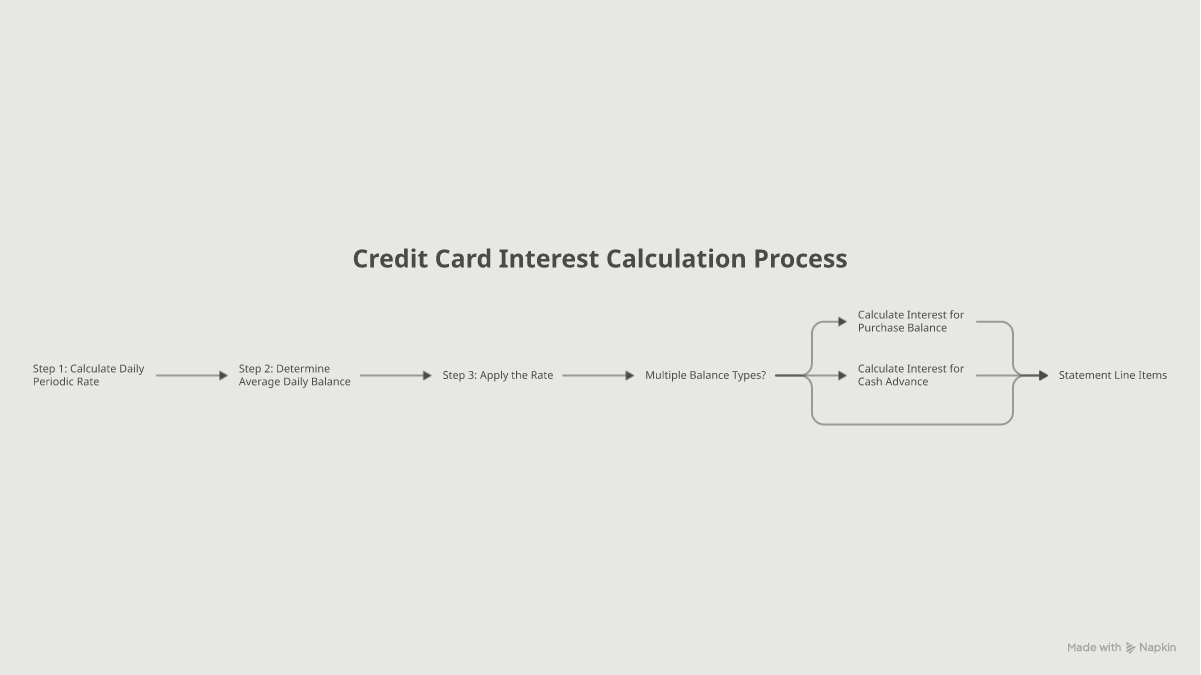
Step 1: Calculate the Daily Periodic Rate The issuer takes the APR and divides it by 365. For a card with a 24% APR, the math is 0.24 / 365 = 0.000657.
Step 2: Determine the Average Daily Balance The issuer looks at the balance on the account for every single day of the billing cycle. They add these daily totals together and divide by the number of days in the cycle, usually 28 to 31.
Step 3: Apply the Rate The average daily balance is multiplied by the daily periodic rate, and then multiplied by the number of days in the billing cycle.
Component
Example Value
Annual Percentage Rate (APR)
24%
Daily Periodic Rate (APR / 365)
0.0657%
Average Daily Balance
$1,000
Days in Billing Cycle
30
Total Monthly Interest
$19.71
If someone has both a purchase balance and a cash advance balance, the issuer performs this calculation twice. This results in two separate line items for interest on the statement.
How issuers calculate the interest charge on a monthly statement
The Role of the Grace Period
The grace period is the time between the end of a billing cycle and the payment due date. During this window, cardholders can avoid interest on new purchases if they paid the previous month's balance in full.
However, the grace period is fragile. If a cardholder fails to pay the full statement balance even once, they usually lose the grace period for the following month. This means every new purchase starts accruing interest immediately.
When the grace period is lost, interest can appear in two ways on the next bill:
Interest on the remaining balance: The portion of the old debt that was not paid.
Interest on new purchases: Because the grace period is gone, new coffee runs or grocery trips start building interest the day they are charged.
To regain the grace period, most issuers require the cardholder to pay the statement balance in full for two consecutive billing cycles.
Residual interest is perhaps the most frustrating reason for seeing two charges. It often appears when someone finally pays off a credit card they have been carrying a balance on for months.
Imagine a cardholder has a $2,000 balance. On June 1st, the statement is issued. It shows the balance is $2,000 and the due date is June 21st. On June 21st, the cardholder pays the full $2,000. They expect their July statement to show a $0 balance.
However, interest was still accruing on that $2,000 for the 20 days between June 1st and June 21st. The June statement could not include those 20 days of interest because they had not happened yet when the statement was printed. Therefore, the July statement will arrive with a small charge for those 20 days of "trailing" interest.
If the cardholder then makes new purchases in July, they may see two interest charges: one for the residual interest from the previous cycle and one for the new purchases if the grace period has not yet been restored.
To stop the cycle of residual interest, a cardholder can take the following steps:
Call the issuer for a payoff amount: Ask for the "real-time" balance, including any interest accrued since the last statement.
Pay more than the statement balance: Paying slightly more than what is listed on the bill can cover the interest that is building up while the payment is in transit.
Check the next statement: Always review the statement following a total payoff to ensure no small interest charges remain. Ignoring a $5 residual interest charge can lead to late fees and credit score damage if it goes unpaid.
How to Compare Credit Cards to Reduce Charges
If someone frequently sees multiple interest charges, it may be a sign that their current credit product does not fit their spending habits. For example, someone who frequently needs cash might benefit from a card with a lower cash advance APR, while someone carrying a large purchase balance might look for a lower standard APR.
When comparing options, look for these specific terms:
Grace Period Length: Most cards offer 21 to 25 days. A longer grace period provides more flexibility.
Compounding Frequency: Most cards compound interest daily, but some may differ. Daily compounding is more expensive than monthly compounding.
Introductory Offers: Many cards offer 0% APR for 12 months or longer on both purchases and balance transfers.
Fees: Look for cards with no annual fees and low balance transfer fees, typically 3% to 5%.
MoneyAtlas provides side-by-side comparisons of these features across hundreds of cards. By evaluating the fine print, consumers can find a card that minimizes the likelihood of complex interest charges.
Managing these charges requires a proactive approach to reading statements and timing payments.
Steps to Manage Multiple Interest Charges
1
Identify the source
Look at the "Interest Charge Calculation" section of the statement. Determine if the charges are from different categories, such as Purchases versus Cash Advances, or if one is a residual charge from a previous month.
2
Verify the APRs
Ensure the rates being charged match the cardholder agreement. If a penalty APR has been applied, identify why and take steps to correct it, such as setting up autopay to avoid late payments.
3
Pay early to reduce the average daily balance
Since interest is calculated based on the average balance held throughout the month, making multiple small payments throughout the cycle can reduce the total interest charged, even if the total amount paid remains the same.
4
Avoid high-rate transactions
If the statement shows a high interest charge for cash advances, avoid using the card at ATMs in the future. Cash advances are almost always the most expensive way to use a credit card.
Multiple interest charges on a credit card statement are usually a logical outcome of the card's terms and the cardholder's recent activity. Whether it is due to different APRs for different types of spending or trailing interest from a previous balance, these charges can be managed with careful observation. Reviewing the interest summary on every statement is the best way to stay informed.
For those looking for a fresh start, comparing current credit card offers can reveal opportunities to move balances to cards with simpler terms or lower rates. We provide comprehensive reviews and comparison tools to help you evaluate which financial products offer the most transparent fee structures for your needs.
Wondering what is the difference between American Express Gold and Platinum? Compare annual fees, 4X vs 5X rewards, and luxury travel perks to find your fit.