Finding which credit cards have low interest rates depends entirely on whether you need a temporary 0% window or a permanently low rate for long term borrowing. Most major bank cards use a high variable Annual Percentage Rate (APR), but they often provide introductory periods of 12 to 21 months with no interest at all. Conversely, credit unions frequently offer the lowest ongoing rates, sometimes staying in the single digits, though they rarely include the flashy rewards found on big bank products. MoneyAtlas tracks these shifts in the lending market to help you distinguish between a short term promotion and a sustainable long term borrowing tool. This guide breaks down the different categories of low interest cards, how to evaluate them, and which features matter most for your specific financial goals. If you want a broader starting point, begin with our best credit cards comparison.
Understanding the Two Types of Low Interest Cards
When you search for a low interest card, you are usually looking for one of two distinct products. It is vital to understand which one aligns with your needs before you start comparing offers on our platform. If your main goal is debt payoff, a balance transfer credit card comparison is usually the most relevant place to start.
Introductory 0% APR Cards
These are the most common "low interest" cards offered by large national banks like Chase, Citi, and Capital One. They offer a promotional period where the interest rate is 0% on purchases, balance transfers, or both. These periods typically last between 12 and 21 months.
For someone planning a major purchase, such as a home renovation or a new appliance, a 0% purchase APR card acts as an interest free loan. The key is to pay off the balance before the promotional period ends. Once the clock runs out, the rate usually jumps to a standard variable APR, which can often be 20% or higher depending on your creditworthiness. For a deeper breakdown of how those offers work, see our guide to 0% APR cards.
Low Ongoing APR Cards
These cards do not necessarily offer a 0% intro period. Instead, they focus on keeping the standard interest rate as low as possible for the life of the card. These are almost exclusively found at credit unions or smaller regional banks.
For instance, some credit union cards offer ongoing rates in the 8% to 13% range. While this is higher than 0%, it is significantly lower than the 24% average often seen with rewards cards. These cards are a fit for people who know they will carry a balance from month to month and want to minimize the cost of that debt over several years. If you want to benchmark what counts as competitive today, this low APR guide for credit cards is a useful reference.
The market for low interest cards is competitive, and the best offer for you depends on your credit score and your primary goal. Below is a comparison of how different types of cards stack up based on recent market data.
Card Category
Typical Intro APR
Typical Ongoing APR
Best For
Balance Transfer Focus
0% for 18 to 21 months
18% to 28% (Variable)
Paying off existing high interest debt
Purchase Focus
0% for 12 to 15 months
18% to 28% (Variable)
Financing a new, large expense
Credit Union Low Rate
N/A or 0% for 6 months
8% to 14% (Variable)
Long term revolving balances
Cash Back + Intro APR
0% for 15 months
19% to 29% (Variable)
Daily spending with a 0% safety net
How to Evaluate a 0% Intro APR Offer
If you decide that a 0% introductory offer is the right path, you need to look beyond the "0%" headline. Not all introductory offers are created equal, and the fine print can change the total cost of the card.
Length of the Promotional Window
The most obvious factor is how long the 0% period lasts. A card with a 21 month window, like the Citi Diamond Preferred, gives you more breathing room than a card with a 12 month window. If you are transferring $5,000 of debt, the difference between 12 and 21 months is the difference between a $416 monthly payment and a $238 monthly payment to reach a zero balance.
Purchases vs. Balance Transfers
Some cards offer 0% APR on new purchases but charge full interest on balance transfers. Others do the opposite. Many "all purpose" cards, like the Chase Freedom Unlimited, often offer 0% on both for a set period, such as 15 months. If your goal is to move debt from another card, you must ensure the 0% offer specifically applies to balance transfers. A good place to compare those options is our best no annual fee credit cards page.
Balance Transfer Fees
Most cards that allow you to move debt will charge a balance transfer fee. This is typically 3% or 5% of the total amount transferred. For a $10,000 transfer, a 5% fee adds $500 to your balance immediately. You have to calculate if the interest you save over 18 or 21 months outweighs the upfront fee. Some cards from smaller lenders or specific "no fee" products occasionally waive this, though they are becoming rarer in the current market.
Why Credit Unions Win on Ongoing Rates
For borrowers who do not want to jump from one promotional offer to another, credit unions are often the best place to look. Because credit unions are member owned nonprofits, they often return profits to members in the form of lower loan rates and higher savings yields.
Many credit union cards, such as those from Navy Federal, PenFed, or local community credit unions, offer "Platinum" cards. These cards are usually "no frills," meaning they might not offer 5% cash back or travel points. In exchange for the lack of rewards, the credit union provides a much lower interest rate. If you are comparing rate versus rewards, our cash back credit card rankings can help frame the trade off.
While a big bank might charge 22% for a rewards card, a credit union might offer a basic card with a 10% APR. This is a massive difference for someone carrying a $3,000 balance. The interest savings at 10% versus 22% is roughly $360 per year. For many, that is worth more than the $50 or $60 in cash back they might have earned on a rewards card.
Factors That Influence Your Interest Rate
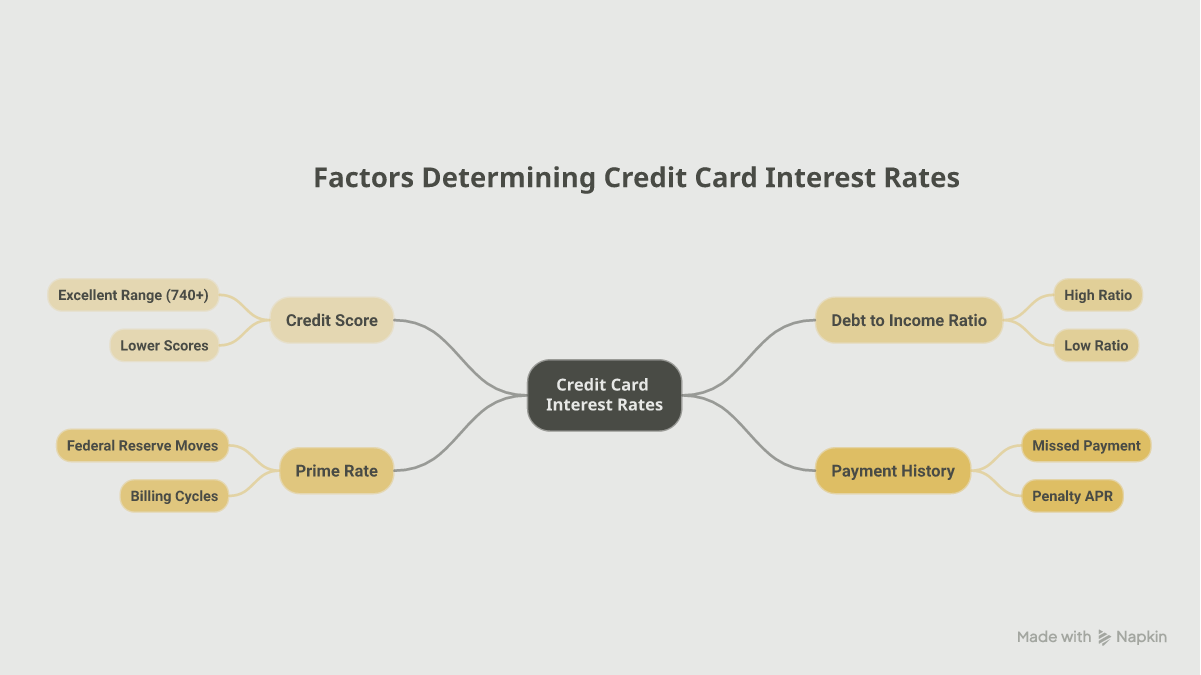
When you apply for a credit card, the "low" rate you see advertised is often the floor. Most cards list a range, such as 18.24% to 28.24%. The rate you actually receive depends on several factors.
Your Credit Score: Borrowers with scores in the "Excellent" range (740+) are most likely to qualify for the lowest advertised APR in a given range.
Debt to Income Ratio: Lenders look at how much of your monthly income is already committed to debt payments. A high ratio might result in a higher interest rate or a lower credit limit.
The Prime Rate: Most credit cards use variable interest rates. This means your APR is tied to the U.S. Prime Rate. When the Federal Reserve raises or lowers rates, your credit card APR will usually follow suit within one or two billing cycles.
Payment History: If you miss a payment, some cards may trigger a "penalty APR." This can be as high as 29.99% and may stay in effect indefinitely, nullifying any low interest benefits you previously had.
What actually moves your rate within a card advertised APR range
It is important to distinguish between a true 0% APR offer and "deferred interest" offers often found on store credit cards. MoneyAtlas suggests reading the summary of terms carefully to avoid this costly mistake.
In a true 0% APR promotion, if you have a balance remaining at the end of the period, you only pay interest on that remaining amount moving forward. In a deferred interest plan, if you do not pay the balance in full by the deadline, the lender charges you interest on the entire original purchase amount starting from the date you bought it.
This can result in a massive, unexpected interest charge on your statement the month after your promotion expires. Most major bank cards use true 0% APR, but many retail cards for furniture, electronics, or medical procedures use deferred interest. If you are still sorting out the difference, the APR basics guide is a helpful follow up.
Step-by-Step: Choosing the Right Low Interest Card
Choosing the Right Low Interest Card
1
Define your goal
Decide if you are trying to pay off existing debt, finance a new purchase, or simply want a low rate for emergencies.
2
Check your credit score
Low interest cards, especially those with long 0% windows, typically require good to excellent credit. Knowing your score helps you avoid unnecessary applications.
3
Compare intro lengths and fees
Use a comparison tool to look at the 0% duration versus the balance transfer fee. A longer window is often worth a slightly higher fee if it ensures you can pay the debt in full.
4
Look at the "post-promo" APR
Check what the rate will be after the 0% period ends. If you might still carry a balance then, the ongoing rate matters just as much as the intro rate.
5
Apply and automate
Once approved, set up autopay for at least the minimum, but ideally for the amount required to clear the balance before the 0% period expires.
There is usually a trade off between a card’s interest rate and its rewards program. High rewards cards (offering 4% or 5% back in certain categories) almost always have the highest interest rates. This is because the bank uses the interest income from people carrying balances to fund the rewards for people who pay in full.
If you are searching for a low interest rate, you are likely in a position where the cost of interest is more important than the value of points. A good example is the Discover it Cash Back review, which shows how a rewards card can still offer a 0% intro period.
If you pay in full every month: The interest rate does not matter. Choose the card with the highest rewards and no annual fee.
If you carry a balance occasionally: Look for a "low interest + rewards" hybrid, like the Capital One Savor Cash Rewards or Discover it. These offer 15 month 0% periods while still earning meaningful cash back.
If you carry a balance consistently: Ignore rewards entirely. A 10% interest rate saving is worth far more than a 1.5% cash back rate.
Conclusion
Selecting a credit card with a low interest rate requires a clear understanding of your spending habits and your timeline for repayment. Whether you opt for a 21 month 0% intro period to crush existing debt or a steady 10% APR from a credit union for ongoing flexibility, the goal is to reduce the "cost of money." If you want to keep exploring broad options, our best credit cards comparison is the best place to continue.
We make it easier to see these tradeoffs side by side. By comparing the length of introductory windows, the reality of balance transfer fees, and the ongoing variable rates, you can choose a card that supports your financial goals rather than one that complicates them.
FAQ
Ready to pick a card?
Compare the cards our editors rate highest right now, side by side, with the fees and rewards that matter.
Learn how to lower credit card APR with 5 proven strategies. From negotiating with issuers to 0% transfers, discover how to offset rising interest rates.