What's the Best Credit Card With the Lowest Interest Rate?


Introduction
Finding the best credit card with the lowest interest rate depends entirely on whether someone is looking to pay down existing debt or finance a new, large purchase. For many, the search for a low interest rate leads to two distinct paths: cards with a temporary 0% introductory rate and cards with a low ongoing Annual Percentage Rate (APR). While a 0% offer provides the most immediate relief, the standard rate that kicks in later is just as important for long-term flexibility.
MoneyAtlas compares hundreds of financial products to help consumers identify which terms align with their specific goals. This article explores the current landscape of low interest credit cards, how to evaluate the math behind balance transfer fees, and the criteria that determine which rate a borrower ultimately receives. Whether the goal is to eliminate interest for 21 months or find a card with a lower-than-average permanent rate, understanding the fine print is the first step toward making an informed choice.
For a broader starting point, begin with our best credit cards comparison. If you are mainly comparing existing debt payoff options, our balance transfer card comparison is the more focused place to start.
Understanding the Two Types of Low Interest Cards
When searching for the best credit card with the lowest interest rate, it is necessary to distinguish between temporary promotional rates and permanent standard rates. These two features serve different financial needs and come with different trade-offs.
Introductory 0% APR Cards
Introductory 0% APR cards are designed for short-term financing. They offer a window, usually between 12 and 21 months, where no interest is charged on purchases, balance transfers, or both. These cards are highly effective for someone who can pay off their full balance before the promotional period ends. However, once the clock runs out, the interest rate jumps to the standard variable APR, which may be significantly higher than the national average.
Low Ongoing APR Cards
Low ongoing APR cards are built for the long term. These cards may not always offer a 0% teaser rate, but their standard interest rate is lower than what is typically found on rewards-heavy cards. These are worth comparing for individuals who occasionally carry a balance from month to month and want to minimize the cost of that debt over several years.
If you want a deeper breakdown of how rates move over time, see how high credit card interest rates are right now.

Comparing Top Low Interest Credit Card Offers
The market for low interest cards is competitive, with several major issuers offering extended 0% periods. Because rates and terms change frequently, it is important to verify current offers directly with the issuer or through the comparison tools provided by MoneyAtlas.
Rates are current as of recent data but are subject to change based on market conditions and creditworthiness.
For readers who want to compare the broader market, the best credit cards page is the most complete side-by-side starting point. If rewards matter more than financing, the cash back credit cards comparison is worth checking next.
Longest 0% Windows
For those prioritizing the longest possible time to pay off debt, cards like the Wells Fargo Reflect® Card and the Citi® Diamond Preferred® Card are prominent options. Both have offered 0% introductory periods for up to 21 months. A longer window reduces the monthly payment required to reach a zero balance before interest begins to accrue.
Low Standard Rate Leaders
The BankAmericard® credit card is often noted for having a lower floor on its standard APR range compared to rewards cards. While the 21 billing cycle 0% intro period is the headline feature, a starting variable APR of around 14.99% is lower than the 20% or higher rates commonly seen on premium travel or cash back cards.
How to Evaluate a Low Interest Offer
Choosing the right card requires looking beyond the headline 0% offer. The total cost of borrowing includes fees and the potential interest charged after the promotion expires.
1. Purchase vs. Balance Transfer APR
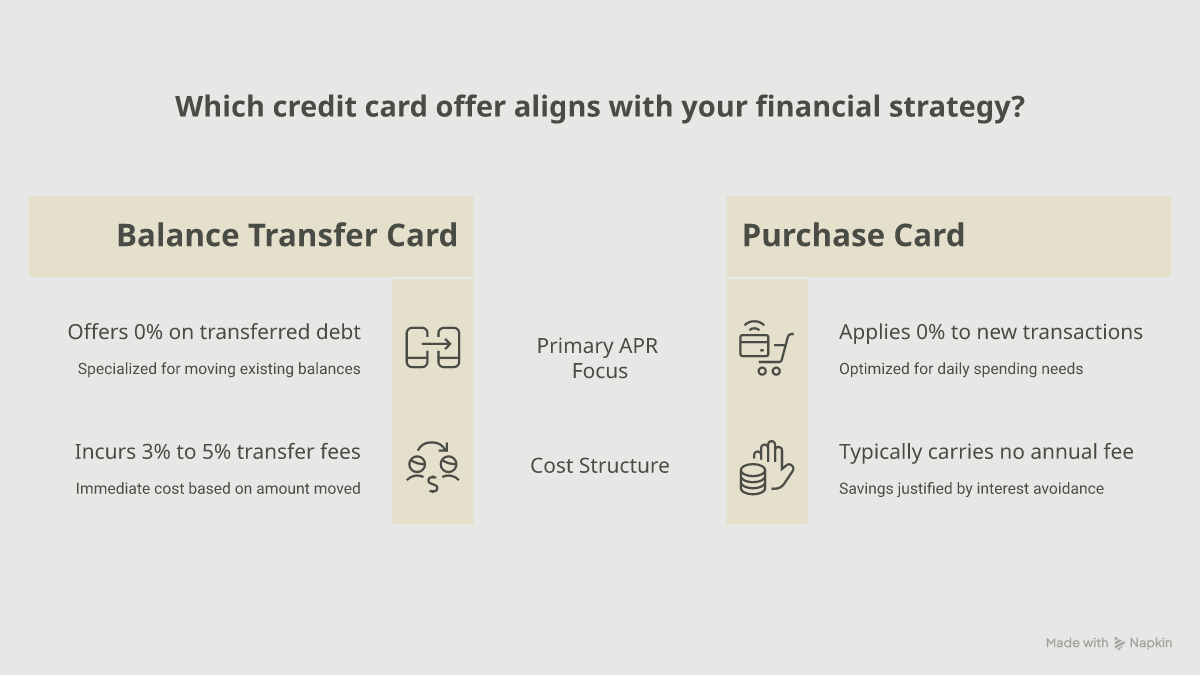
It is common for a card to offer 0% interest on balance transfers but a different rate on new purchases. For someone moving existing debt, the balance transfer rate is the priority. For someone buying a new appliance or furniture, the purchase APR is what matters. Always check if the 0% offer applies to both.
2. The Impact of Balance Transfer Fees
Moving debt to a 0% card is rarely free. Most issuers charge a balance transfer fee, typically 3% to 5% of the total amount moved. For a $5,000 balance, a 5% fee adds $250 to the debt immediately.
3. The APR Range
Every credit card lists an APR range (e.g., 17.49% to 28.24%). The rate an applicant receives is determined by their credit score and financial history. Only those with excellent credit typically qualify for the lowest rate in that range. When comparing cards, it is safer to assume a rate in the middle or top of the range unless your credit score is exceptionally high.
If you want more context on how APR is calculated, our credit card APR guide breaks down the basics.
4. Annual Fees
Most dedicated low interest cards do not charge an annual fee. If a card does charge a fee, it must provide enough value in interest savings or rewards to justify the cost. For most borrowers looking to save on interest, a $0 annual fee card is the logical starting point.
The Trade-off: Interest vs. Rewards
There is often an inverse relationship between a card’s interest rate and its rewards program.
Rewards Cards (Cash back, travel points) usually have higher interest rates, often exceeding 22% or 25%. These cards are designed for "transactors" who pay their balance in full every month. The higher APR subsidizes the rewards and perks offered to cardholders.
Low Interest Cards usually offer minimal or no rewards. These cards are for "revolvers" who may carry a balance. By stripping away the cost of travel points and concierge services, issuers can afford to offer a lower interest rate.
For someone carrying a balance, the interest charges will almost always outweigh the value of any cash back or points earned. In this scenario, prioritizing the lowest APR is the mathematically superior choice.
Who Qualifies for the Lowest Rates?
Credit card issuers use a process called risk-based pricing to determine an applicant's interest rate. While every bank has its own internal formula, several factors consistently influence the outcome.
Credit Score Requirements
Generally, a credit score in the "Good" to "Excellent" range (670 to 850) is required to qualify for the most competitive low interest cards. Those with scores above 740 are the most likely to be approved for the lowest possible APR within a card’s advertised range.
Debt-to-Income Ratio
Issuers look at how much of a borrower's monthly income is already committed to debt payments. Even with a high credit score, a high debt-to-income (DTI) ratio might result in a higher interest rate or a lower credit limit, as the lender perceives a higher risk of default.
Credit Utilization
The amount of credit currently being used compared to total credit limits affects both the credit score and the issuer's decision. High utilization across other cards can signal financial stress, leading to less favorable interest terms on a new application.
If you are trying to understand how your current rate compares with the market, the average interest rate on credit cards guide is a helpful reference.
Step-by-Step: How to Compare and Choose
How to Compare and Choose a Low Interest Credit Card
- 1
Identify the goal.
Determine if the priority is paying off old debt or making a new purchase.
- 2
Calculate the payoff timeline.
Divide the total debt by the number of months in the 0% intro period. If the resulting monthly payment is affordable, a 0% card is likely the best fit.
- 3
Compare transfer fees.
If moving debt, check if the fee is 3% or 5%. On a large balance, this difference is substantial.
- 4
Check the ongoing rate.
Look at the standard APR that applies after the intro period. This is the "exit rate" and matters if the debt isn't fully paid off in time.
- 5
Use comparison tools.
MoneyAtlas provides side-by-side breakdowns of these terms so borrowers can see the total cost of each option.
For readers ready to widen the search, the credit card reviews index is a good place to compare individual cards one by one.
Avoiding Common Low Interest Traps
Low interest cards are powerful tools, but they require discipline to be effective. Falling into certain traps can negate the benefits of a low rate.
Missing the Promo Deadline
If a balance remains when a 0% intro period ends, interest is charged on the remaining amount at the standard rate. Unlike "deferred interest" offers often found at furniture or electronics retailers, most major credit cards do not charge backdated interest from the day of purchase. They only charge interest on the remaining balance going forward. However, that rate is usually high enough to make the remaining debt expensive.
The Penalty APR
Late payments can trigger a "Penalty APR." This is a significantly higher interest rate (often around 29.99%) that can replace the promotional rate and the standard rate. Making at least the minimum payment on time every month is essential to keeping a low interest rate active.
New Spending on a Balance Transfer Card
For those using a card for a balance transfer, it is often wise to avoid making new purchases on that same card. Some cards apply payments to the balance with the highest interest rate first, but others have complex rules about how payments are allocated between a 0% transfer balance and a higher-interest purchase balance.
If your goal is to move debt into one structured payoff plan, the personal loans comparison can also be worth a look.
How the Federal Reserve Affects Your Rate
Most credit card interest rates are variable, meaning they are tied to a benchmark called the Prime Rate. The Prime Rate is directly influenced by the Federal Reserve’s federal funds rate.
When the Fed raises interest rates to combat inflation, the Prime Rate increases, and credit card APRs usually follow suit within one or two billing cycles. Conversely, when the Fed lowers rates, credit card interest costs eventually decrease.
Because of this, the "lowest" rate available today might be different six months from now. Using a comparison platform like MoneyAtlas allows borrowers to see how current market trends are reflected in the latest credit card offers.
If you want more background on rate movement and benchmarks, read what APR is on a credit card.
Summary of Key Factors
- Introductory Duration: Periods range from 12 to 21 months. Longer is better for large debts.
- Balance Transfer Fees: Usually 3% to 5%. This is the "cost of entry" for moving debt.
- Variable APR: The permanent rate that applies after the intro period.
- Credit Health: Higher scores lead to lower rates within the provided APR range.
Strategies for Lowering an Existing Interest Rate
Applying for a new card is not the only way to secure a lower rate. For those who already have a credit card and a solid payment history, other options are available.
Negotiating With Your Current Issuer
It is possible to call a credit card issuer and ask for a lower interest rate. This is most successful for long-term customers who have never missed a payment. If a competitor is offering a lower rate, mentioning that offer can sometimes prompt the issuer to match it or provide a temporary rate reduction.
Consolidating with a Personal Loan
If a credit card interest rate is 25% and a borrower doesn't qualify for a 0% intro card, a personal loan might be worth comparing. Personal loans often have fixed interest rates that can be lower than credit card APRs for those with good credit. This turns revolving credit card debt into a structured installment loan with a clear end date.
Improving Credit Scores
Since interest rates are tied to credit risk, improving a credit score is the most sustainable way to access lower rates in the future. Paying down balances to lower utilization and ensuring all payments are on time are the two most impactful steps.
Final Thoughts on Choosing a Card
The search for the best credit card with the lowest interest rate is ultimately a search for a more manageable way to handle debt. While 0% introductory offers are the gold standard for saving money, they are temporary. Borrowers should prioritize cards that match their payoff timeline and have a standard APR they can live with if life's circumstances prevent them from clearing the balance immediately.
MoneyAtlas provides the expert ratings and side-by-side comparisons necessary to cut through the marketing and see the real cost of each card. If you want to keep comparing, start with the best credit cards comparison, then move to the balance transfer card comparison if your priority is paying down debt, or the credit card reviews index if you want to evaluate a specific product in more detail.
FAQ
MoneyAtlas Staff
Articles and reviews from the MoneyAtlas editorial team — independent research on credit cards, banking, loans, insurance, and investing.
Related Articles

Which Card Is Better: American Express Gold or Platinum?
Deciding which card is better: American Express Gold or Platinum? Compare fees, 4X dining rewards, and luxury travel perks to find your perfect match.

Should I Get an American Express Gold Card? Breaking Down the Value
Should I get an American Express Gold card? Explore the 4X rewards on dining and groceries vs. the $325 fee to see if this premium card fits your budget.

How to Get the American Express Gold Card: A Practical Guide
Learn how to get the American Express Gold Card with our guide on credit score requirements, income, and the 'Apply with Confidence' tool. Apply today!