What Is the Interest Rate on Chase Credit Card?


Introduction
Chase interest rates are a primary concern for anyone comparing new credit cards or managing an existing balance. These rates, known as the Annual Percentage Rate (APR), determine the cost of carrying a balance from month to month. MoneyAtlas monitors these figures across the credit landscape to help people understand the real cost of their financial choices. If you are starting from scratch, begin with our best credit cards comparison. Most Chase cards currently feature variable interest rates that fall between roughly 18% and 28% based on the specific card and the creditworthiness of the applicant. This article breaks down the current rates for popular Chase cards, how the bank calculates monthly interest, and the ways different types of transactions carry different costs. Understanding these variables is the first step toward comparing options effectively and making informed decisions about which card fits a specific budget.
Current Chase Credit Card Interest Rates
Chase offers a wide variety of credit products, ranging from no-annual-fee cash back cards to premium travel rewards cards. If you want to compare those categories side by side, start with cash back card rankings or browse the credit card reviews index. Because each card serves a different purpose, the interest rates vary. Generally, cards designed for luxury travel or those with high rewards rates tend to have slightly higher minimum APRs than those focused on balance transfers or simple cash back.
The table below provides a breakdown of current APR ranges for some of the most popular Chase credit cards. Note that these rates are variable and subject to change based on the market.
If you are comparing a travel-focused option, the Chase Sapphire Preferred review is a useful place to see how a premium card balances rewards against its ongoing APR.

Understanding the Types of Chase APR
When looking at a Chase credit card agreement, it is common to see several different interest rates listed. Most people focus on the purchase APR, but other types of transactions can trigger much higher costs.
Purchase APR
The purchase APR is the interest rate applied to standard transactions, such as buying groceries or paying for a flight. If the statement balance is paid in full every month by the due date, no interest is charged on these purchases. However, if any portion of the balance is carried over to the next month, the purchase APR is applied to the average daily balance.
Balance Transfer APR
A balance transfer involves moving debt from one credit card to another, usually to take advantage of a lower interest rate. If that is your goal, compare the best balance transfer credit cards. While many Chase cards offer a 0% introductory APR on balance transfers, the regular balance transfer APR will apply once that period ends. This rate is often the same as the purchase APR, but it can differ. Most balance transfers also involve a one-time fee, typically 3% or 5% of the transferred amount.
Cash Advance APR
Using a credit card to get cash from an ATM or through a convenience check is considered a cash advance. Chase typically charges a much higher interest rate for these transactions, often around 29.99% variable. Unlike purchases, cash advances usually do not have a grace period. Interest begins accruing the moment the cash is received.
Penalty APR
If a cardholder makes a late payment or a payment is returned, Chase may apply a penalty APR. This rate is often significantly higher than the standard purchase APR, sometimes reaching 29.99%. Once a penalty APR is applied, it may remain on the account indefinitely, though issuers are required to review the account periodically to see if the original rate can be restored.
How Chase Calculates Your Interest
Understanding how interest is calculated can help in visualizing the actual cost of debt. Chase, like most major issuers, uses the Daily Balance Method. This means interest is calculated every day based on how much is owed.
The Variable Rate Formula
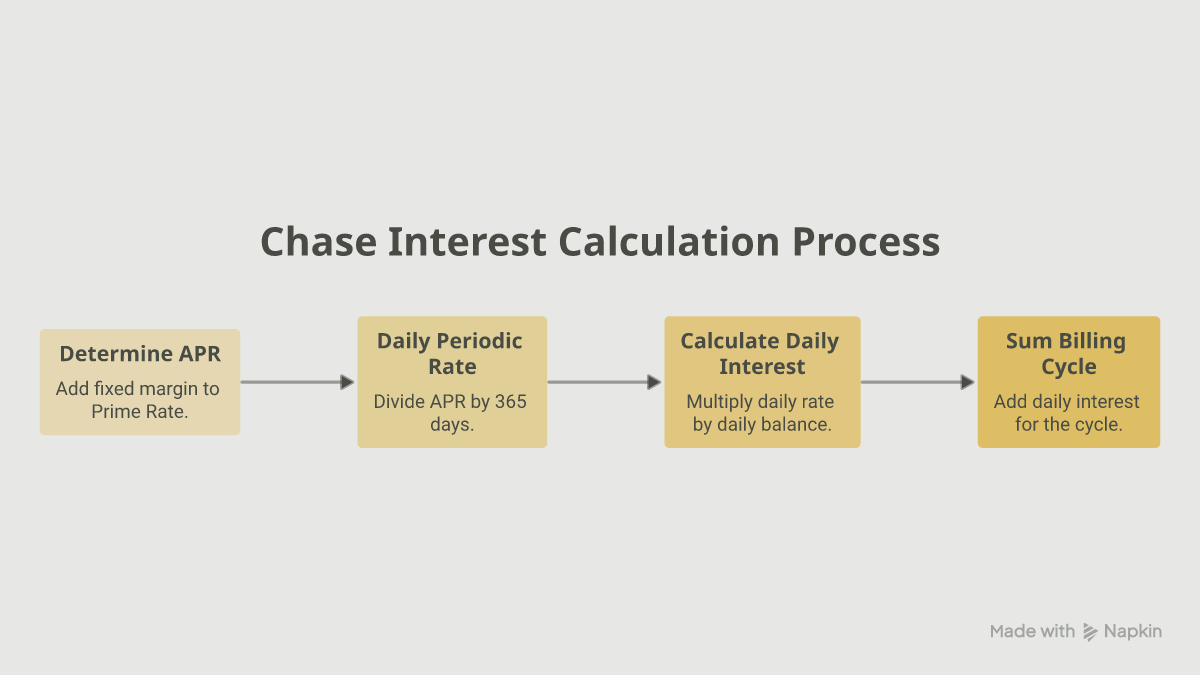
Most Chase cards have a variable APR. This rate is determined by taking the Prime Rate and adding a specific percentage, known as the margin. The Prime Rate is a base interest rate used by banks, which is heavily influenced by the federal funds rate set by the Federal Reserve.
If the Federal Reserve raises interest rates, the Prime Rate usually goes up by the same amount. Consequently, the variable APR on a Chase card will also increase. This change happens automatically without the need for a 45 day notice, which is why variable rates can fluctuate throughout the year.
Daily Periodic Rate (DPR)
To calculate the daily interest charge, the annual APR is divided by 365 days. This results in the Daily Periodic Rate. For a card with a 24% APR, the math looks like this:
- 24% divided by 365 = 0.0657% per day.
Each day, the bank multiplies this percentage by the current balance. If someone owes $2,000, they are being charged roughly $1.31 in interest every day. Over a 30 day billing cycle, that adds up to nearly $40.
If you want a deeper breakdown of the math, see our step-by-step credit card interest calculator guide.
Promotional 0% Intro APR Offers
For those looking to avoid interest entirely for a set period, Chase offers several cards with introductory 0% APR periods. These offers are particularly useful for making a large purchase or paying down existing high-interest debt from another card.
- Chase Freedom Unlimited and Freedom Flex: These cards frequently offer 15 months of 0% intro APR on both purchases and balance transfers.
- Chase Slate Edge: This card is designed specifically for those prioritizing interest savings, often offering 18 months or more of 0% intro APR.
- United Gateway: This is one of the few co-branded airline cards that offers an introductory 0% APR, typically for 12 months on purchases.
If you are comparing cards built around this strategy, the Chase Slate review is a good starting point.
It is vital to remember that once the introductory period ends, any remaining balance will be subject to the regular variable APR. Additionally, if a payment is late during the introductory period, the 0% rate may be revoked immediately.
Factors That Determine Your Specific Rate
When applying for a Chase card, the bank does not simply give every person the same interest rate. Instead, it assigns a rate within a published range based on several factors.
- Credit Score: Generally, applicants with higher credit scores are more likely to receive an APR at the lower end of the range. Those with scores in the "good" range may receive a rate in the middle or high end.
- Credit History: Chase looks at the length of credit history and the types of accounts previously managed. A long history of on-time payments across different types of loans can lead to better rates.
- Debt-to-Income Ratio: The bank evaluates how much of an applicant's monthly income is already committed to debt payments. A lower ratio suggests a higher capacity to repay new debt, which can influence the risk assessment.
- Existing Relationship with Chase: MoneyAtlas has noted that Chase sometimes considers whether an applicant already has a checking or savings account with the bank. For example, the Chase Freedom Rise card is specifically designed for those building credit, and having a $250 balance in a Chase checking account can improve the chances of approval.
If you want a broader overview of fee-free options, our no annual fee credit cards guide is a practical comparison point.
Finding Your Current Chase Interest Rate
If someone already has a Chase card, there are three primary ways to find the exact interest rate currently being applied to the account.
- Monthly Statement: On the last page of the paper or PDF statement, there is a table labeled "Interest Charge Calculation." This table lists the APR for purchases, balance transfers, and cash advances. It also shows the "Balance Subject to Interest Rate," which clarifies exactly how much of the debt is accruing interest.
- Online Account or Mobile App: After logging into the Chase website or app, selecting a specific card and navigating to "Account Details" or "Statements and Documents" will provide the current terms.
- Cardmember Agreement: This is the document received when the card was first opened. While the base margin stays the same, the total APR may have changed if the Prime Rate has moved since the account was opened.
Managing and Reducing Interest Costs
While the assigned interest rate is largely based on market factors and credit history, there are ways to minimize the impact of interest.
- Pay the Statement Balance in Full: This is the only guaranteed way to avoid interest on purchases. Most Chase cards have a grace period of at least 21 days between the end of a billing cycle and the payment due date.
- Make Multiple Payments: Since interest is calculated on the average daily balance, making smaller payments throughout the month instead of one large payment at the end can reduce the average balance and, therefore, the interest charge.
- Improve Credit Scores: If a credit score improves significantly after holding a card for a year or more, it is possible to call Chase and request a lower APR. While not guaranteed, the bank may lower the rate to keep a customer with a strong repayment history.
- Use Balance Transfer Offers: For those carrying a balance on a card with a 25% APR, moving that balance to a card like the Chase Slate Edge with a 0% intro period can save hundreds of dollars in interest over a year.
If you are focused on lowering a card rate, this guide to applying for a lower interest rate on a credit card walks through the comparison math in more detail.
FAQ
MoneyAtlas Staff
Articles and reviews from the MoneyAtlas editorial team — independent research on credit cards, banking, loans, insurance, and investing.
Related Articles

Which Card Is Better: American Express Gold or Platinum?
Deciding which card is better: American Express Gold or Platinum? Compare fees, 4X dining rewards, and luxury travel perks to find your perfect match.

Should I Get an American Express Gold Card? Breaking Down the Value
Should I get an American Express Gold card? Explore the 4X rewards on dining and groceries vs. the $325 fee to see if this premium card fits your budget.

How to Get the American Express Gold Card: A Practical Guide
Learn how to get the American Express Gold Card with our guide on credit score requirements, income, and the 'Apply with Confidence' tool. Apply today!