What Is a Minimum Interest Charge on a Credit Card?


Introduction
A minimum interest charge is a specific fee a credit card issuer applies when the calculated interest on a balance falls below a set threshold. While most cardholders focus on the Annual Percentage Rate, or APR, this smaller charge often appears when a very low balance is carried from one month to the next. MoneyAtlas helps consumers navigate these technical terms, and you can start with our best credit cards comparison to see how different cards stack up. This article covers how these charges work, where to find them in your card agreement, and the mechanics of how they are applied to your account. Understanding this fee is essential for anyone who carries a balance, as it establishes a floor for the cost of borrowing.
How a Minimum Interest Charge Works
Credit card interest is typically calculated using your average daily balance and your Daily Periodic Rate. The Daily Periodic Rate is your APR divided by 365. When you carry a balance, the bank performs this math to determine your finance charge. However, if the result of this calculation is a very small number, the bank may instead charge a flat minimum fee.
This fee generally ranges from $0.50 to $2.00. It exists because it costs the bank money to process and bill an interest charge. If the calculated interest is only a few cents, the bank uses the minimum interest charge to ensure the transaction remains profitable. It effectively serves as a minimum price for the privilege of carrying debt.
The Math Behind the Charge
To understand why the minimum charge exists, you first need to see how standard interest is calculated. Most issuers use the average daily balance method. They track your balance every day of the billing cycle, add those totals together, and divide by the number of days in the cycle.
Once they have that average, they multiply it by the Daily Periodic Rate and then by the number of days in the billing cycle. For example, if someone has a 24% APR, their daily rate is roughly 0.0657%. If they carry a $10 balance for a 30 day cycle, the math looks like this:
- $10 (Balance) x 0.0657% (Daily Rate) x 30 (Days) = $0.197
In this scenario, the calculated interest is roughly $0.20. If the card agreement specifies a minimum interest charge of $1.50, the cardholder will be charged $1.50 instead of $0.20.
When the Charge Is Triggered
The minimum interest charge is only triggered if you are already subject to interest. If you pay your statement balance in full every month by the due date, you generally operate within a grace period. During a grace period, the bank does not charge interest on new purchases. Since no interest is due, the minimum interest charge is not applied.
However, if you fail to pay the full statement balance, the grace period is lost. At that point, even a tiny leftover balance will trigger interest. If that calculated interest is less than the floor set by the bank, the minimum charge appears on your statement.
Where to Find the Minimum Interest Charge
Federal law requires credit card issuers to be transparent about their fees. You can find the specific minimum interest charge for any card in the Schumer Box. This is the standardized table included in credit card offers and monthly statements that lists APRs, annual fees, and other costs.
Reading the Schumer Box
The Schumer Box is divided into two main sections: interest rates and fees. The minimum interest charge is usually located in the interest rates section, often directly below the various APRs for purchases, balance transfers, and cash advances. It will be labeled clearly as "Minimum Interest Charge" or "Minimum Finance Charge."
MoneyAtlas makes it easier to compare these terms side by side across different cards, and our credit card reviews index is a useful place to start when you want to compare options. When evaluating a new card, checking this section of the Schumer Box helps you understand the true cost of carrying small balances.
Terms to Look For
When reviewing a credit card agreement, you may see different types of minimums. It is important to distinguish the minimum interest charge from the minimum payment.
- Minimum Interest Charge: The smallest amount of interest you will pay if you carry a balance.
- Minimum Payment: The smallest amount you must pay toward your total balance each month to keep the account in good standing.
Comparing Minimum Interest Charges to Other Fees
While a $1.00 or $2.00 charge may seem small, it is one of several costs associated with credit cards. Understanding how it fits into the broader fee structure helps you evaluate the total cost of a card.
Interest vs. Fees
A minimum interest charge is technically considered interest, not a penalty fee. This is an important distinction because penalty fees, like late payment fees or over-the-limit fees, are subject to different regulatory caps under the Credit CARD Act of 2009. Minimum interest charges are generally more stable and are tied to the act of carrying a balance rather than a mistake made by the cardholder.
Impact on Small Balances
The minimum interest charge has a disproportionate impact on small balances. If you carry a $1,000 balance, your interest charge will likely be $15.00 to $25.00 depending on your APR. In this case, the minimum charge of $1.50 is irrelevant because your calculated interest is higher.
However, if you have a $5.00 balance, a $1.50 minimum charge represents a massive percentage of that balance. In one month, you would effectively pay 30% of the principal in interest. This is why it is mathematically beneficial to pay off small balances entirely rather than letting them linger.
How to Calculate Your Potential Interest
To determine if you will be hit with a minimum charge, you can follow these steps. Note that rates and terms change. Verify your specific card details on your statement or use MoneyAtlas comparison tools to look up current product terms.
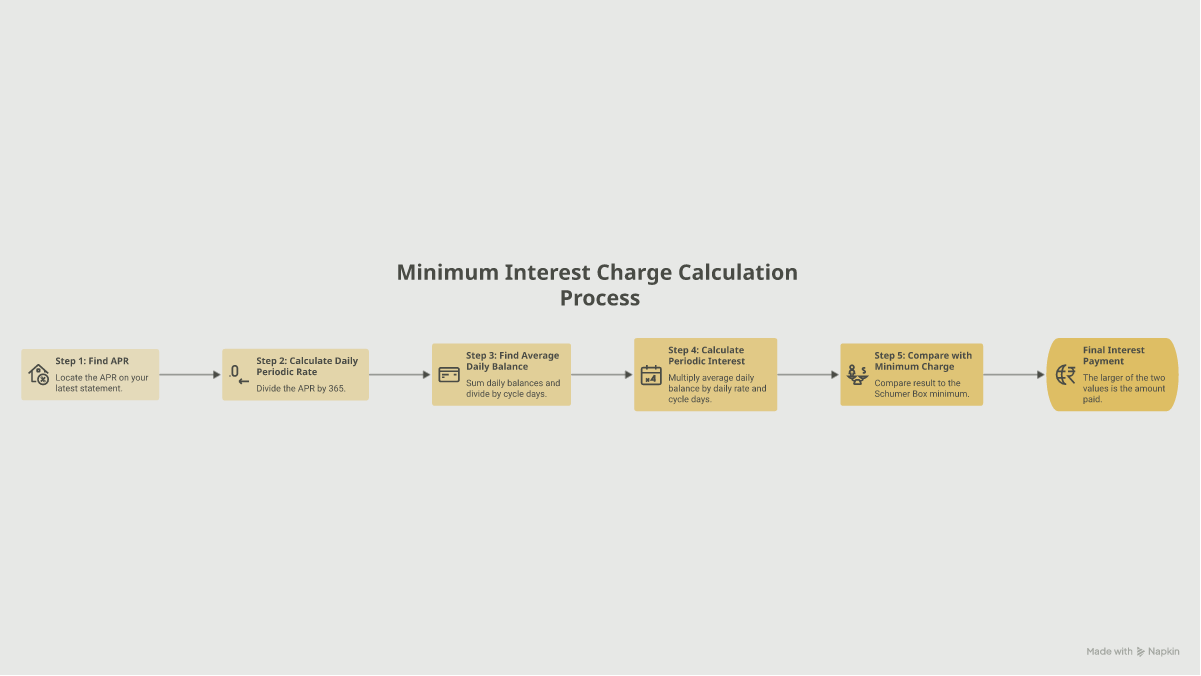
- Find your APR: Look at your latest statement for the purchase APR. For example, it might be 18% or 24%.
- Calculate the Daily Periodic Rate: Divide your APR by 365. If your APR is 24%, your daily rate is 0.0657%.
- Find your average daily balance: Add your balance from each day of the month and divide by the number of days in the billing cycle.
- Multiply the figures: Multiply the average daily balance by the daily rate, then multiply by the number of days in the cycle.
- Compare to the minimum: Compare your result from Step 4 to the minimum interest charge listed in your Schumer Box. The larger of the two is what you will pay.
The Role of the Grace Period
The most effective way to ignore minimum interest charges entirely is to maintain a grace period. A grace period is the time between the end of your billing cycle and your payment due date. Most credit cards offer a grace period of at least 21 days for new purchases.
Avoiding Interest Entirely
If you pay your statement balance in full every month by the due date, you do not owe interest. Since you do not owe interest, the bank cannot apply a minimum interest charge. The charge only exists for cardholders who "revolve" their balance, meaning they carry some of the debt into the next month.
Losing the Grace Period
If you carry even $1.00 of debt past the due date, you usually lose the grace period for the following month. This means new purchases start accruing interest immediately. If you are in this situation, when interest is charged on a credit card becomes especially important, since the minimum interest charge is much more likely to appear when you are working on paying down the last few dollars of a debt.
Specialized Interest Scenarios
Not all credit card interest is treated the same. Different types of transactions may have different rules regarding how interest is applied.
Cash Advances and Balance Transfers
Cash advances often do not have a grace period. Interest begins accruing the moment you take the cash out. Because interest starts on day one, you are almost guaranteed to pay some form of interest. If you pay back the cash advance very quickly, the calculated interest might be just a few cents. In that case, the minimum interest charge will likely kick in.
Balance transfers may also have different APRs. If you transfer a very small amount, or if you have nearly paid off a large transfer, the minimum charge remains a factor to watch. If you are comparing payoff tools, balance transfer cards can be a practical place to look.
Deferred Interest Plans
Some retail credit cards offer deferred interest plans, such as "no interest if paid in full within 12 months." These are not the same as 0% intro APR offers. With deferred interest, the bank tracks the interest every month. If you fail to pay the balance in full by the deadline, all that tracked interest is added to your bill at once. In these cases, the minimum interest charge may have been calculated in the background each month and then applied in a lump sum if the terms were not met.
Strategies for Managing Your Balance
If you want to minimize the impact of interest and fees, there are several practical steps you can take. These strategies focus on avoiding the conditions that trigger the minimum charge.
- Pay the full statement balance. This is the primary way to avoid all interest, including the minimum charge. Setting up autopay for the "Statement Balance" can help ensure this happens every month.
- Clear small balances immediately. If you see a small balance of $10 or $20 on your account, pay it off before the cycle ends. Leaving it can trigger a minimum charge that is high relative to the balance.
- Check the Schumer Box before applying. Compare credit cards with no annual fee if you want to weigh fees alongside interest terms.
- Use alerts. Set up notifications for when a statement is generated. Checking the statement balance immediately allows you to pay it off and keep your grace period intact.
Why Minimum Interest Charges Vary
Not every credit card has a minimum interest charge. Some cards, particularly those from credit unions or certain premium issuers, may only charge the actual calculated interest, even if it is only $0.05.
Issuer Differences
Large national banks are more likely to have a minimum interest charge, often around $1.50 or $2.00. They handle millions of transactions, and the minimum charge helps cover the overhead of servicing those accounts. Smaller lenders might waive this charge to remain competitive or because they have lower overhead costs.
Regulatory Limits
While there is no specific federal "cap" on the dollar amount of a minimum interest charge like there is for late fees, the charge must be "reasonable." Most banks keep these charges low to avoid regulatory scrutiny and to stay competitive. If a bank were to charge a $10.00 minimum interest fee, it would likely be viewed as a penalty rather than an interest floor, which would trigger different legal requirements.
How to Compare Credit Cards Effectively
When you are looking for a new card, the minimum interest charge is just one piece of the puzzle. It is a sign of how the bank treats small balances. If you frequently carry a balance, you should look for a low APR first. If you always pay in full, the minimum interest charge matters less than the rewards program or the annual fee.
MoneyAtlas provides tools to compare these factors side by side. By looking at the APR, annual fee, and minimum interest charge together, you can get a clearer picture of which card is the most cost effective for your spending habits. If you want a deeper look at how issuers apply interest in practice, how credit card interest rates are applied is a helpful next step.
Identifying Your Spending Profile
If you are someone who occasionally forgets to pay the full balance, a card with no minimum interest charge and a low APR is worth comparing. If you are a "transactor" who uses the card for points and pays it off every Friday, these fees will likely never impact you.
Summary of Key Points
A minimum interest charge is a common but often overlooked part of credit card terms. It ensures that if you owe any interest at all, you pay at least a specific amount.
- It typically ranges from $0.50 to $2.00.
- It only applies when you carry a balance and lose your grace period.
- You pay either the calculated interest or the minimum charge, whichever is higher.
- It is listed in the Schumer Box on your statement and in card offers.
Checking your statement for this fee can help you understand why your balance might be slightly higher than expected. While it is a small fee, it can add up over time if you consistently carry small amounts of debt. Paying your balance in full remains the best way to keep your cost of credit at zero. To see how different cards compare on fees and interest, browse the MoneyAtlas credit card reviews and use the comparison tools available through MoneyAtlas to find the right fit for your financial situation.
FAQ
Ready to pick a card?
Compare the cards our editors rate highest right now, side by side, with the fees and rewards that matter.
Compare the best credit cardsMoneyAtlas Staff
Articles and reviews from the MoneyAtlas editorial team — independent research on credit cards, banking, loans, insurance, and investing.
Related Articles

The Fed just raised rates. Which of your debts will cost more?
The Fed made its first rate hike since 2023 on September 16. See which debts go up, which stay locked, and what the hike costs you each month.

Your credit card APR is going up. Here's what to do before your next statement
Learn how to lower credit card APR with 5 proven strategies. From negotiating with issuers to 0% transfers, discover how to offset rising interest rates.

Does Credit Card APR Go Down? How to Lower Your Interest Rate
Does credit card APR go down? Learn how market shifts, improved credit, or negotiation can lower your rate and save you money on interest today.