Deciding whether a credit card interest rate is fair depends on the current economic climate and your specific credit profile. For many consumers, seeing an 18% Annual Percentage Rate (APR) on a credit card statement or application raises a natural question about whether they are getting a good deal. MoneyAtlas compares over 1,500 financial products to help you understand how these rates stack up against the broader market. If you want to widen the search beyond one offer, start with our best credit cards comparison.
In the current high interest rate environment, an 18% APR is actually below the national average for new credit card offers. While this rate is lower than what many major national banks charge, it still represents a significant cost for anyone who carries a balance from month to month. This article explores how 18% compares to current market benchmarks, the factors that determine your specific rate, and how to find even lower options if you prioritize minimizing interest.
Understanding the 18% APR Benchmark
The Annual Percentage Rate (APR) represents the yearly cost of borrowing money on your credit card. While many people use the term interest rate, the APR is the more accurate figure because it includes the interest rate plus certain fees required to maintain the account. For most credit cards, the interest rate and the APR are identical because common fees like annual fees or late fees are charged separately. For a deeper breakdown of the math, see our guide on how credit card APR is calculated.
The number 18% holds a specific significance in the US financial system. This is because the National Credit Union Administration (NCUA) currently imposes an 18% interest rate ceiling on most loans made by federal credit unions, including credit cards. This cap was established to protect members of credit unions from excessive borrowing costs. Because of this regulation, 18% is often the highest rate you will see at a federal credit union, whereas traditional banks have no such federal ceiling and frequently charge much more.
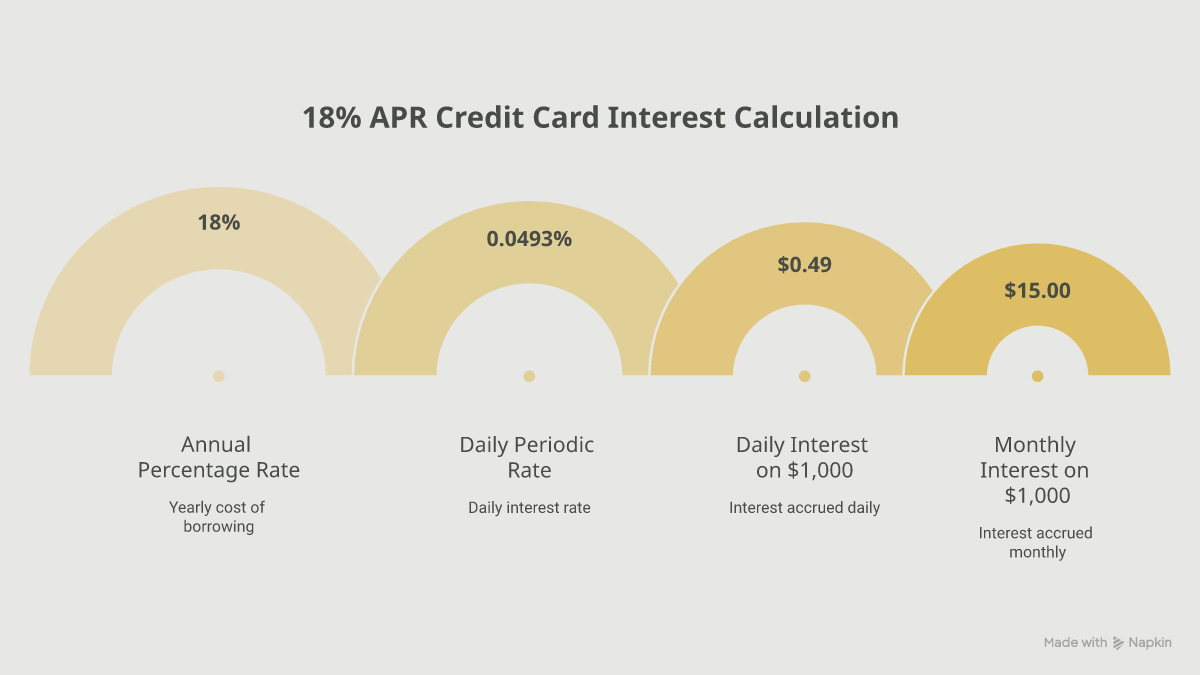
Credit card interest is typically calculated using a daily periodic rate. To find this, the card issuer divides the 18% APR by 365 days.
APR: 18%
Daily Periodic Rate: 0.0493%
Daily Interest on a $1,000 balance: $0.49
Where an 18% APR sits against the federal credit union rate ceiling
While $0.49 per day might seem small, it compounds. This means the issuer calculates interest today based on your balance plus the interest that accrued yesterday. Over a 30 day billing cycle, a $1,000 balance at 18% APR would result in approximately $15.00 in interest charges if the balance remains steady.
Comparing 18% to Current Market Averages
When comparing an 18% APR to the rest of the market, context is everything. Based on recent data from the Federal Reserve and major financial institutions, the average APR for credit card accounts that incur interest has hovered between 21% and 25%. In this light, 18% is objectively lower than the typical rate most Americans are paying today.
The following table illustrates how an 18% APR compares to different categories of credit cards as of recent market data.
Card Category
Typical APR Range
Comparison to 18%
National Average (All Cards)
21% to 25%
18% is Lower
Rewards Credit Cards
22% to 29%
18% is Significantly Lower
Store/Retail Cards
28% to 33%
18% is much lower
Credit Union Cards
12% to 18%
18% is at the high end
Secured Cards
20% to 30%
18% is Lower
A rate of 18% is particularly competitive for a rewards card. Most cards that offer cash back, travel points, or premium perks carry higher APRs to offset the cost of those benefits. If a card offers significant rewards alongside an 18% APR, it is worth comparing against other premium options, as it sits well below the 25% to 28% range often seen in the rewards category. If rewards matter more than rate alone, take a look at travel credit cards to see how those tradeoffs usually look.
The Real Cost of Carrying a Balance at 18%
The impact of an 18% APR is only felt if you carry a balance. If you pay your statement in full every month by the due date, your APR is effectively 0% because of the grace period. A grace period is the window of time between the end of your billing cycle and your payment due date when the issuer does not charge interest on new purchases.
For those who do carry debt, the difference between 18% and the national average is substantial. Consider a scenario where a cardholder has a $5,000 balance and makes a fixed monthly payment of $200.
At 25% APR (Current Bank Average): It would take 34 months to pay off the balance, with total interest costs of approximately $2,015.
At 18% APR: It would take 30 months to pay off the balance, with total interest costs of approximately $1,254.
In this comparison, an 18% rate saves the borrower $761 in interest and shortens the repayment period by four months. MoneyAtlas makes it easier to compare side by side how different rates and payment amounts change the total cost of debt. If you are focused on debt payoff, our balance transfer credit card comparison is a logical next step.
Factors That Determine Your Credit Card APR
Credit card issuers do not give the same rate to everyone. Most cards are advertised with an APR range, such as 17.99% to 28.99%. Where an individual falls within that range depends on several critical factors.
1. Credit Score and History
Your credit score is the most significant factor in determining your APR. Lenders view a higher score as an indication of lower risk. Someone with an excellent credit score, typically 740 or higher, is more likely to be approved for the lower end of an APR range. Conversely, those with scores in the fair or poor range (below 670) may find that 18% is unavailable to them, with offers starting closer to 25% or 30%.
2. The Prime Rate
Most credit cards have variable APRs tied to the prime rate. The prime rate is a benchmark interest rate that banks charge their most creditworthy corporate customers. It moves in tandem with the federal funds rate set by the Federal Reserve. When the Fed raises rates to combat inflation, the prime rate goes up, and almost all variable rate credit cards follow suit. If the prime rate is 8.5% and your card agreement specifies "Prime + 9.5%," your APR will be 18%.
3. Type of Credit Card
The card's purpose influences its interest rate.
Low Interest Cards: These cards often strip away rewards and perks to offer the lowest possible ongoing APR. For these cards, 18% might actually be considered high, as some credit unions offer specialized cards with rates between 10% and 15%.
Rewards Cards: Because rewards programs are expensive for banks to operate, these cards almost always carry higher APRs. An 18% rate on a premium travel card is generally considered excellent.
Store Cards: Retail-branded cards often have some of the highest rates in the industry, frequently exceeding 30%.
Existing customers sometimes have more leverage. Some financial institutions, particularly credit unions and smaller local banks, may offer more competitive rates to members who already have checking accounts, mortgages, or other loans with them.
When Is 18% APR Too High?
While 18% is a good rate for a credit card today, it is high compared to other types of debt. If you are looking to borrow a large sum of money for a long period, a credit card is rarely the most cost effective tool.
Personal Loans: For individuals with good credit, personal loan rates often range from 7% to 15%. If you are carrying a large credit card balance at 18%, consolidating that debt into a personal loan could lower your interest costs significantly.
Home Equity Lines of Credit (HELOC): Because these loans are secured by your home, the rates are typically much lower than credit card rates, though they are often variable.
Auto Loans: New car loan rates are significantly lower than 18%, even in high rate environments.
If you have excellent credit, you should also look for 0% introductory offers. Many cards provide a 0% introductory APR on purchases or balance transfers for 12 to 21 months. During this period, 18% is definitely "high" because you could be paying 0%. These offers are ideal for someone planning a large purchase or looking to pay down existing debt without interest getting in the way. For more on that tradeoff, read how 0 APR works on credit cards.
How to Lower Your Credit Card APR
You are not necessarily stuck with the APR you were originally assigned. There are several steps a cardholder can take to move toward a lower rate.
How to Lower Your Credit Card APR
1
Improve your credit profile
Focus on paying every bill on time and reducing your credit utilization ratio. This ratio is the amount of credit you are using compared to your total limits. Lowering this below 30% can significantly boost your score.
2
Ask for a rate reduction
If your credit score has improved since you opened the account, you can call the issuer and request a lower APR. Mention that you have seen lower offers from competitors. Many issuers would rather lower your rate than lose you as a customer.
3
Join a credit union
Because of the 18% cap mentioned earlier, credit unions are consistently among the best places to find low interest credit cards. MoneyAtlas tracks current rates from various institutions, making it easier to see how credit union offers compare to big bank cards.
4
Use a balance transfer
If you are currently paying 25% or 30% interest, moving that balance to a card with an 18% APR or a 0% intro offer can save hundreds of dollars. Be aware of balance transfer fees, which are typically 3% to 5% of the amount transferred. If you are weighing that option, review our best balance transfer credit cards before you decide.
Strategies for Managing High Interest Debt
If 18% feels high because you are struggling to pay down a balance, specific strategies can help. Dealing with interest requires a plan that prioritizes the most expensive debt first.
The Debt Avalanche Method: This involves making minimum payments on all debts and putting every extra dollar toward the card with the highest APR. Once that is paid off, you move to the next highest. This mathematically minimizes the total interest you pay.
The Debt Snowball Method: This prioritizes paying off the smallest balances first to build psychological momentum. While it may cost more in interest over time than the avalanche method, it is highly effective for staying motivated.
Automated Payments: Set up at least the minimum payment to be made automatically. Missing a payment can trigger a penalty APR, which is often as high as 29.99%, and it will stay at that level for months or even years.
If you want a broader explanation of payoff tactics, our article on how balance transfers work is a helpful companion piece.
Summary Checklist for Evaluating an 18% APR Offer
If you are considering a credit card with an 18% APR, use this checklist to decide if it is the right move for you:
Check the national average: Is the current average still above 20%? (If yes, 18% is a competitive offer.)
Review your credit score: If your score is above 740, could you qualify for a card at 12% to 15% from a credit union?
Evaluate the rewards: If it is a rewards card, 18% is excellent. If it is a "plain" card with no perks, 18% is just average.
Look for 0% offers: Do you need to carry a balance for more than 12 months? If so, a 0% intro offer is a better choice than a standard 18% APR.
Read the fine print: Does the 18% apply to all transactions, or is the cash advance APR much higher?
MoneyAtlas makes it easier to compare these factors side by side so you can see exactly what you are signing up for. Choosing a card with a lower APR is one of the simplest ways to protect your finances from the high cost of debt. If you want to compare no-fee options next, browse our no annual fee credit cards or our credit card reviews.
FAQ
Ready to pick a card?
Compare the cards our editors rate highest right now, side by side, with the fees and rewards that matter.
Should I get an American Express Gold card? Explore the 4X rewards on dining and groceries vs. the $325 fee to see if this premium card fits your budget.
Learn how to get the American Express Gold Card with our guide on credit score requirements, income, and the 'Apply with Confidence' tool. Apply today!