When an unexpected interest charge appears on a credit card statement, it can feel like a setback to your financial goals. Whether the charge stems from a billing error, a merchant dispute, or a simple oversight, understanding your rights is the first step toward resolving the issue. MoneyAtlas tracks these common financial pain points to help cardholders navigate the complex world of banking terms and consumer protections.
This guide explores the specific methods for disputing interest charges: from legal protections under the Fair Credit Billing Act to the practical steps of requesting a courtesy waiver. While interest is a standard cost of carrying a balance, there are several scenarios where you may not actually be responsible for paying it. If you are also comparing new options for managing ongoing debt, start with our best credit cards comparison.
Understanding Why Interest Charges Appear
Before initiating a dispute, it is helpful to identify why the interest was charged. Most credit cards offer a grace period, which is the time between the end of a billing cycle and your payment due date. If you pay your entire statement balance by the due date every month, you typically avoid interest on new purchases. If you want a deeper breakdown of how issuers arrive at the number on your statement, see how APR is calculated on a credit card.
Interest usually appears when the grace period is lost. This happens if you carry a balance from the previous month or if you make a late payment. Most issuers use the Average Daily Balance method to calculate interest. They take your balance for each day of the billing cycle, add them together, and divide by the number of days in the cycle. This daily average is then multiplied by your Daily Periodic Rate, which is your Annual Percentage Rate (APR) divided by 365.
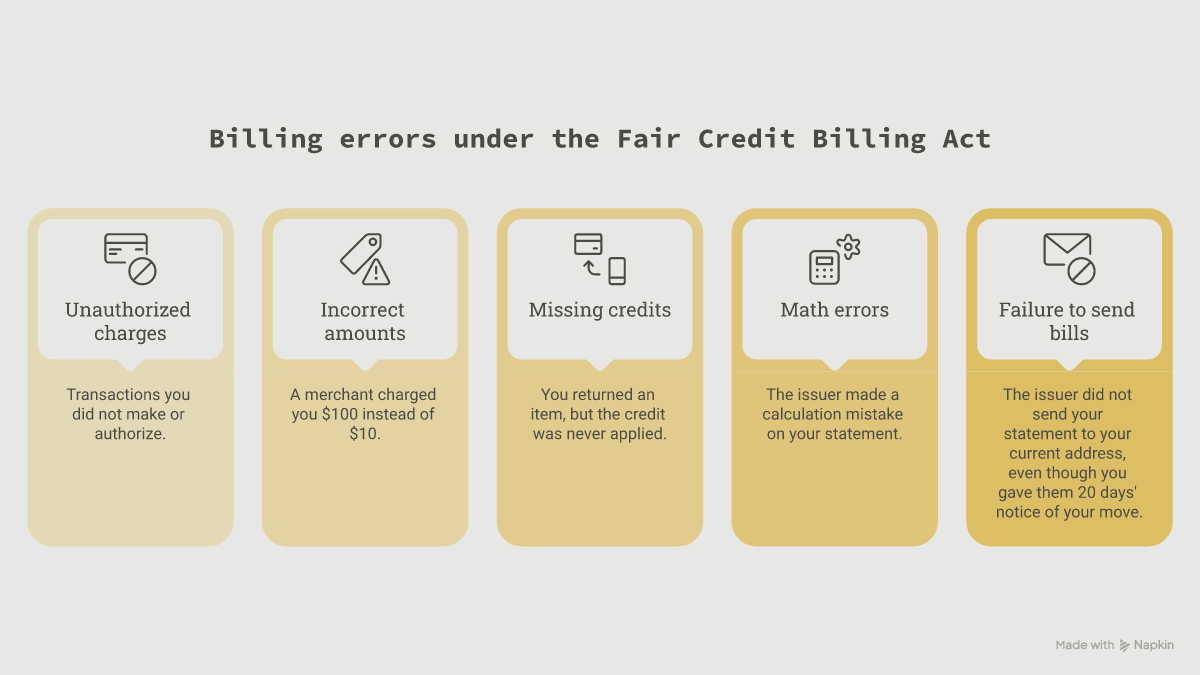
If the interest on your statement is the result of an error made by the bank or a merchant, you have strong legal protections. The Fair Credit Billing Act (FCBA) defines the process for correcting these mistakes.
Common billing errors that lead to unfair interest include:
Unauthorized charges: Transactions you did not make or authorize.
Incorrect amounts: A merchant charged you $100 instead of $10.
Missing credits: You returned an item, but the credit was never applied.
Math errors: The issuer made a calculation mistake on your statement.
Failure to send bills: The issuer did not mail your statement to your current address, provided you gave them 20 days' notice of your move.
Five types of billing errors that can trigger unfair interest, and that the FCBA lets you dispute
The Formal Dispute Process
To protect your rights under the FCBA, you must follow a specific procedure. While many people start with a phone call, federal law only fully protects you if you submit your dispute in writing.
The Formal Dispute Process
1
Write a dispute letter
Include your name, account number, the dollar amount of the error, and a clear description of why you believe it is a mistake. Specifically mention that you are also disputing the interest and finance charges associated with that error.
2
Mail the letter to the correct address
Do not send the letter to the address where you send your payments. Check your statement for the specific address listed for "billing inquiries" or "disputes."
3
Meet the 60-day deadline
The issuer must receive your letter within 60 days of the date they sent the first statement containing the error. Sending the letter via certified mail with a return receipt provides proof of delivery.
4
Wait for the investigation
The issuer must acknowledge your letter within 30 days and resolve the dispute within two billing cycles, no more than 90 days. During this time, you do not have to pay the disputed amount or the interest related to it.
Requesting a Courtesy Interest Waiver
Not every interest charge is the result of a legal "error." Sometimes, a cardholder simply forgets to make a payment by the due date or experiences a technical glitch. In these cases, you are not protected by the FCBA, but you can still request a courtesy waiver.
Credit card issuers often value long-term relationships. If you have a history of on-time payments, many banks are willing to remove a one-time interest charge as a gesture of goodwill.
How to Prepare for the Call
Before calling customer service, it is useful to have your facts ready. Check your account to see how long you have been a customer and confirm that your current balance is paid in full. Issuers are much more likely to waive interest if the underlying balance has already been cleared.
How to Prepare for the Call
1
Contact the customer service department
Call the number on the back of your card. When you reach a representative, state clearly that you noticed an interest charge and would like to see if it can be waived as a one-time courtesy.
2
Provide a brief explanation
If there was a specific reason for the late payment, such as a travel delay or a bank holiday, mention it. Keep the explanation brief and focused on the fact that this is not a recurring habit.
3
Highlight your loyalty
If you have been a customer for several years or have multiple accounts with the bank, mentioning this can be helpful. If you are looking for a broader side-by-side comparison before making any changes, browse the latest best credit cards rankings.
4
Ask for a supervisor if necessary
If the first representative says they do not have the authority to waive interest, politely ask to speak with a supervisor. Often, higher-level staff have more discretion to grant courtesy adjustments.
Disputing Interest via Claims and Defenses
There is a second legal path for disputing charges known as Claims and Defenses. This applies when there is a problem with the quality of a product or service you purchased, and the merchant refuses to fix it.
If you bought a defective appliance or never received a service you paid for, you can assert a claim against the credit card issuer to stop payment. If the dispute is successful, the interest tied to that purchase should also be removed.
To use this protection, several criteria must generally be met:
The purchase must be for more than $50.
The purchase must have been made in your home state or within 100 miles of your billing address. (Note: These geographic limits often do not apply to online or phone orders).
You must have made a good-faith effort to resolve the issue with the merchant first.
You must not have paid the full balance for the item yet.
Comparing Dispute Types
Knowing which type of dispute to file is essential for a successful outcome. The following table breaks down the differences between the three main ways to handle interest charges.
Dispute Type
Primary Reason
Legal Basis
Time Limit
Billing Error
Math error, fraud, or missing credit
Fair Credit Billing Act
60 days from statement date
Courtesy Waiver
Late payment or human error
Bank Policy
No strict limit, usually immediate
Claims & Defenses
Poor quality or non-delivery of goods
Fair Credit Billing Act
Up to 1 year
How Interest Disputes Impact Your Credit Score
A common concern for cardholders is whether disputing a charge or interest will hurt their credit score. In general, the act of disputing an error does not negatively impact your score. Federal law prohibits issuers from reporting an account as delinquent just because you are exercising your right to dispute a bill.
However, there are important caveats:
The Rest of the Bill: You must continue to pay the parts of your bill that are not in dispute. If you stop paying your entire bill, the issuer can report your account as late, which will damage your credit score.
Utilization: While a charge is in dispute, it still counts toward your total credit limit. If the disputed charge is large, it could increase your credit utilization ratio, which is the percentage of available credit you are using. A high ratio can temporarily lower your score.
Final Decision: If the issuer investigates and decides the charge was correct, you will be responsible for paying the amount plus any accrued interest. Refusing to pay after a dispute is finalized can lead to negative credit reporting.
If your goal is to reduce the cost of carrying a balance rather than dispute a single statement entry, a balance transfer card comparison may be worth reviewing.
Managing Interest Moving Forward
If you find that interest charges are becoming a recurring problem, it may be time to evaluate your current financial products. While disputing a single charge can provide temporary relief, high-interest debt requires a more sustainable strategy.
MoneyAtlas provides tools to compare different financial products that can help manage interest costs. For instance:
0% Intro APR Cards: If you are planning a large purchase or need to pay down existing debt, these cards offer a window where no interest is charged on new purchases or balance transfers.
Balance Transfer Cards: Moving debt from a high-interest card to one with a lower rate can save hundreds of dollars in interest. It is important to check for balance transfer fees, which are often 3% to 5% of the total amount.
Personal Loans: For significant debt, a personal loan often provides a lower fixed rate than a variable-rate credit card, making the monthly costs more predictable.
When an issuer agrees to waive interest or corrects a billing error, they must also correct the interest calculation for that period. This is not always a simple subtraction of one line item.
Because interest compounds, meaning you pay interest on previously accrued interest, the total refund should include the interest on the interest. If a $500 error stayed on your account for three months, the issuer must calculate how much total interest that $500 generated over the entire 90-day period.
If you are checking the math on your own statement, remember that the Daily Periodic Rate is applied to your average balance every single day. Even a small error in the underlying balance can lead to a significant interest discrepancy over several months. For a step-by-step walkthrough of the math, see how to calculate the interest rate on a credit card.
Step-by-Step Checklist for Disputing Interest
If you are ready to start the process, follow these steps to ensure nothing is missed:
Step-by-Step Checklist for Disputing Interest
1
Identify the cause
Determine if the interest is from a late payment (courtesy waiver) or a transaction error (legal dispute).
2
Gather documentation
Collect receipts, emails from merchants, and previous statements that show your payment history or the error.
3
Attempt a courtesy waiver first
A quick phone call is often the fastest path. If the bank agrees to waive the interest, ask for a confirmation number.
4
Send a formal letter for errors
If the call doesn't work or the issue is a complex legal error, use the formal FCBA written process.
5
Pay the undisputed portion
Ensure you pay the rest of your statement balance on time to protect your credit score.
6
Monitor your next statement
Verify that the interest credit appears on your bill as promised.
Conclusion
Disputing interest charges on a credit card is more than just asking for a favor. It is about ensuring your financial records are accurate and that you are only paying for the credit you actually used according to the agreed terms. Whether you are leveraging the protections of the Fair Credit Billing Act or seeking a courtesy adjustment for a simple mistake, being proactive is essential.
If you find that high interest rates are making it difficult to keep up with your balance, it is worth comparing alternative options. MoneyAtlas helps you evaluate credit cards with lower ongoing rates or promotional periods that can give your budget more breathing room. For a broader look at cards that may help reduce interest costs, review our balance transfer card options, then compare them with our cash back credit card rankings if rewards matter too.
FAQ
Ready to pick a card?
Compare the cards our editors rate highest right now, side by side, with the fees and rewards that matter.
Wondering what is the difference between American Express Gold and Platinum? Compare annual fees, 4X vs 5X rewards, and luxury travel perks to find your fit.