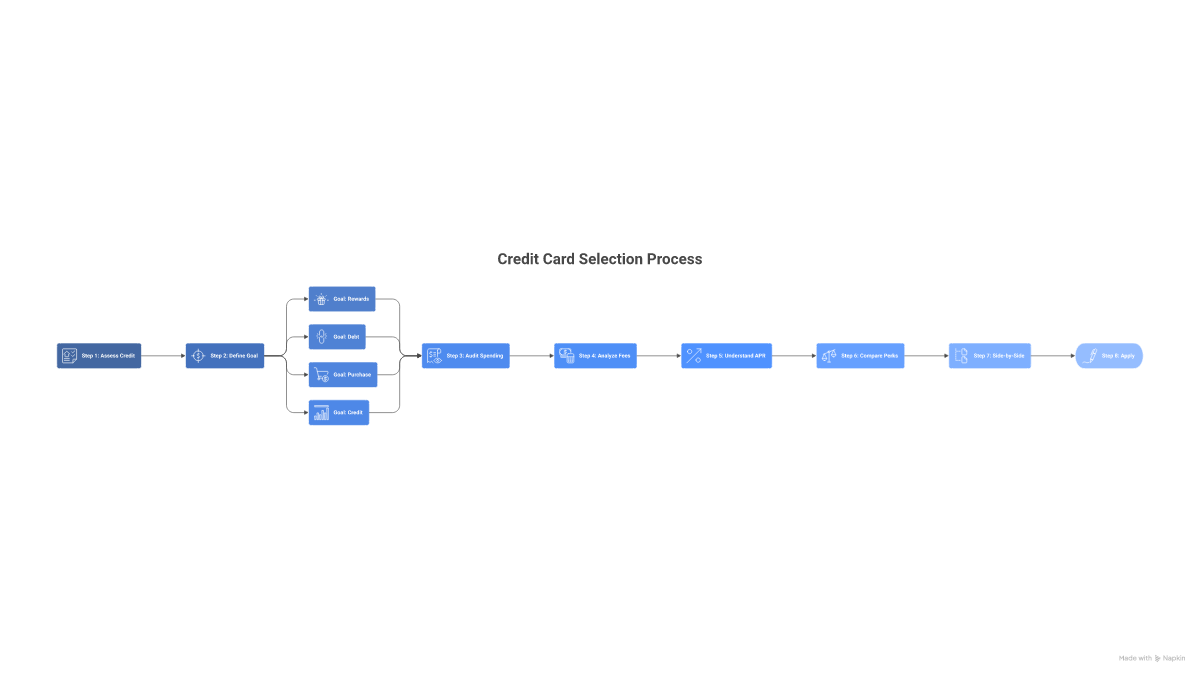
Choosing the right credit card is a decision that impacts your daily budget, your credit score, and your long term financial flexibility. With thousands of options on the market, the process often feels like a search for a needle in a haystack. The best credit card is rarely a single, universal choice. Instead, it is the card that aligns most closely with your specific credit profile, your monthly spending patterns, and your primary financial objectives. MoneyAtlas reviews hundreds of financial products to help you cut through the noise of marketing jargon and fine print. This article explores the specific criteria you must evaluate to distinguish a high-value offer from a costly mistake. We will break down how to assess your credit health, calculate the real value of rewards, and understand the impact of fees so you can compare options with confidence.
Step 1: Assess Your Credit Score and Eligibility
Before looking at rewards or perks, you must know where your credit stands. Your credit score is the primary filter that banks use to decide which products you can access. Most premium rewards cards require good or excellent credit. This typically means that a FICO score of 670 or higher may open more doors.
If your score is in the fair range, which is roughly 580 to 669, your options may be more limited. You might find cards with fewer rewards or higher interest rates. Those with poor credit or no credit history at all should look toward secured cards. These require a refundable security deposit that serves as your credit limit. If that is your situation, start with our credit cards for bad credit comparison.
Knowing your score helps you avoid unnecessary hard inquiries. Every time you apply for a credit card, the lender performs a hard pull on your credit report. This can cause a temporary dip in your score. By only applying for cards that match your credit profile, you reduce the risk of rejection and protect your score. For a deeper look at how scores affect major borrowing decisions, see what credit score is needed to buy a car.
Step 2: Define Your Primary Financial Goal
A credit card is a tool, and you must choose the right tool for the job. Most people fall into one of four categories when searching for a new card.
Earning Rewards on Daily Spending
If you pay your balance in full every month, a rewards card is often the best choice. These cards offer cash back, points, or miles on your purchases. The goal here is to get paid for the spending you are already doing. You can choose between flat rate cards that offer the same percentage on every purchase or tiered cards that offer higher percentages on specific categories like groceries or gas. If rewards are your main focus, compare the options in our rewards credit cards comparison.
Paying Down Existing Debt
For someone carrying a balance on a high interest card, a balance transfer card is worth comparing. These cards often offer an introductory 0% Annual Percentage Rate (APR) on transferred balances for a set period, typically 12 to 21 months. This allows you to pay down the principal faster without new interest charges piling up. Note that most of these cards charge a balance transfer fee, usually 3% to 5% of the total amount moved. If that is your goal, start with our balance transfer card comparison.
Financing a Large Purchase
If you have a significant upcoming expense, such as a home repair or a medical bill, a card with a 0% introductory purchase APR can provide a window to pay it off interest free. As long as the balance is cleared before the promotional period ends, you avoid interest entirely. If a balance remains after the period expires, the standard variable APR will apply to the rest. To understand the cost of borrowing more clearly, read what APR on a credit card means.
Building or Rebuilding Credit
For those starting from scratch or recovering from past financial mistakes, the goal is simply to establish a positive payment history. In this case, the rewards and interest rates matter less than the card's reporting habits. You should verify that the issuer reports your activity to all three major credit bureaus: Experian, TransUnion, and Equifax. If you want a practical place to begin, compare secured and rebuilding options and review the Discover it Secured card.
Step 3: Audit Your Monthly Spending Habits
To maximize the value of a credit card, the rewards structure must match your lifestyle. A card that offers 5% back on travel is of little use if you rarely leave your zip code.
Review your bank statements from the last three months. Look for the categories where you spend the most money. Common high spend categories include:
Groceries: Many cards offer 3% to 6% back at supermarkets.
Dining and Delivery: Some cards prioritize restaurants and takeout.
Gas and Transit: This is ideal for commuters.
Utilities and Streaming: A niche but growing category for rewards.
General Shopping: If your spending is spread across many small categories, a flat rate card offering 1.5% or 2% on everything might be the most lucrative option.
Compare the math between flat rate and tiered rewards. For example, a card offering a flat 2% cash back on all purchases will earn someone spending $2,000 a month exactly $40. A tiered card offering 3% on groceries and 1% on everything else would only earn $30 if that person only spends $500 on groceries and $1,500 on other items. MoneyAtlas provides comparison tools that allow you to plug in your spending habits to see which rewards structure generates the most value for you.
Step 4: Analyze the Real Cost of Fees
A high rewards rate can be easily cancelled out by high fees. You must read the fine print to understand what you are actually paying for the privilege of carrying the card.
Annual Fees
Some of the most powerful rewards cards charge an annual fee, which can range from $95 to over $600. To decide if an annual fee is worth it, you must calculate if the benefits outweigh the cost. If a card costs $95 but gives you a $100 annual hotel credit and 6% back on groceries, the card effectively pays you to carry it. If you do not use those specific perks, a no fee card is likely a better choice. If you want a cleaner starting point, compare no annual fee credit cards.
Foreign Transaction Fees
If you travel internationally or buy from overseas websites, look for a card with no foreign transaction fees. Many cards charge a fee of roughly 3% on every purchase made outside the US. This can quickly erode any rewards you earn while on vacation. For travelers who want a card with stronger perks, the Capital One Venture Rewards Card review is a useful next stop.
Late Fees and Penalty APRs
While you should always aim to pay on time, it is important to know the consequences of a missed payment. Some cards charge up to $40 for a late payment and may trigger a penalty APR. A penalty APR is a significantly higher interest rate that stays on your account for several months or longer.
Step 5: Understand Interest Rates (APR)
The Annual Percentage Rate, or APR, is the cost of borrowing money on the card. For most cards, this is a variable rate tied to the U.S. Prime Rate.
If you pay your balance in full every month, the APR is largely irrelevant. This is because of the grace period. Most issuers do not charge interest on new purchases if you pay the entire statement balance by the due date every month.
If you plan to carry a balance, the APR is the most important factor. Even a difference of 2% or 3% in your APR can result in hundreds of dollars of interest over a year. When comparing cards, look for the lowest ongoing APR if you know you cannot always pay the full balance. Rates for credit cards are currently competitive, but they can fluctuate based on market conditions. Always check the issuer's website for the most up to date figures.
Step 6: Compare Intro Bonuses and Perks
Credit card issuers often offer "welcome bonuses" to attract new customers. These might include a large lump sum of points or cash back after you spend a certain amount in the first few months.
Evaluating the Welcome Bonus
A bonus of $200 for spending $1,000 in three months is a 20% return on that spending. This is a significant boost in the first year of card ownership. However, you should never spend more than you normally would just to trigger a bonus. Doing so can lead to debt that costs far more in interest than the bonus is worth.
Beyond the Bonus: Secondary Perks
The best cards often include "hidden" benefits that provide long term value. These may include:
Cell Phone Protection: Coverage for damage or theft if you pay your monthly bill with the card.
Extended Warranty: Adds extra time to a manufacturer’s warranty on items bought with the card.
Purchase Protection: Covers new items against theft or accidental damage for a set period.
Travel Insurance: Includes coverage for trip cancellation or car rental collisions.
These perks are often overlooked but can save you hundreds of dollars in unexpected costs. When you compare cards side by side, it helps to use a broader credit card reviews page as a jumping off point.
Step 7: How to Compare Options Side by Side
Once you have narrowed down your list to two or three cards, it is time for a final head to head comparison. Use a structured approach to ensure you are looking at the same criteria for each card.
Comparison Checklist
Check the Credit Requirement: Ensure your score matches the typical requirements for the card.
Compare the Rewards Rate: Calculate your expected annual earnings based on your specific budget.
Subtract the Annual Fee: Find the net value of the rewards.
Evaluate the Intro Offer: Look at the 0% APR period or the welcome bonus.
Look for "Deal Breakers": Check for foreign transaction fees or lack of travel insurance if those are important to you.
MoneyAtlas makes this process easier by organizing these details into clear tables. Instead of digging through multiple bank websites, you can see the APR ranges, fee structures, and reward categories in one place.
Step 8: The Application Process
Applying for a credit card is usually a fast, online process. Most issuers provide a decision in 60 seconds or less. To make the process as smooth as possible, follow these steps.
How to Apply for a Credit Card
1
Gather Your Information
You will need your Social Security number, your total annual gross income, and your monthly housing payment. Lenders use your income to debt ratio to determine your credit limit.
2
Look for Pre-Approval Offers
Many issuers allow you to see if you "pre-qualify" for a card without a hard credit pull. While this is not a guaranteed approval, it gives you a much better idea of your chances before you commit to a hard inquiry.
3
Complete the Application
Ensure all information is accurate. Even a small typo in your Social Security number or address can lead to a manual review, which can delay the decision by several days.
4
Read the Final Terms
If approved, you will receive a specific credit limit and a specific APR. Review these one last time before activating the card. If the limit is too low to be useful or the APR is higher than expected, you can choose not to use the card, though the hard inquiry will remain on your report.
Common Pitfalls to Avoid
When choosing a card, it is easy to be swayed by flashy marketing. Avoid these common mistakes to ensure you get the best deal.
Don't ignore the "Effective" APR. If a card has a 0% intro period, people often forget to check what the rate will be after that period ends. If you expect to still have a balance 18 months from now, the ongoing rate is more important than the intro rate.
Avoid cards with "Deferred Interest." Some store cards offer "no interest if paid in full" by a certain date. This is different from a 0% APR offer. With deferred interest, if you owe even $1 when the period ends, the issuer may charge you interest on the entire original purchase amount from the date of purchase. Genuine 0% APR cards only charge interest on the remaining balance.
Watch out for "Credit Junk" cards. Some cards targeted at those with poor credit charge "monthly maintenance fees" or "application fees" before you even use the card. These fees are often predatory. A secured card from a reputable bank is almost always a better choice for building credit than a "subprime" unsecured card with high fees.
Be realistic about travel rewards. Travel points often have complex redemption rules. If you prefer simplicity, a cash back card is usually the better choice. Cash is flexible and never expires, whereas airline miles can be devalued by the airline at any time. If you are comparing travel-first cards, our travel rewards card comparison is a good next step.
Summary of the Selection Process
Choosing a credit card doesn't have to be a guessing game. By following a logical path, you can find a product that saves you money and helps you reach your financial goals.
Check your credit score to know which cards are within reach.
Choose a goal, whether it is rewards, debt payoff, or building credit.
Match rewards to spending by looking at your past bank statements.
Calculate the net value by subtracting annual fees from expected rewards.
Check for secondary perks like insurance and protection plans.
Use comparison tools to view multiple offers side by side.
The landscape of credit cards is always shifting. New offers appear and terms change frequently. MoneyAtlas provides the updated research and expert ratings you need to stay informed. Once you have a clear understanding of your needs, the next step is to head to our comparison page and see how the current top offers stack up against each other.
FAQ
Choosing the right credit card in eight steps
Ready to pick a card?
Compare the cards our editors rate highest right now, side by side, with the fees and rewards that matter.
Learn how to lower credit card APR with 5 proven strategies. From negotiating with issuers to 0% transfers, discover how to offset rising interest rates.