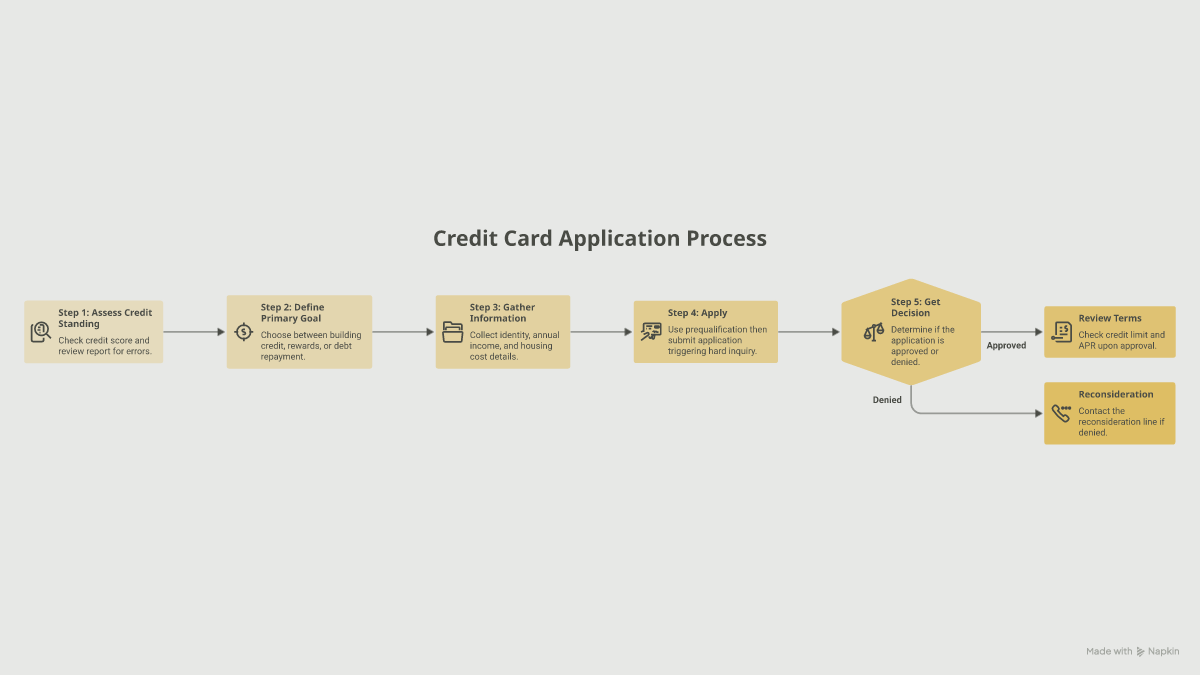
Applying for a credit card is a significant financial step that impacts your credit score and long-term borrowing power. Whether you are seeking to build credit from scratch or looking to maximize rewards on your daily spending, the process requires more than just filling out a form. Understanding the mechanics of credit inquiries and eligibility requirements can help you avoid unnecessary hits to your credit score. MoneyAtlas provides a best credit cards comparison to help you evaluate different card offers side by side before you commit to an application. This article covers the essential steps of the application process, the documentation you need, and how to choose a card that aligns with your financial profile. Successful credit card applications depend on careful preparation and a clear understanding of what lenders look for in a borrower.
The five key steps of the credit card application process.
Assess Your Credit Standing
Before you look at specific card offers, you need to know where your credit stands. Lenders use your credit score to determine the risk of lending to you. This score is a three-digit number, typically between 300 and 850, calculated based on your payment history, debt levels, and the length of your credit history.
Checking your credit score does not hurt your credit. Most major banks and many third-party services offer free access to your FICO or VantageScore. Knowing this number helps you filter cards. For example, some premium travel cards generally require a score of 670 or higher. If your score is in the 500s, you may be better suited for a secured credit card or a card designed for rebuilding credit. If you are still getting oriented, our fair credit card comparison can help you narrow the field.
Review Your Credit Report
Your credit score is based on the information in your credit report. It is useful to pull a full report from the three major bureaus: Equifax, Experian, and TransUnion.
Look for errors such as accounts you did not open or late payments that were actually made on time. Correcting these errors before you apply for a credit card can lead to a higher score and better approval odds. Lenders look for a history of on-time payments and low credit utilization, which is the percentage of your available credit you are currently using.
Define Your Primary Goal
Not all credit cards serve the same purpose. Identifying your primary goal allows you to ignore irrelevant offers and focus on cards that provide the most value for your specific situation. Common goals include building credit, earning rewards, or reducing interest on existing debt.
Building or Rebuilding Credit
For those with no credit history or a low score, the primary goal is often credit building. Secured credit cards are a common entry point. These cards require a refundable security deposit that usually acts as your credit limit. If you deposit $200, your limit is $200. This deposit protects the lender while you prove you can manage credit responsibly. Many issuers will graduate you to an unsecured card and return your deposit after several months of on-time payments. For a deeper look at starter options, see our secured credit card reviews.
Maximizing Rewards
If you already have a good to excellent credit score, you might prioritize rewards. These typically fall into two categories: cash back and travel points. Cash back cards often offer a flat rate, such as 1.5% or 2% on all purchases, or higher rates on specific categories like groceries or gas. Travel cards earn points or miles that can be redeemed for flights, hotels, or car rentals. These often come with higher annual fees but offer perks like airport lounge access or travel insurance. If cash back is your focus, browse the cash back card comparison to compare rates and fees.
Paying Down Debt
For someone carrying a balance on a high-interest card, a balance transfer card is worth comparing. These cards often feature an introductory 0% APR period on transferred balances, sometimes lasting 12 to 21 months. This allows you to pay down the principal faster without accumulating new interest. Note that most balance transfer cards charge a fee, often between 3% and 5% of the total amount transferred. If that is your goal, compare balance transfer cards before applying.
Gather Necessary Information
Federal law requires credit card issuers to verify your identity. This is part of the Know Your Customer (KYC) regulations designed to prevent money laundering and identity theft. Having this information ready makes the online application process faster.
Standard personal information includes:
Full legal name and date of birth.
Social Security number or Individual Taxpayer Identification Number (ITIN).
Current residential address and sometimes previous addresses if you have moved recently.
Contact information, including email and phone number.
Understanding Income Requirements
You will also be asked for your annual gross income. This is your total income before taxes. Under the Credit Card Accountability Responsibility and Disclosure (CARD) Act, issuers must consider your "ability to pay."
If you are 21 or older, you can include income to which you have a "reasonable expectation of access." This may include a spouse's income, partner's income, or household income from other sources, provided you can use that money to pay your bills. If you are under 21, you can generally only include your own independent income, such as wages from a job or specific grants and scholarships.
Commonly accepted income sources include:
Full-time or part-time wages.
Freelance or side-gig earnings.
Social Security or pension payments.
Investment income or dividends.
Child support or alimony, if you choose to include it.
Housing Costs
Most applications ask for your monthly housing payment. This includes your rent or mortgage. Lenders use this to calculate your debt-to-income ratio. They want to ensure that after you pay your housing and other obligations, you have enough left to manage a credit card payment.
The Application Process
Once you have chosen a card and gathered your information, you are ready to apply. Most people apply online through the issuer's website. MoneyAtlas makes it easier to compare side by side before clicking through to an application.
Prequalification vs. Pre-approval
Many issuers offer a prequalification or pre-approval tool. This is a highly recommended step. When you use these tools, the issuer performs a soft credit pull. This does not affect your credit score. It allows the issuer to tell you which cards you are likely to be approved for based on a preliminary look at your credit profile.
While prequalification is not a guarantee of approval, it significantly reduces the risk of applying and being denied. A formal application will still require a hard credit pull, which typically stays on your credit report for two years and may temporarily lower your score by a few points.
The Hard Credit Inquiry
When you submit the final application, the lender requests your full credit report from one or more of the credit bureaus. This is the hard pull. If you apply for multiple cards in a short period, these inquiries can add up and signal to lenders that you are a high-risk borrower.
The Wait for a Decision
Many online applications provide an instant decision. You might see an "Approved," "Denied," or "Pending" message within 60 seconds. If your application is pending, the issuer may need to manually verify your income or identity. You might receive a request for additional documents.
If you are approved, the issuer will tell you your credit limit and your Annual Percentage Rate (APR). Your credit card will typically arrive in the mail within 7 to 10 business days. Some issuers provide a digital version of the card immediately that you can add to a mobile wallet.
From Comparison to Card in Hand
1
Check your credit score
Use a free service to find your current FICO or VantageScore so you know which card tier to target.
2
Compare offers on MoneyAtlas
Look at annual fees, rewards rates, and introductory APR offers to find the best fit for your spending habits.
3
Use a prequalification tool
Check if the issuer has a "see if you're pre-approved" option to verify your odds without hurting your credit.
4
Complete the formal application
Fill out the online form with your SSN, income, and housing details.
5
Review the terms
If approved, read the Cardmember Agreement carefully to understand the late fees, foreign transaction fees, and how interest is calculated.
6
Activate and use responsibly
Once the card arrives, activate it and set up automatic payments for at least the minimum amount to ensure you never miss a due date.
What to Do if Your Application is Denied
A credit card denial is common and does not permanently damage your financial standing. Federal law requires the lender to send you an "adverse action notice." This letter explains the specific reasons you were denied.
Common reasons for denial include a credit score that is too low, insufficient income, a high debt-to-income ratio, or too many recent hard inquiries. Read this letter carefully because it tells you exactly what you need to improve.
The Reconsideration Line
If you believe your application was denied in error or if you have additional information that might change the decision, you can call the issuer's reconsideration line. This connects you with a human representative who can review your application again. You might explain that a recent pay raise is not reflected in your report or that you have a long-standing banking relationship with the institution. Sometimes, a simple conversation can turn a denial into an approval.
Improving Your Odds for Next Time
If the denial stands, focus on the reasons cited in the notice. If the issue was credit utilization, pay down your existing balances. If the issue was a lack of credit history, consider starting with a secured card or becoming an authorized user on a family member's account. MoneyAtlas reviews different credit-building products that can help you bridge the gap until you qualify for a standard unsecured card. If you want to compare starter options in more detail, review the secured card lineup.
Best Practices for New Cardholders
After you are approved and receive your card, the way you manage it will determine its impact on your credit score. Credit cards are tools that can either build your financial reputation or create a cycle of debt.
Understand Your APR
The Annual Percentage Rate is the cost of borrowing money if you do not pay your balance in full every month. Most credit cards have variable APRs, meaning they can change based on the prime rate. If you pay your statement balance in full by the due date every month, you will not be charged interest on purchases. This is known as a grace period. For a closer look at how interest works, read what APR means on a credit card.
Monitor Your Utilization
Your credit utilization ratio is the second most important factor in your credit score. It is calculated by dividing your total credit card balances by your total credit limits. For example, if you have a $1,000 limit and spend $300, your utilization is 30%. Financial experts often suggest keeping this ratio below 30%, though staying under 10% is even better for your score. If you are thinking about whether to keep or close an account, this guide on closing a credit card explains the credit score trade-offs.
Set Up Autopay
Payment history is the single most important factor in your credit score. Even one payment that is 30 days late can cause a significant drop in your score. Setting up automatic payments for at least the minimum amount due ensures you never miss a deadline. However, to avoid interest charges, you should aim to pay the full statement balance every month.
Conclusion
Applying for a credit card is a straightforward process when you have the right information. By checking your credit score, defining your goals, and using comparison tools, you can identify the card that offers the most value for your situation. MoneyAtlas helps you compare the latest offers from top issuers so you can make an informed choice. Remember that the application is just the beginning. Responsible use, including on-time payments and low utilization, will help you build a strong credit profile over time.
If you are ready to see which cards you might qualify for, use our best credit cards comparison to evaluate rewards, fees, and interest rates today.
Ready to pick a card?
Compare the cards our editors rate highest right now, side by side, with the fees and rewards that matter.
Learn how to lower credit card APR with 5 proven strategies. From negotiating with issuers to 0% transfers, discover how to offset rising interest rates.