



LoansApril 30, 2025
What Credit Score is Needed to Buy a Car? Tips for Approval
Learn what credit score is required to get approved for an auto loan and how to boost your chances of securing better loan terms.
Continue Reading


A home equity agreement, or HEA, gives you a lump sum of cash today in exchange for a share of your home's value when you sell or settle the deal later. There are no monthly payments and no interest in the usual sense. The trade sounds simple, but the cost lands at the end, when you hand over a slice of your home's appreciation. This guide explains how HEAs work, what they cost, which companies offer them, and when a HELOC or home equity loan is the smarter call.
A home equity agreement is a financing contract, not a loan. An investor pays you a lump sum today, and in return they receive a percentage of your home's value when the agreement ends. The same product goes by other names: home equity investment (HEI), shared equity agreement, or equity sharing. Because it is not a loan, there is no interest rate and no monthly bill. You repay by buying out the investor or selling the home, any time within a term that usually runs 10 to 30 years.
The distinction from a loan matters. You are not borrowing money and paying it back with interest; you are selling a stake in your home's future value. You keep the title, you keep living there, and you make the decisions about the property. What you give up is certainty about the final cost, because the payoff floats with your home's value instead of a fixed rate you can calculate in advance.
The amount you can access depends on your home equity, your home's appraised value, and the provider's limits. Most companies require you to keep a minimum ownership stake, so you cannot cash out all of your equity. the CFPB's market overview of home equity contracts tracks how fast this market has grown and flags the disclosure gaps borrowers should watch.
An HEA runs in three stages. First, the provider appraises your home and offers you a lump sum, often 5% to 20% of your home's current value. Second, you take the cash with no monthly payments for the length of the term. Third, you settle: when you sell, refinance, or reach the end of the term, you repay the original amount plus the investor's agreed share of your home's appreciation.
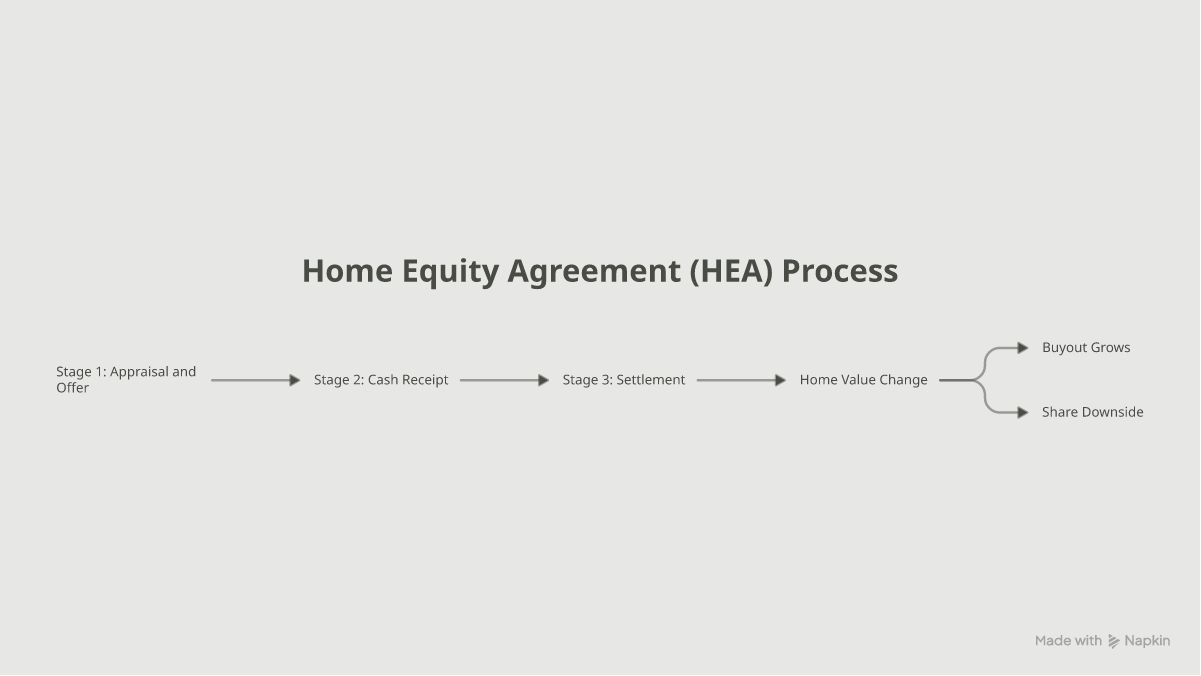
The investor's cut is tied to your home's value, not a fixed interest rate. If your home gains value, the buyout grows. If your home loses value, most agreements share the downside, so you may repay less than a comparable loan would have cost. The provider places a lien on the property to secure its position, similar to a second mortgage, which is why you keep the title and keep living in the home.
A ratings-agency primer on home equity investments explains the investor side: providers pool and sell these contracts, which shapes how they price the appreciation share.
A simple example shows where the cost comes from. Say your home is worth $400,000 and a provider gives you $40,000, or 10% of the value, for a 20% share of future appreciation. If you sell years later for $500,000, the home gained $100,000. The investor's 20% share of that gain is $20,000, so your buyout is the original $40,000 plus $20,000, or $60,000 total. Repaying $60,000 on $40,000 of cash is a steep effective cost, and it climbs with every dollar your home appreciates. That math is the whole story of an HEA: the faster your home rises, the more the deal costs you.
All three products let you tap home equity, but they cost money in very different ways. A HELOC and a home equity loan are debt: you borrow against your equity and repay with interest on a monthly schedule. An HEA is not debt: you trade a share of future appreciation for cash and settle in one payment later. The table below shows where each one fits.
To run the numbers on a traditional option, our home equity loan calculator estimates monthly payments, and our guide to the best HELOC lenders compares current rates. The CFPB's explainer on home equity loans and HELOCs is a neutral primer if you are weighing the debt route.
Four providers lead the HEA market in 2026: Hometap, Point, Unlock, and Splitero. Figure also offers home equity products, though it leans toward HELOCs. Terms, maximum payouts, and state availability vary, so the right fit depends on your home value, your credit, and how long you want the agreement to run. Short profiles below link to our full independent reviews, and you can compare every provider on our home equity investment hub.
Hometap offers cash for a share of your home's value on a 10-year term with no monthly payments. It is one of the most established providers and works with a wide credit range. Read our Hometap review for current terms and eligibility.
Point offers home equity investments with terms up to 30 years, which gives you more runway before the buyout comes due, and it serves a broad set of credit profiles. See our Point review for the details.
Unlock allows partial buyouts during the term, so you can settle in stages instead of one lump sum. That flexibility sets it apart from the others. Our Unlock review covers the fee structure.
The three most-searched providers differ mainly on term length, buyout flexibility, and how they handle partial settlements. Here is a side-by-side look. [MANUAL: confirm each provider's current term length, credit minimum, and buyout rules against the live reviews before publishing.]
These differences matter most at settlement. A longer term, like Point's, delays the buyout but gives appreciation more time to grow the investor's share, which can cut both ways. Unlock's partial buyouts let you reduce the obligation early, which limits how large the final payoff can get. Hometap's 10-year window suits owners who expect to sell or refinance within the decade. Match the structure to your exit plan, then read the full review of whichever provider lines up, because the appreciation share and any fees are where the real cost differences live.
An HEA solves a specific problem: it unlocks equity without a monthly payment. It is not free money, and the cost can run high if your home appreciates fast.
No monthly payments: You get a lump sum without adding to your monthly bills, which helps when cash flow is tight.
Flexible credit requirements: Many providers approve scores in the 500s, where a HELOC would decline you.
Shared downside: If your home loses value, most agreements lower your payoff, unlike a fixed loan.
Expensive in a hot market: Strong appreciation means the investor's share can cost far more than loan interest would have.
Equity dilution: You give up a slice of future gains and reduce the equity you keep at sale.
Buyout pressure: You must settle within the term, which can force a sale or refinance if you cannot fund the buyout.
A home equity agreement fits a narrow profile. Consider one if you have meaningful home equity, want cash without a new monthly payment, and either cannot qualify for a HELOC or do not want more monthly debt. It also suits owners who expect flat or modest home appreciation, since that keeps the investor's share in check.
Look elsewhere if you expect your home to appreciate quickly, because the appreciation share can dwarf loan interest, or if you plan to stay long term without selling, since the buyout still comes due at the end of the term. Eligibility usually turns on your loan-to-value ratio, your remaining equity, and owner-occupancy; most providers want you living in the home and lend against a primary residence, though some allow investment properties. Debt-to-income matters less than it does for a loan because there is no monthly payment to underwrite.
Common uses include consolidating high-interest debt, funding a renovation, covering a large one-time expense, or bridging income during a career change. The throughline is the same in each case: you need cash, you have equity, and a monthly payment would strain your budget. If a HELOC or home equity loan is within reach and you can carry the payment, run both options side by side first, because the fixed cost of a loan is often cheaper than handing over a share of appreciation in a market that keeps climbing.
The application is lighter than a mortgage because there is no monthly payment to underwrite. Most providers move from estimate to funding in two to four weeks.
Check your eligibility
Confirm you have enough equity and that your home qualifies. Most providers set a minimum equity threshold and lend against owner-occupied homes, though some allow investment properties.
Get an estimate
Enter your home value and mortgage balance on the provider's site. You will see an estimated lump sum and the share of future value you would owe at settlement.
Complete the application and appraisal
Submit income and property details. The provider orders a home appraisal to set the official value the agreement is based on.
Review the agreement terms
Read the term length, the appreciation share, and the buyout formula. Compare the likely total cost against a HELOC or home equity loan before signing.
Close and receive funds
Sign the agreement, which places a lien on your home, and receive the lump sum, usually by wire within a few days.
See offers from multiple lenders in minutes with no impact to your credit score.
Check my rateArticles and reviews from the MoneyAtlas editorial team — independent research on credit cards, banking, loans, insurance, and investing.
Learn what credit score is required to get approved for an auto loan and how to boost your chances of securing better loan terms.

Confused about student loans? Learn the key differences between subsidized and unsubsidized loans, their benefits, and which is best for you.

Buying your first car? Learn how to get approved for a first-time car buyer loan, improve your chances, and save money on interest and payments.