Requesting a 0% Annual Percentage Rate (APR) on an existing credit card is possible, though success often depends on your payment history and the specific policies of the card issuer. Most 0% offers are marketed as introductory deals for new customers, but cardholders can sometimes negotiate temporary rate reductions or hardship plans. MoneyAtlas tracks various credit products to help you understand how these interest-free periods work and how they compare across the market. This article explores the methods for requesting a lower rate from your current bank, the likelihood of securing a true 0% deal on an active account, and the alternative of moving your balance to a new card. Understanding these options is the first step toward reducing interest costs and managing debt more effectively.
Requesting a 0% APR from Your Current Issuer
If you want to lower the interest rate on a card you already own, the most direct path is to call the customer service number on the back of your card. While banks are not required to lower your rate, they may do so to keep you as a customer. However, a jump all the way down to 0% is uncommon for standard accounts.
The Retention Request
Credit card companies want to keep profitable customers who pay on time. If you have a high credit score and a history of on-time payments, you may have leverage. You can mention that you are considering moving your balance to a competitor offering a 0% introductory rate. In some cases, the issuer may offer a temporary retention rate that is significantly lower than your current APR, though it may still be higher than 0%.
Hardship Programs
If you are struggling to make payments due to a job loss, illness, or other financial setback, you can request a hardship program. These programs are designed to help you avoid default. Under a hardship plan, an issuer might lower your APR to 0% or a very low percentage for a set period, such as 6 to 12 months. Note that entering a hardship program often results in the issuer freezing or closing your account to prevent further spending.
Step-by-Step: How to Negotiate Your Rate
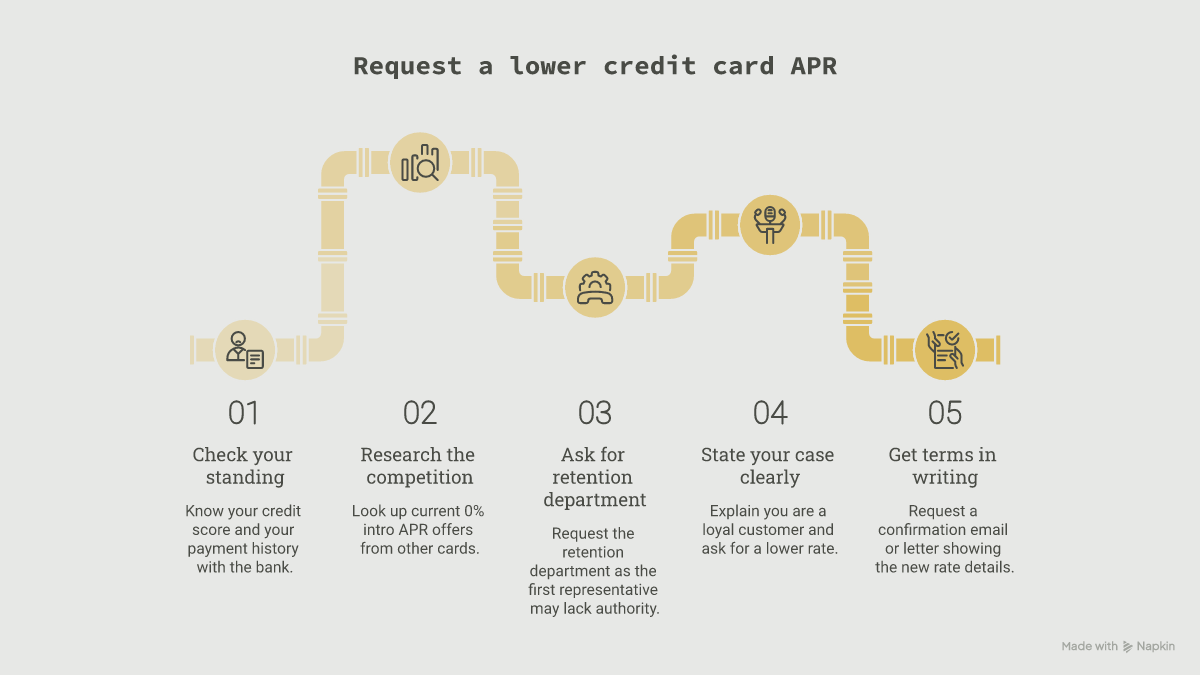
Check your current standing. Know your credit score and your history with the bank. High scores provide the most leverage.
Research the competition. Look at current 0% intro offers from other cards so you can reference them during the call.
Call and ask for the retention department. The first representative you speak with may not have the authority to change your rate.
State your case clearly. Use a script such as, "I have been a loyal customer for five years, but my current APR is too high. I see other cards offering 0% for 15 months. Can you offer a 0% rate to keep my business?"
Get the terms in writing. If they agree to a lower rate, ask for a confirmation email or letter detailing how long the rate lasts and what triggers its end.
Five steps to negotiate a lower APR with your current card issuer
The Alternative: New 0% Introductory APR Cards
For many cardholders, requesting 0% from a current bank is less effective than applying for a new card. Credit card issuers use 0% introductory periods to attract new customers. These offers typically last between 12 and 21 months. If you want to compare current options, start with our balance transfer card comparison and then review the best credit cards side by side.
Purchase APR vs. Balance Transfer APR
When comparing 0% offers, it is vital to distinguish between the two main types of promotional rates. For rewards-heavy spending, it can also help to look at the cash back card comparison.
0% Intro Purchase APR: This applies to new things you buy with the card. It is useful for someone planning a large expense, like a home appliance or holiday shopping.
0% Intro Balance Transfer APR: This applies to debt you move from an old card to the new one. This is a common strategy for debt consolidation.
Some cards offer 0% on both, while others limit the offer to just one category. MoneyAtlas makes it easier to compare these terms side by side so you can see which cards offer the longest windows for your specific needs.
Common 0% Intro Terms
The following table illustrates typical 0% intro APR offers available in the current market. These figures are based on recent data and are subject to change.
Card Category
Typical 0% Duration
Common Standard APR After Intro
Best For
Low Interest / Utility
18 to 21 months
17% to 28% (Variable)
Maximum time to pay off debt
Cash Back Rewards
12 to 15 months
18% to 27% (Variable)
New purchases plus earning rewards
Travel Rewards
12 to 15 months
19% to 28% (Variable)
Financing a trip while earning miles
Business Cards
12 months
16% to 24% (Variable)
Managing business cash flow
How 0% APR Works Mechanically
Even when you have a 0% rate, you must follow specific rules to keep it. The APR, or Annual Percentage Rate, is the yearly cost of borrowing money. At 0%, that cost is zero, but the underlying account still functions like a standard credit card.
Minimum Payments Are Still Required. You must make at least the minimum monthly payment by the due date. If you miss a payment, the issuer can cancel your 0% promotion immediately and move you to the standard ongoing APR.
The Schumer Box Disclosure. Every credit card offer includes a standardized table of rates and fees called a Schumer Box. You should read this carefully to see when the 0% period ends and what the rate will be afterward. The 0% rate is temporary. Once it expires, any remaining balance will start accruing interest at the standard variable rate.
Balance Transfer Fees. If you use a 0% offer to move debt, you will likely pay a balance transfer fee. This is usually 3% to 5% of the amount you move. For someone moving $5,000, a 5% fee adds $250 to the balance. You must calculate if the interest saved over the 0% period exceeds the cost of the fee. For more detail, see how a credit card balance transfer works.
0% Intro APR vs. Deferred Interest
It is easy to confuse a true 0% APR offer with deferred interest promotions often found at furniture or electronics stores. They are not the same thing.
In a 0% intro APR arrangement, if you have a balance left when the period ends, you only pay interest on that remaining amount going forward.
In a deferred interest arrangement, you must pay the entire balance to zero before the promotional period ends. If you have even $1 left on the account, the lender may charge you interest on the full original purchase amount, backdated to the day you bought it. This can result in a massive, unexpected interest charge.
Comparison of 0% APR and Deferred Interest
0% Intro APR:
Interest starts only after the period ends.
Only applies to the remaining balance.
Common with major bank credit cards.
Deferred Interest:
Interest is waiting in the background.
If not paid in full, interest is charged on the total original amount.
Common with store-branded financing and no interest if paid in full offers.
If you want a broader explanation of how borrowing costs are calculated, our guide on how APR works on a credit card is a useful next step.
Impact on Your Credit Score
Requesting a lower rate on an existing card usually does not affect your credit score. The bank performs an internal review of your account. However, if you decide to apply for a new 0% APR card, there are a few factors to consider.
Hard Inquiries. When you apply for a new card, the lender will perform a hard credit pull. This typically causes a small, temporary dip in your credit score.
Credit Utilization. Your credit utilization ratio is the percentage of your total available credit that you are currently using. Adding a new card increases your total available credit. If you keep your spending the same, your utilization ratio drops, which can actually help your credit score. If you want a deeper explanation, our article on how 0% APR balances affect credit scores covers the tradeoffs.
Average Age of Accounts. Opening a new card lowers the average age of your credit accounts. This is a smaller factor in your credit score, but it is worth noting if you have a very short credit history.
What to Do Before the 0% Period Ends
The goal of a 0% APR period is to pay off the balance before interest begins to accrue. If you still have a balance as the deadline approaches, you have a few options.
Set a Calendar Reminder. Do not rely on the bank to tell you when your rate is about to expire. Mark your calendar for two months before the expiration date to assess your progress.
Increase Your Payments. If you have a remaining balance, try to adjust your budget to pay it off more aggressively. Every dollar paid during the 0% window is a dollar that will never be charged interest.
Consider Another Transfer. If you still owe a significant amount, you might look for another balance transfer offer. However, you generally cannot transfer a balance between two cards from the same bank. You would need to find a card from a different issuer. Using MoneyAtlas to compare current balance transfer offers can help you find a new home for that debt if needed. If your goal is a simple no-fee card, you can also browse no annual fee credit cards.
Conclusion
While you can request 0% APR on an existing credit card, it is a difficult request to get approved outside of specific hardship programs. Most people find that the most effective way to secure a 0% rate is to compare new credit card offers. These introductory deals provide a set window of time to pay down debt or finance large purchases without the burden of interest. Before choosing a card, check the length of the intro period, the balance transfer fees, and the ongoing APR that will apply once the promotion ends.
Check your credit score to see which offers you likely qualify for.
Calculate the cost of balance transfer fees against your potential interest savings.
Create a repayment plan to ensure the balance is gone before the 0% period expires.
To find the right fit for your financial situation, use the comparison tools at MoneyAtlas to look at the latest 0% intro APR offers side by side. You can also explore our credit card review hub when you want to dig into individual card details.
Ready to pick a card?
Compare the cards our editors rate highest right now, side by side, with the fees and rewards that matter.
Learn how to lower credit card APR with 5 proven strategies. From negotiating with issuers to 0% transfers, discover how to offset rising interest rates.