The question of what counts as a low interest rate is one of the most common points of confusion for credit cardholders. Most people want to know if the rate on their current statement is competitive or if they are paying more than necessary to carry a balance. Because credit card interest rates are tied to market conditions and individual credit profiles, the definition of a "low" rate changes over time. MoneyAtlas tracks these shifts to help you understand where your accounts stand compared with the broader market. This guide covers how to identify a low interest rate, the difference between introductory and ongoing APRs, and the factors that determine the rate a lender offers you. Understanding these benchmarks is the first step toward comparing your options, and you can start by exploring our best credit cards comparison.
The Benchmark for Low Interest Rates
To determine if a rate is low, you first need to look at the national average Annual Percentage Rate (APR). The APR is the cost of borrowing money on your card over the course of a year, including interest and certain fees. The Federal Reserve tracks the average APR for all credit card accounts in the United States. As of recent data, that average has hovered between 21% and 23%. If you want to compare that benchmark against current products, take a look at our credit card reviews index.
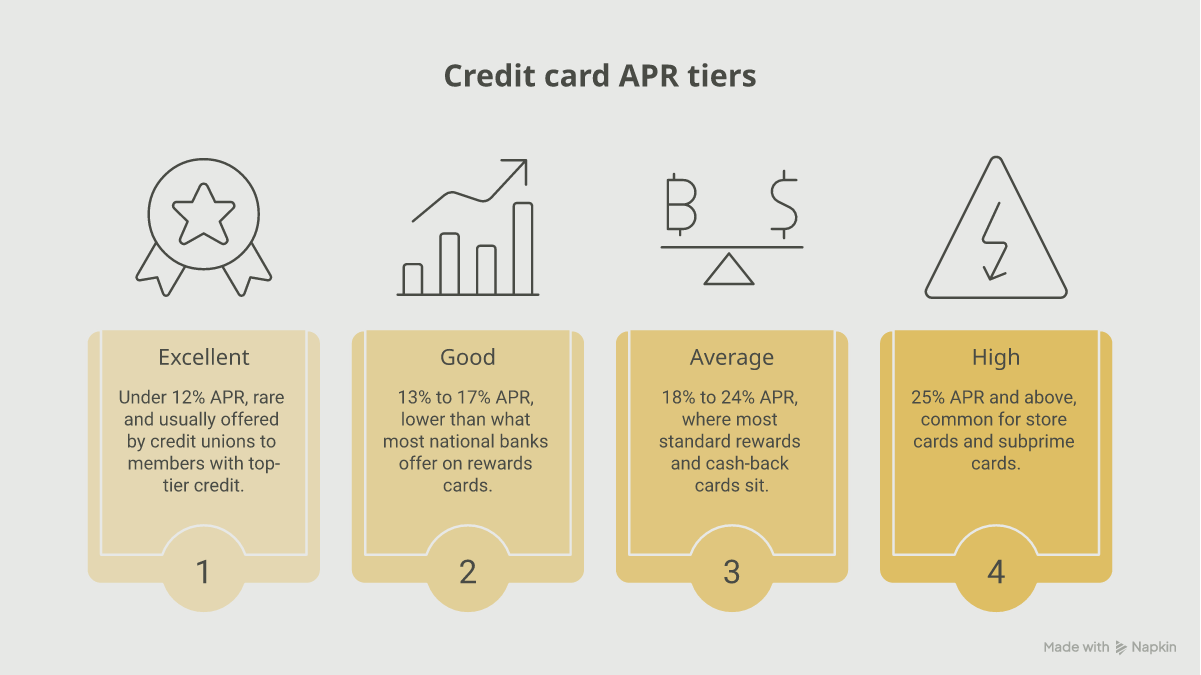
If a card offers an APR below this range, it can technically be considered a low-interest card. However, the financial industry often uses more specific tiers to categorize these rates:
Excellent: Under 12%. These rates are rare and usually offered by credit unions to members with top-tier credit.
Good: 13% to 17%. This range is lower than what most national banks offer for rewards cards.
Average: 18% to 24%. Most standard rewards and cash-back cards fall into this bracket.
High: 25% and above. These rates are common for store cards, subprime cards, or for borrowers with lower credit scores.
The rate you receive is not just a reflection of the market. It is a reflection of your creditworthiness. Lenders use your credit history to determine how much risk they take by lending to you. Lower risk for the lender translates to a lower APR for you.
Credit card APR tiers, from excellent to high, against the 21-23% national average
Your credit score is the single most important factor in the interest rate you are offered. Credit card issuers typically provide a range for each card, such as 18.99% to 29.99%. Where you land in that range depends on your credit profile.
Excellent Credit (740+)
Borrowers in this range have the best chance of qualifying for the lowest advertised rates. For a card with a range of 15% to 25%, someone with a 780 score will likely receive the 15% rate. This group also has the most access to 0% intro APR offers, which can last for 15 to 21 months.
Good Credit (670 to 739)
Those with good credit usually qualify for mid-range interest rates. While they might not get the absolute lowest rate available, they are still likely to stay below the national average on many non-rewards cards.
Fair to Poor Credit (Below 669)
For borrowers in this tier, "low interest" is a relative term. Most cards available to those building or repairing credit will have APRs toward the higher end of the scale, often 26% or higher. In these cases, the priority is often credit building rather than finding the lowest possible rate, as carrying a balance should be avoided whenever possible.
Low Ongoing APR vs. 0% Introductory APR
It is vital to distinguish between a card that has a low ongoing rate and one that offers a 0% introductory period. These two products serve very different financial needs. If you want a deeper explanation of how promotional windows work, read what 0 percent APR means on a credit card.
0% Introductory APR Cards
Many cards offer 0% interest on purchases or balance transfers for a set period, typically between 12 and 21 months. This is an excellent tool for someone looking to pay off a large purchase or consolidate existing debt without accruing new interest. However, once the promotional period ends, the rate will jump to the standard ongoing APR. If you still have a balance at that point, you will begin paying interest at the regular rate, which may be higher than average.
Low Ongoing APR Cards
These cards do not necessarily offer a 0% "teaser" rate. Instead, they provide a consistently lower interest rate than the rest of the market. These are often "plain vanilla" cards, meaning they do not offer much in the way of rewards or travel perks. They are designed for people who know they will carry a balance from month to month and want to minimize the cost of that debt over the long term.
Comparing the Two
If you have a specific plan to pay off your debt within 18 months, a 0% intro card is almost always the better choice. If you tend to carry a balance indefinitely or use your card for emergency expenses that you cannot pay off quickly, a low ongoing APR card provides more stability.
Why Some Cards Have Higher Rates
You might notice that the most popular rewards cards often have APRs that seem high, even for people with excellent credit. This is because rewards programs are expensive for banks to operate. To fund the 2% cash back or the 50,000-point sign-up bonus, issuers often charge a higher interest rate.
Standard rewards cards generally start their APR ranges around 19% or 20%. If you pay your balance in full every month, this high rate does not matter because you never trigger interest charges. However, if you carry a balance, the interest you pay will quickly outweigh the value of any rewards you earn. For someone carrying debt, a non-rewards card with a 12% APR is far more valuable than a rewards card with a 22% APR.
The Role of the Prime Rate
Most credit card interest rates are variable, meaning they can change over time. They are typically tied to a benchmark called the Prime Rate. The Prime Rate is influenced by the federal funds rate set by the Federal Reserve.
When the Federal Reserve raises interest rates to combat inflation, the Prime Rate goes up. Because most credit cards have a formula like "Prime Rate + 15.99%," your APR will increase automatically when the Fed acts. This is why a rate that felt "low" two years ago might feel "high" today.
Where to Find the Lowest Interest Rates
National mega-banks are rarely the place to find the lowest ongoing interest rates. Their business models often focus on high-reward cards with higher APRs. If your goal is to find the absolute lowest ongoing rate, you should look toward other types of institutions.
Credit Unions
Credit unions are member-owned, not-for-profit organizations. Because they do not have to answer to shareholders, they often return profits to members in the form of lower interest rates. Many credit unions offer cards with APRs under 12%, and federal credit unions have a legal cap on how much interest they can charge.
Small Community Banks
Local banks often compete with national giants by offering more personalized service and more competitive rates on basic credit products. They may not have the best mobile apps or the flashiest rewards, but their interest rates can be significantly lower than those at big-brand banks.
Comparison Platforms
Using a platform like MoneyAtlas allows you to see side-by-side comparisons of rates from different types of issuers. By looking at dozens of options at once, you can identify which lenders are currently trending toward lower rates for your specific credit profile, especially when you compare no annual fee credit cards.
How APR Is Calculated and Charged
To understand the impact of a low rate, you need to know how the bank actually calculates your interest. Most issuers use a method called the "average daily balance."
Each day, the bank takes your APR and divides it by 365 to find your daily periodic rate. For example, if your APR is 24%, your daily rate is about 0.0657%. They multiply this daily rate by your balance at the end of each day. This means interest is compounding daily. Even a small difference in APR can lead to large differences in cost over time.
Example: The Cost of a $5,000 Balance
If you carry a $5,000 balance for one year:
At a 28% APR: You would pay roughly $1,400 in interest.
At a 15% APR: You would pay roughly $750 in interest.
At a 10% APR: You would pay roughly $500 in interest.
In this scenario, moving from a high-interest card to a low-interest card saves you $900 in a single year. That is money that could have been used to pay down the principal balance faster.
Steps to Get a Lower Interest Rate
How to Get a Lower Interest Rate on a Credit Card
1
Improve Your Credit Utilization
Your credit utilization ratio is the percentage of your total available credit that you are currently using. If you have $10,000 in limits and a $5,000 balance, your utilization is 50%. Lenders prefer to see this under 30%. Lowering this number is one of the fastest ways to boost your credit score, which makes you eligible for lower-rate cards.
2
Negotiate with Your Current Issuer
Many people do not realize they can simply ask for a lower rate. If you have been a customer for at least a year and have a history of on-time payments, call the number on the back of your card. Mention that you have seen lower offers from other banks. While they may not match a 10% credit union rate, they might drop your 24% rate down to 19%.
3
Look for Balance Transfer Offers
If you are carrying a balance on a high-interest card, look for a new card with a 0% intro APR on balance transfers. This allows you to move your debt to the new card and pay it off without any interest for a year or more. Keep in mind that most cards charge a balance transfer fee, usually 3% to 5% of the amount transferred. For a deeper comparison, see our balance transfer card comparison.
4
Join a Credit Union
Check the eligibility requirements for local or national credit unions. Many allow you to join if you live in a certain area, work for a specific employer, or make a small donation to a partner charity. Once you are a member, you can apply for their low-interest credit card options. If you want another way to reduce borrowing costs, read how to avoid APR fees on credit card balances.
Important Caveats: The Fine Print
A low interest rate is only one part of a credit card's cost. You must read the fine print to ensure the low rate isn't offset by other expenses.
Annual Fees: Some low-interest cards charge an annual fee. If the fee is $95 and you only carry a small balance, the interest savings might not cover the cost of the fee.
Penalty APRs: Many cards have a clause stating that if you make a late payment, your rate will jump to a "penalty APR," which can be as high as 29.99%. This can happen even on a low-interest card.
Deferred Interest: Be extremely careful with "no interest if paid in full" offers often found on store cards. This is not the same as a 0% APR offer. If you have even $1 left on the balance when the promo ends, the bank will charge you all the interest that would have accrued since the day of purchase.
Evaluating Your Options
When you are ready to shop for a new card, prioritize your needs. If you are struggling with debt, ignore rewards and focus entirely on the APR and balance transfer fees. If you have a solid handle on your finances but want a "safety net" card, a low-interest option from a credit union is a great choice.
MoneyAtlas provides tools to filter cards by their APR ranges and credit requirements. This makes it easier to spot the outliers that are offering rates well below the national average. By comparing these options side-by-side, you can see the real-world impact that a 5% or 10% difference in APR will have on your monthly budget. If you want a broader comparison of available products, start with our best credit cards rankings.
Conclusion
Identifying a low interest rate requires looking past the marketing and comparing a card's APR to the national average. While 21% to 23% is the current norm, someone with strong credit can find significantly better options. Whether you choose a 0% introductory offer for short-term relief or a low ongoing rate for long-term flexibility, the goal is to reduce the amount of money going toward interest and increase the amount going toward your financial goals. If you are ready to compare current offers, begin with our balance transfer card comparison.
FAQ
Ready to pick a card?
Compare the cards our editors rate highest right now, side by side, with the fees and rewards that matter.
Learn how to lower credit card APR with 5 proven strategies. From negotiating with issuers to 0% transfers, discover how to offset rising interest rates.