What Is a Good Credit Card Interest Rate?


Introduction
Determining what qualifies as a good credit card interest rate requires looking at the current economic landscape and your personal credit history. Because interest rates are variable, a rate that was considered high a few years ago might be the market average today. For most consumers, the primary goal is to find an Annual Percentage Rate (APR) that is lower than the national average to minimize the cost of borrowing.
MoneyAtlas tracks the shifting trends in the credit card market to help consumers evaluate their current accounts and new offers. If you want a broader starting point, begin with our best credit cards comparison. This guide explains how to identify a competitive interest rate based on your credit tier and the type of card you use. By understanding how these rates are calculated and how they compare to the wider market, you can better position yourself to choose a card that aligns with your financial habits.
Understanding the Current Interest Rate Landscape
To determine if a rate is good, you first need to know the baseline. The average credit card APR has climbed significantly over the last several years. For a closer look at how current rates stack up, see our guide to the average credit card APR. This means if your card has a rate in the 18% to 21% range, you are already performing better than the average consumer.
The interest rate you are offered is not a random number. Most credit cards have a variable APR, which is calculated by taking a base rate, the Prime Rate, and adding a margin determined by the bank. The Prime Rate is heavily influenced by the Federal Reserve's decisions. When the Federal Reserve raises or lowers its benchmark interest rates, your credit card APR typically follows suit.
The Benchmarks for "Good" Rates
What counts as a good rate varies depending on the specific category of the card. A specialized low-interest card will naturally have a better rate than a high-end travel rewards card.
- Low-Interest Cards: These cards prioritize a lower APR over rewards. A good rate in this category is typically between 13% and 18%.
- Rewards and Cash Back Cards: Because these cards offer points or miles, they usually have higher interest rates to offset the cost of the rewards. If you want to compare cards built around perks instead of low borrowing costs, take a look at our travel credit cards comparison.
- Store Credit Cards: These often have the highest rates in the market. A "good" rate for a store card might still be 28% or higher, which is why carrying a balance on these cards is generally discouraged.
- Credit Union Cards: Federal credit unions are subject to a legal interest rate cap of 18%. This makes almost any federal credit union card a strong contender for a "good" rate compared to big-bank alternatives.

How Credit Scores Dictate Your Interest Rate
Your credit score is the single most important factor within your control that determines your interest rate. Lenders view the APR as a reflection of risk. A lower credit score suggests a higher risk of default, so the bank charges a higher interest rate to compensate.
For a deeper explanation of how credit card APRs are set, read how APR works on credit cards. The gap between rates for excellent credit and poor credit can be substantial.
For someone with a score above 750, any rate above 25% might be considered poor, as their profile typically qualifies them for the best terms available. Conversely, someone rebuilding their credit might find a 29% rate to be the best available option for their current situation.
Different Types of APR to Monitor
Most people focus on the Purchase APR, but a single credit card can have several different interest rates depending on how you use it. Knowing these distinctions is vital because some transactions are significantly more expensive than others.
Purchase APR
This is the standard rate applied to new purchases. If you pay your balance in full every month by the due date, you generally will not be charged this interest. This is known as a grace period.
Introductory APR
Many cards offer a 0% intro APR for a set period, often 12 to 21 months. This is widely considered the best possible rate. It allows you to carry a balance without interest charges, provided you pay the balance before the promotional period ends.
Balance Transfer APR
This applies when you move debt from one card to another. If you are looking for a way to lower the cost of existing debt, start with our balance transfer credit cards comparison. While many cards offer 0% intro balance transfer rates, the standard rate after the promo ends is often similar to the purchase APR. Note that balance transfers usually involve a separate fee of 3% to 5% of the transferred amount.
Cash Advance APR
If you use your credit card to get cash from an ATM, you will likely face a Cash Advance APR. This rate is almost always higher than the purchase APR, often reaching 29.99% or more. There is also usually no grace period for cash advances, so interest begins accruing the moment you take the money.
Penalty APR
If you are more than 60 days late on a payment, the issuer may trigger a penalty APR. This can be as high as 29.99% and may stay in effect indefinitely. It is one of the most expensive consequences of missed payments.
The Real Cost of a High Interest Rate
It can be difficult to visualize how a 5% difference in APR affects your wallet. However, when carrying a balance, that difference translates into hundreds or thousands of dollars over time.
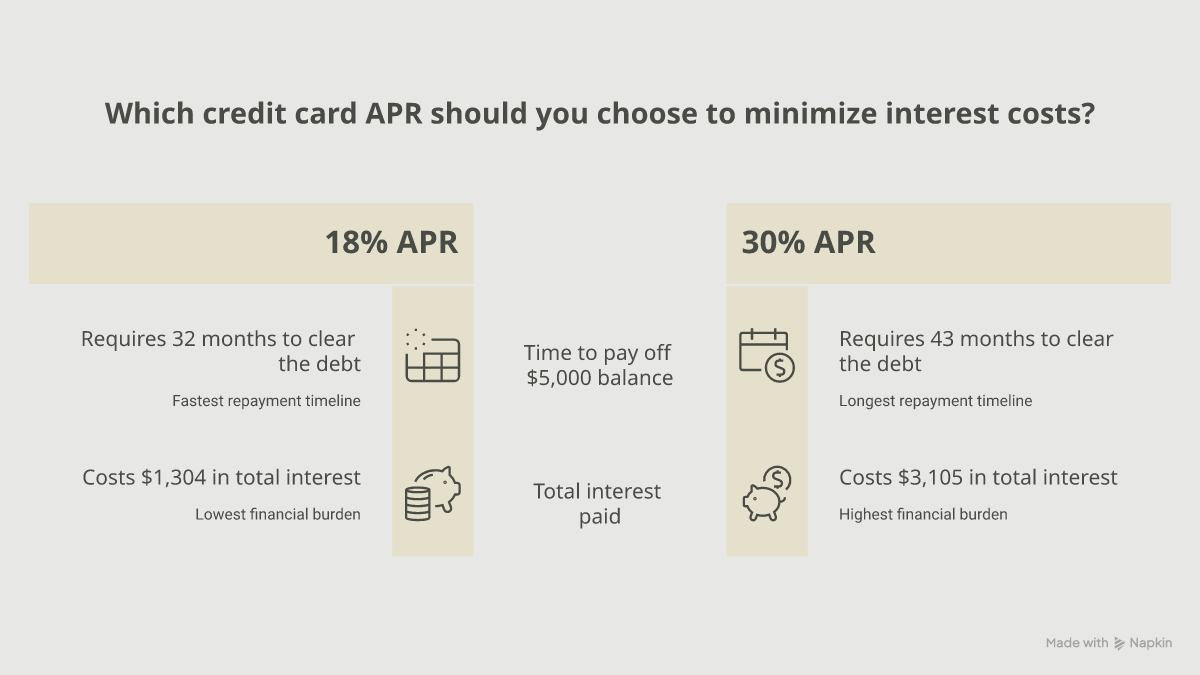
If you want a quick way to see how expensive high rates can become, read what high APR means on credit cards. Consider a scenario where a cardholder carries a $5,000 balance and pays $200 per month toward the debt.
- At 18% APR: It takes 32 months to pay off the balance, and the total interest paid is $1,304.
- At 25% APR: It takes 37 months to pay off the balance, and the total interest paid is $2,126.
- At 30% APR: It takes 43 months to pay off the balance, and the total interest paid is $3,105.
In this example, moving from a 30% rate to an 18% rate saves over $1,800 in interest. This illustrates why comparing rates on MoneyAtlas is a critical step before opening a new account, especially for those who do not plan to pay their balance in full every month.
How to Get a Better Interest Rate
If your current interest rate feels too high, you have several paths to lower it. You do not always have to open a new card to improve your terms.
How to Get a Better Interest Rate
- 1
Improve Your Credit Profile
The most sustainable way to qualify for better rates is to increase your credit score. Focus on making every payment on time and keeping your credit utilization ratio, the amount of credit you use compared to your total limits, below 30%.
- 2
Negotiate with Your Current Issuer
Many people do not realize that they can call their credit card company and request a lower interest rate. If you have a history of on-time payments and your credit score has improved since you opened the card, the issuer may be willing to lower your APR to keep you as a customer. If you want to compare current products before you make the call, visit our credit card reviews index.
- 3
Utilize Balance Transfer Offers
For those currently carrying high-interest debt, moving that balance to a card with a 0% introductory APR is a common strategy. This pauses interest accumulation, allowing every dollar of your payment to go toward the principal balance. MoneyAtlas allows you to compare the length of these introductory periods across different cards.
- 4
Explore Credit Union Options
Credit unions often offer lower rates than national banks. Because they are member-owned cooperatives, their goal is to provide value to members rather than profit for shareholders. The 18% federal cap on credit union interest rates ensures that their "high" rates are still lower than many banks' "average" rates.
- 5
Consider a Debt Consolidation Loan
If you have a high balance that will take years to pay off, a personal loan might offer a lower fixed interest rate than a variable-rate credit card. This changes the debt from revolving credit to an installment loan, which can also help your credit score by lowering your utilization.
When the Interest Rate Matters Most
The importance of your APR depends entirely on how you use your credit card. For some, the interest rate is the most important feature. For others, it is irrelevant.
When APR is critical:
If you tend to carry a balance from month to month, the APR is the most important factor to consider. In this case, a low-interest card with no rewards is often a better financial choice than a rewards card with a high interest rate. The interest you pay on a 25% APR rewards card will quickly outweigh the value of the 2% cash back you earn.
When APR is secondary:
If you pay your balance in full every single month, your interest rate is essentially 0% due to the grace period. In this scenario, you should prioritize cards with the best rewards, travel perks, or sign-up bonuses. If you are focused on perks instead of borrowing costs, you may want to compare travel rewards cards and no annual fee cards. The Purchase APR could be 30% and it would not cost you a penny as long as you never carry a balance past the due date.
The Future of Interest Rates
Interest rates are not static. They are influenced by the economy and potential regulation. There has been public discussion regarding a national interest rate cap, such as a proposed 10% ceiling. While such a cap would lower the cost of borrowing for existing cardholders, it might also lead banks to tighten their lending standards.
If rates are capped significantly lower than they are today, it may become harder for people with fair or poor credit to get approved for cards. Lenders might also reduce rewards programs or increase annual fees to make up for the lost interest revenue.
For now, consumers must navigate the existing environment where rates remain near historical highs. Staying informed about Federal Reserve movements and regularly checking for more competitive offers is the best way to manage these costs.
How to Compare Credit Card Offers
When you are ready to look for a new card, use a systematic approach to compare the interest rates.
- Check the APR Range: Most cards list a range, for example 18.49% to 28.49%. Assume you will get a rate in the middle or higher end of that range unless your credit is excellent.
- Look for Intro Offers: A 0% intro period is a massive advantage. Check how long the offer lasts and what the rate becomes after it expires.
- Evaluate the Fees: A low APR is less helpful if the card has a high annual fee. Calculate the total cost of ownership.
- Read the Schumer Box: This is the standardized table included in credit card agreements. It clearly lists all APR types and fees. It is the best place to find the fine print about how your interest will be calculated.
MoneyAtlas provides tools to view these details side by side, and if you want to keep comparing options, the best credit cards comparison is the right place to start.
FAQ
Conclusion
A good credit card interest rate is a moving target that depends on the economy and your creditworthiness. While the current national average is near 25%, aiming for a rate below 20% is a proactive goal for those with strong credit. For anyone carrying a balance, even a small reduction in APR can lead to significant savings and a faster path to being debt-free.
Managing your interest costs involves a combination of maintaining a high credit score, choosing the right type of card for your spending habits, and occasionally negotiating with your lenders. By using the comparison tools and reviews on MoneyAtlas, you can identify which cards currently offer the most competitive rates for your credit tier.
MoneyAtlas Staff
Articles and reviews from the MoneyAtlas editorial team — independent research on credit cards, banking, loans, insurance, and investing.
Related Articles

Which Card Is Better: American Express Gold or Platinum?
Deciding which card is better: American Express Gold or Platinum? Compare fees, 4X dining rewards, and luxury travel perks to find your perfect match.

Should I Get an American Express Gold Card? Breaking Down the Value
Should I get an American Express Gold card? Explore the 4X rewards on dining and groceries vs. the $325 fee to see if this premium card fits your budget.

How to Get the American Express Gold Card: A Practical Guide
Learn how to get the American Express Gold Card with our guide on credit score requirements, income, and the 'Apply with Confidence' tool. Apply today!