How to Compare Zero APR Credit Cards for Your Financial Goals


Introduction
Choosing a credit card with a 0% introductory Annual Percentage Rate (APR) involves more than just finding a 0% label. The core decision usually centers on whether you need to finance a new purchase or pay down existing debt without accruing interest. While the headline offer looks the same across many cards, the underlying terms, fee structures, and long term benefits vary significantly. MoneyAtlas makes it easier to evaluate these options by highlighting the trade-offs between intro period length and ongoing rewards. This guide breaks down the specific criteria used to evaluate these offers so you can decide which card suits your current budget and your future spending habits. By understanding how these cards differ, you can maximize your interest savings while avoiding common pitfalls like late fees or high transfer costs.
Identify Your Primary Goal
Before looking at specific card offers, it is helpful to define why you need a 0% APR period. Most cards in this category serve one of two main purposes: financing a new expense or consolidating existing high interest debt. Some cards offer 0% APR on both, but the duration of the offer may differ for each category.
Financing a Major Purchase
If you are planning a large expenditure, such as a home repair, a new appliance, or a major trip, a card with a 0% purchase APR is the primary focus. These cards allow you to pay for the item upfront and spread the payments over the introductory period without interest charges. When comparing these, the rewards program often becomes a deciding factor. If you spend $2,000 on a new refrigerator, earning 1.5% to 3% cash back on that purchase adds immediate value that a non rewards card would not provide. If that sounds like your situation, it helps to compare cash back credit cards before you apply.
Debt Consolidation and Balance Transfers
If the goal is to move debt from a high interest card to a 0% interest card, the balance transfer APR is the most important metric. For this use case, rewards are often secondary to the length of the interest free window. Someone carrying a $5,000 balance may prioritize a 21 month intro period over a 15 month period, even if the 21 month card offers no cash back. The goal here is to stop the interest "leakage" so every dollar of the payment goes toward the principal. For that use case, our balance transfer card comparison is the best place to start.
The Hybrid Approach
Some users want both. They may have a small balance to move but also need to make new purchases for an upcoming life event. In these cases, it is critical to find a card where the 0% offer applies to both purchases and balance transfers for the same amount of time. MoneyAtlas provides side by side comparisons that clarify these dual offers, as some cards might offer 18 months for transfers but only 12 months for new purchases.
Evaluate the Length of the Introductory Period
Introductory periods typically range from 6 months to as long as 21 months or more. The length of the window determines your monthly "break even" payment. To compare these effectively, you should calculate what your monthly payment would need to be to reach a zero balance before the standard APR kicks in.
For example, if you are financing a $3,000 purchase:
- With a 12 month offer, the monthly payment is $250.
- With a 15 month offer, the monthly payment is $200.
- With an 18 month offer, the monthly payment is $166.67.
- With a 21 month offer, the monthly payment is $142.86.
A longer period provides more flexibility and lower required monthly payments to avoid interest. However, cards with the longest intro periods, such as 21 months, often do not offer rewards like cash back or travel points. You are essentially trading long term earning potential for a longer interest free loan.
Compare Fees and Costs
A 0% APR does not mean the card is free. There are three main types of costs to compare when looking at these offers: balance transfer fees, annual fees, and penalty fees.
Balance Transfer Fees
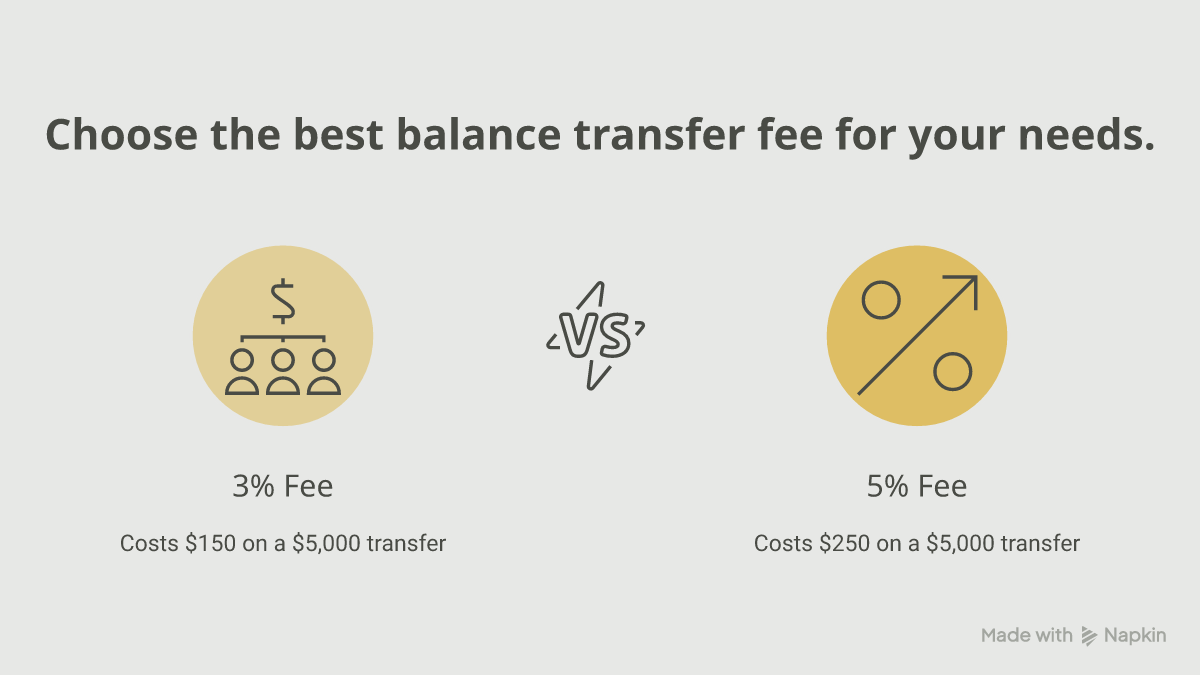
Nearly every card that allows balance transfers will charge a fee to move the money. This is typically a percentage of the amount transferred, often 3% or 5%. On a $5,000 transfer, a 3% fee costs $150, while a 5% fee costs $250. This fee is usually added to the total balance of the new card. When comparing cards, it is important to check if there is an "introductory" transfer fee. Some cards may offer a 3% fee if you transfer the balance within the first 60 or 120 days, then increase the fee to 5% after that.
Annual Fees
The majority of the best 0% APR cards do not charge an annual fee. For someone trying to save money on interest, paying a $95 annual fee can quickly negate the benefits of the 0% offer. Unless the card offers premium travel perks or exceptionally high cash back rates that you are certain will outweigh the fee, a $0 annual fee card is usually the more practical choice for this category. If you want to narrow things down quickly, our no annual fee credit cards can help.
Penalty Fees and Rates
It is vital to read the fine print regarding late payments. Many 0% APR offers are conditional. If you miss a payment or are more than 60 days late, the issuer may cancel the 0% offer immediately and move the account to a penalty APR. This penalty rate can be as high as 29.99%. Additionally, late payment fees can cost up to $40. When comparing cards, check if the issuer offers "late payment fee waivers" for the first occurrence, though this is rare.
Understanding Ongoing APR
The 0% rate is temporary. Once the introductory period ends, the remaining balance will be subject to the standard ongoing APR. This rate is usually variable and depends on your creditworthiness and the current Prime Rate.
Ongoing APRs typically range from 18% to 28% or higher. While the goal is to pay off the balance before the intro period ends, life is unpredictable. If there is a chance you will still carry a balance after 15 or 21 months, comparing the ongoing APR becomes important. A card that settles into a 19% APR is significantly better than one that jumps to 27% if you are still chipping away at a balance. MoneyAtlas tracks these ongoing ranges to help users see the long term cost of the card.
Rewards and Long Term Value
If you plan to keep the card in your wallet after the interest free period, the rewards program is the most significant factor in your comparison. Some 0% APR cards are "plain vanilla," meaning they offer the intro period but no ongoing rewards. These are usually the ones with the longest 0% windows.
Other cards are high earners that happen to have a 0% intro period. These might include:
- Flat Rate Cash Back: Earns a consistent percentage, like 1.5% or 2%, on every purchase. This is excellent for simple, everyday spending.
- Tiered Rewards: Earns higher percentages, like 3%, in specific categories like groceries, gas, or dining.
- Rotating Categories: Offers 5% back in categories that change every quarter, such as Amazon, wholesale clubs, or grocery stores.
When comparing, consider where you spend the most money. If you spend heavily on groceries and online shopping, a card like the Blue Cash Everyday Card from American Express might be worth comparing. If you prefer a simple approach, a 2% flat rate card may be more useful.
Credit Requirements and Approval Odds
Most 0% APR credit cards with competitive terms require good to excellent credit. This generally means a FICO score of 670 or higher. If your score is in the "fair" range (580 to 669), you may still qualify for some offers, but the introductory period may be shorter, and the ongoing APR will likely be higher.
Before applying, it is helpful to check for pre approval offers. Many issuers allow you to see if you are likely to be approved without a hard inquiry on your credit report. Applying for multiple credit cards in a short window can cause a temporary dip in your credit score, so being selective about which card you apply for is a smart move. For a broader starting point, browse the best credit cards to compare the options side by side.
Credit Limits and Utilization
One factor that is difficult to compare upfront is the credit limit you will receive. If you need to transfer a $10,000 balance, but the issuer only gives you a $5,000 limit, you will only be able to move a portion of your debt. Additionally, if you use $4,500 of a $5,000 limit, your credit utilization will be 90% for that card. High utilization can negatively impact your credit score, even if you are not paying interest. To mitigate this, some people choose cards from issuers where they already have a relationship, as those banks may be more likely to grant a higher limit based on existing history.
How to Compare: A Step-by-Step Process
To find the right card, follow these steps to ensure you are looking at the right data points.
How to Compare 0% APR Credit Cards
- 1
Calculate Total
Determine exactly how much you need to finance or transfer. Having a hard number helps you decide if a 12 month or 21 month window is necessary.
- 2
Check Credit Score
Knowing your score helps narrow down which cards are within reach. Most 0% offers are reserved for those with scores above 670.
- 3
Compare Transfer Cost
If you are consolidating debt, add the balance transfer fee to your principal. Compare this total cost across cards. A 3% fee on a 15 month card might be better than a 5% fee on a 21 month card if you can afford the higher payments.
- 4
Use Comparison Tool
MoneyAtlas allows you to view multiple cards side by side. Look at the purchase APR intro length, the balance transfer fee, the annual fee, and the rewards rate simultaneously. You can also start with the best credit cards comparison if you want a broader shortlist.
- 5
Read the Schumer Box
This is the standardized table of rates and fees required by law. It will clearly state the intro APR, the ongoing APR, the balance transfer fee, and any penalty rates. It is the most reliable way to find the "fine print" before you hit the apply button.
Common Pitfalls to Avoid
Comparing these cards requires a skeptical eye for certain terms that can cost you money.
Deferred Interest vs. 0% APR
There is a major difference between a "0% APR" offer and a "No Interest if Paid in Full" offer. True 0% APR cards, usually offered by major banks like Chase, Citi, or Wells Fargo, do not charge you back interest if you have a balance left at the end of the period. You only pay interest on the remaining balance moving forward.
"No Interest if Paid in Full" offers are common on store credit cards. These are "deferred interest" offers. If you have even $1 left on the balance when the period ends, the issuer will charge you interest on the entire original purchase amount dating back to day one. This can result in a massive, unexpected interest charge. For most consumers, a true 0% APR card is a safer and more predictable choice. If you want more background on how rates stack up, this APR guide is a useful next step.
The "Transfer Clock"
Most balance transfer offers require you to move the debt within a specific timeframe, usually 60 to 120 days from account opening. If you wait too long, you might lose the 0% offer or be charged a higher fee. When comparing cards, check how long you have to initiate the transfer.
Minimum Payments Still Apply
A 0% APR does not mean $0 payments. You are still required to make the monthly minimum payment, which is usually 1% to 2% of the balance. Missing a single payment can lead to the termination of your 0% offer and a permanent hit to your credit score. For a deeper look at this issue, see whether 0 APR cards have minimum monthly payments.
Conclusion
Comparing zero APR credit cards is about finding the right balance between time and value. If you are aggressive about paying down debt, a rewards focused card with a 15 month window may be the smartest choice. If you need the lowest possible monthly payment to manage a major life change, prioritizing a 21 month window is likely worth the trade-off of forgoing rewards. Remember to factor in the balance transfer fees and the potential ongoing APR when making your decision. We provide tools to help you look at these factors objectively, so you can stop paying for interest and start making your money work for you. To find the card that fits your specific needs, visit the MoneyAtlas best credit cards comparison to see the latest offers and expert ratings.
FAQ
MoneyAtlas Staff
Articles and reviews from the MoneyAtlas editorial team — independent research on credit cards, banking, loans, insurance, and investing.
Related Articles

Which Card Is Better: American Express Gold or Platinum?
Deciding which card is better: American Express Gold or Platinum? Compare fees, 4X dining rewards, and luxury travel perks to find your perfect match.

Should I Get an American Express Gold Card? Breaking Down the Value
Should I get an American Express Gold card? Explore the 4X rewards on dining and groceries vs. the $325 fee to see if this premium card fits your budget.

How to Get the American Express Gold Card: A Practical Guide
Learn how to get the American Express Gold Card with our guide on credit score requirements, income, and the 'Apply with Confidence' tool. Apply today!