How to Calculate Daily Interest Rate on Credit Card


Introduction
Understanding how your credit card issuer calculates interest can help you manage your debt more effectively and prioritize which balances to pay down first. While most lenders advertise an Annual Percentage Rate (APR), the actual interest added to your account is usually calculated on a daily basis. This is why a balance can seem to grow even when you are making monthly payments. MoneyAtlas helps consumers navigate these complex terms by breaking down the fine print into actionable steps. This guide covers how to find your daily periodic rate, how your average daily balance is determined, and how these figures combine to create your monthly interest charge. By learning the mechanics of these calculations, you can better compare credit card offers and choose the account that fits your financial goals.
What Is the Daily Periodic Rate?
The Annual Percentage Rate (APR) is the standard way lenders express the cost of borrowing over a full year. However, credit card companies do not wait until the end of the year to apply interest. Instead, they use a Daily Periodic Rate (DPR) to calculate interest every single day you carry a balance. This rate represents the interest cost for a 24-hour period.
Most credit card issuers determine the DPR by dividing the APR by 365, which is the number of days in a standard year. Some issuers use 360 days for their calculation, which is a legacy banking standard. While the difference between 360 and 365 might seem small, a 360-day divisor actually results in a slightly higher daily rate.
Knowing your daily rate is the first step in understanding the true cost of your debt. If you are carrying a $5,000 balance on a card with a 24% APR, your daily interest charge is not just a few cents. It is a recurring daily cost that compounds over time. When you compare cards, looking at the APR is essential, but understanding how that rate translates to daily costs gives you a clearer picture of your monthly obligations.

How to Calculate Daily Interest Rate on Credit Card
Calculating your daily interest rate is a straightforward process once you have your credit card statement in hand. You do not need complex financial software to find this number. You can follow these steps to determine exactly what you are being charged each day.
How to Calculate Daily Interest Rate on Credit Card
- 1
Locate your purchase APR
Find your monthly statement and look for the section labeled "Interest Charge Calculation" or "Account Summary." Note the APR listed for purchases, as this is the rate that applies to most of your transactions.
- 2
Divide the APR by 365
Take the APR as a decimal and divide it by 365. For example, if your APR is 18%, you would divide 0.18 by 365. This gives you a daily periodic rate of 0.000493, or 0.0493%.
- 3
Account for different APRs
Check if your card has different rates for balance transfers or cash advances. Each of these categories will have its own daily periodic rate calculated in the same way.
- 4
Check for a 360-day divisor
Read the fine print in your cardholder agreement to see if your bank uses a 360-day year. If they do, divide your APR by 360 instead of 365 to get an accurate daily rate.
Understanding the Average Daily Balance
Your daily interest rate is only one half of the equation. The other half is the amount of money the rate is applied to. Credit card issuers do not just look at your balance on the last day of the month. Instead, they use the Average Daily Balance (ADB) method.
To find your average daily balance, the issuer tracks your balance at the end of each day in your billing cycle. If you make a purchase on day 10, your balance increases for the remaining 20 days of a 30-day cycle. If you make a payment on day 15, your balance decreases for the final 15 days. The issuer adds up the closing balance for every day in the cycle and divides that total by the number of days in the cycle.
This method means that the timing of your payments matters. A payment made early in the billing cycle reduces your balance for more days, which results in a lower average daily balance. Conversely, making a payment on the very last day of the cycle does almost nothing to reduce the interest you owe for that specific month.
In this example, the balance was $1,000 for 10 days, $1,500 for 10 days, and $700 for 10 days. To calculate the ADB, you would multiply each balance by the number of days: (10 * 1,000) + (10 * 1,500) + (10 * 700) = 32,000. Dividing 32,000 by 30 days results in an average daily balance of $1,066.67.
How Daily Interest Compounds
Most credit cards use daily compounding interest. This means that the interest you earn today is added to your balance tomorrow. Then, the next day, the issuer calculates interest based on that new, higher balance. This cycle repeats every day of the year.
Compounding is why carrying a credit card balance for a long time is so expensive. You are not just paying interest on the money you spent at the store. You are also paying interest on the interest that the bank has already charged you. Over months and years, this "interest on interest" can cause your debt to snowball, making it much harder to pay off the original principal.
While daily compounding is the industry standard, some older or specialized accounts might use monthly compounding. Monthly compounding is slightly more favorable for the consumer because interest is only added to the principal once per month. However, for most modern credit cards, you should assume that your interest is compounding every 24 hours.
The Role of the Grace Period
For many credit card users, the daily interest rate is a number that exists only on paper. This is because of the grace period. A grace period is a window of time, usually between 21 and 25 days, between the end of your billing cycle and your payment due date.
If you pay your statement balance in full every month by the due date, the issuer generally does not charge any interest on your purchases. In this scenario, your effective interest rate is 0%, regardless of what your APR is. This is a primary benefit of using credit cards for daily spending as long as you can manage the cash flow to clear the balance monthly.
However, the grace period usually disappears if you carry even a small balance from one month to the next. Once you lose your grace period, interest begins to accrue on new purchases the moment they are made. You typically have to pay your balance in full for two consecutive billing cycles to "reset" the grace period and stop the daily interest accrual.
If you want a deeper refresher on timing and interest rules, see how APR works on a credit card.
Different APRs for Different Transactions
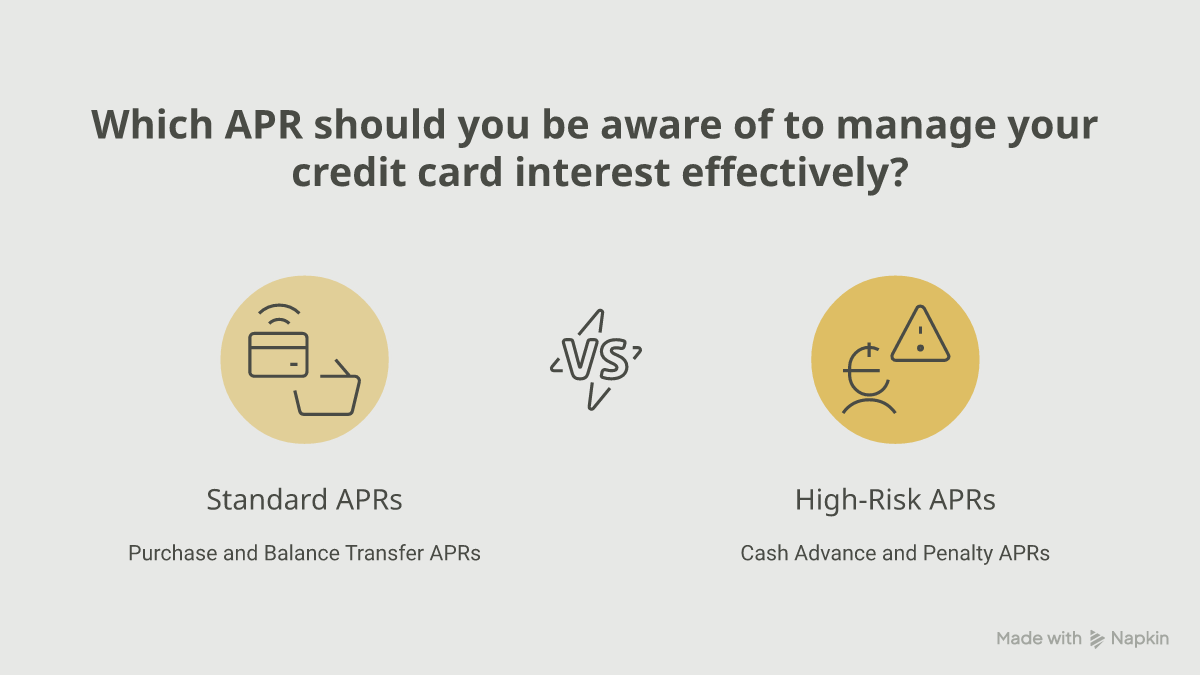
It is a common misconception that a single interest rate applies to everything you do with your credit card. In reality, most cards have multiple APRs, each with its own daily periodic rate. When you calculate your interest, you must apply the correct rate to the correct portion of your balance.
Purchase APR
This is the most common rate. It applies to standard transactions like buying groceries, paying for gas, or shopping online. If you have a grace period, you can avoid this interest entirely.
Cash Advance APR
If you use your credit card to get cash from an ATM, you are usually charged a cash advance APR. This rate is almost always significantly higher than your purchase APR. Furthermore, cash advances usually do not have a grace period. Interest starts accumulating the very second the cash is in your hand.
Balance Transfer APR
This rate applies to debt you move from another credit card. Some cards offer a 0% introductory APR on balance transfers for 12 to 21 months. After that period ends, the remaining balance will be subject to a standard balance transfer APR, which is often similar to the purchase APR.
Penalty APR
If you miss a payment or a check bounces, your issuer might trigger a penalty APR. This rate can be as high as 29.99% or more. A penalty APR can stay on your account for several months, or even indefinitely, which dramatically increases your daily interest costs.
How to Calculate Your Total Monthly Interest Charge
Once you have determined your daily periodic rate and your average daily balance, you can estimate your total monthly interest charge. This formula is the same one used by most major banks. It helps you see how much of your monthly payment is going toward the bank's profit versus reducing your debt.
The formula is: Average Daily Balance x Daily Periodic Rate x Number of Days in Billing Cycle.
For example, imagine a cardholder has:
- An Average Daily Balance of $2,500.
- A Purchase APR of 22% (0.22 / 365 = 0.0006027 DPR).
- A 31-day billing cycle.
The math would look like this: $2,500 * 0.0006027 * 31 = $46.71.
In this scenario, the cardholder is paying nearly $47 in interest for that month. If their minimum payment is only $60, only $13 of that payment is actually reducing the amount they owe. This is why credit card debt feels so persistent. Using a calculator or a spreadsheet to track these numbers can help you visualize the impact of your spending.
Strategies to Lower Your Interest Expenses
Understanding the math behind your credit card interest is only the beginning. The goal is to use that knowledge to reduce the amount of money you pay to lenders. There are several practical ways to disrupt the daily interest calculation and keep more of your money.
Pay Multiple Times per Month
Since your interest is based on your average daily balance, making payments throughout the month rather than waiting for the due date can save you money. A $500 payment made on day 5 of your billing cycle reduces your ADB much more than the same payment made on day 25.
Focus on High-Interest Debt
If you have multiple credit cards, use your daily rate calculations to identify the most expensive one. Directing extra funds toward the card with the highest DPR is the most efficient way to reduce your total interest expenses across all accounts.
Consider a Balance Transfer
If your daily interest rate is high, it may be worth comparing 0% intro APR balance transfer cards. Moving a high-interest balance to a card with a 0% rate for 15 months can stop the interest clock entirely. This allows every dollar of your payment to go directly toward the principal. MoneyAtlas provides tools to compare these offers side by side so you can see which cards offer the longest introductory periods and the lowest transfer fees.
Request a Rate Reduction
If your credit score has improved since you first opened your account, you can call your issuer and ask for a lower APR. A lower APR directly reduces your daily periodic rate. While not every request is granted, many lenders are willing to negotiate to keep a customer with a good payment history.
If your debt is larger or you want a fixed repayment term, it can also help to compare personal loan options against your current card rates.
The Long-Term Impact of Daily Interest
Credit card interest is not a one-time fee. Because it compounds daily, it has a cumulative effect that can span decades. If you only make the minimum payment on a high-interest credit card, you could end up paying back two or three times what you originally borrowed.
Lenders are required to include a "Minimum Payment Warning" on your monthly statement. This table shows how long it would take to pay off your balance if you only made minimum payments and how much total interest you would pay. Most people are shocked to see that a $3,000 balance can take 15 years to pay off using minimum payments alone.
By calculating your daily interest rate, you are taking control of the narrative. You are no longer just looking at a "finance charge" on a statement. You are seeing the daily cost of your debt. This perspective shift is often the motivation needed to change spending habits or seek out better financial products.
For a broader view of what current rates look like, you can also read what is high APR on credit cards.
How to Compare Credit Card Costs Effectively
When you are in the market for a new credit card, the interest rate should be a top priority if there is any chance you will carry a balance. However, the headline APR is not the only factor that determines your cost. You must also consider fees and the calculation methods used by the bank.
- Check the divisor: Does the bank use 365 or 360 days? As noted, 360 days is slightly more expensive.
- Look for compounding frequency: Ensure the card compounds daily, as this is the standard you should use for your comparisons.
- Evaluate the grace period: Confirm the length of the grace period and make sure it applies to all purchases.
- Compare introductory offers: If you have existing debt, look for 0% intro periods that apply to both purchases and balance transfers.
We make it easier to compare these details by aggregating data from over 1,500 financial products. Instead of digging through multiple websites and fine-print PDF documents, you can use our comparison tools to see the APRs, fees, and terms for the leading credit cards in one place. For a broader starting point, browse our credit card reviews.
If you want more background on how rates move in the market, see the average interest rate of a credit card.
Conclusion
Calculating the daily interest rate on your credit card reveals the true cost of carrying a balance. By dividing your APR by 365 and multiplying it by your average daily balance, you can demystify the finance charges on your monthly statement. This knowledge empowers you to make smarter decisions about when to pay your bills and which cards to use for different types of purchases.
- DPR Calculation: Divide your APR by 365 to find your daily cost.
- Average Daily Balance: The timing of your payments significantly affects your total interest charge.
- Compounding: Daily compounding means you pay interest on your interest.
- Grace Periods: Paying in full monthly is the only way to ensure your daily rate is effectively 0%.
To find a credit card that better fits your spending habits and offers more competitive rates, use the MoneyAtlas best credit cards comparison to evaluate your options side by side.
FAQ
MoneyAtlas Staff
Articles and reviews from the MoneyAtlas editorial team — independent research on credit cards, banking, loans, insurance, and investing.
Related Articles

Which Card Is Better: American Express Gold or Platinum?
Deciding which card is better: American Express Gold or Platinum? Compare fees, 4X dining rewards, and luxury travel perks to find your perfect match.

Should I Get an American Express Gold Card? Breaking Down the Value
Should I get an American Express Gold card? Explore the 4X rewards on dining and groceries vs. the $325 fee to see if this premium card fits your budget.

How to Get the American Express Gold Card: A Practical Guide
Learn how to get the American Express Gold Card with our guide on credit score requirements, income, and the 'Apply with Confidence' tool. Apply today!