How Is APR Calculated on a Credit Card?


Introduction
Many cardholders look at a monthly statement and wonder how a 24% APR translates into a specific dollar amount in interest charges. Understanding how is apr calculated credit card accounts is the first step toward managing debt and choosing the right financial products.
MoneyAtlas tracks hundreds of card offers to help readers see how different rates impact their bottom line. This guide breaks down the math behind your finance charges, including the daily periodic rate and the effects of daily compounding. By learning these formulas, you can better compare credit cards side by side and understand the true cost of carrying a balance.
The Daily Periodic Rate: Converting Annual to Daily
The first step in the calculation involves converting the annual rate into a daily one. Even though the APR is expressed as a yearly figure, interest on most modern credit cards accrues every single day that you carry a balance.
To find your daily periodic rate, take your APR and divide it by 365. For example, if a card has a 25% APR, the math looks like this:
0.25 / 365 = 0.0006849
In this scenario, the daily periodic rate is roughly 0.0685%. Some banks may use 360 days instead of 365, though 365 is the standard for most US consumer cards. You can find your specific APR and the method used in the terms and conditions or on the "Interest Charge Calculation" section of your monthly statement.
The Average Daily Balance Method
Most credit card issuers do not calculate interest based on your balance at the beginning or the end of the month. Instead, they use the average daily balance (ADB). This method accounts for every purchase and payment made throughout the billing cycle.
To calculate the average daily balance, the issuer follows these steps:
- Identify the balance on the account at the end of each day in the billing cycle.
- Add all of those daily balances together.
- Divide the total by the number of days in the billing cycle.
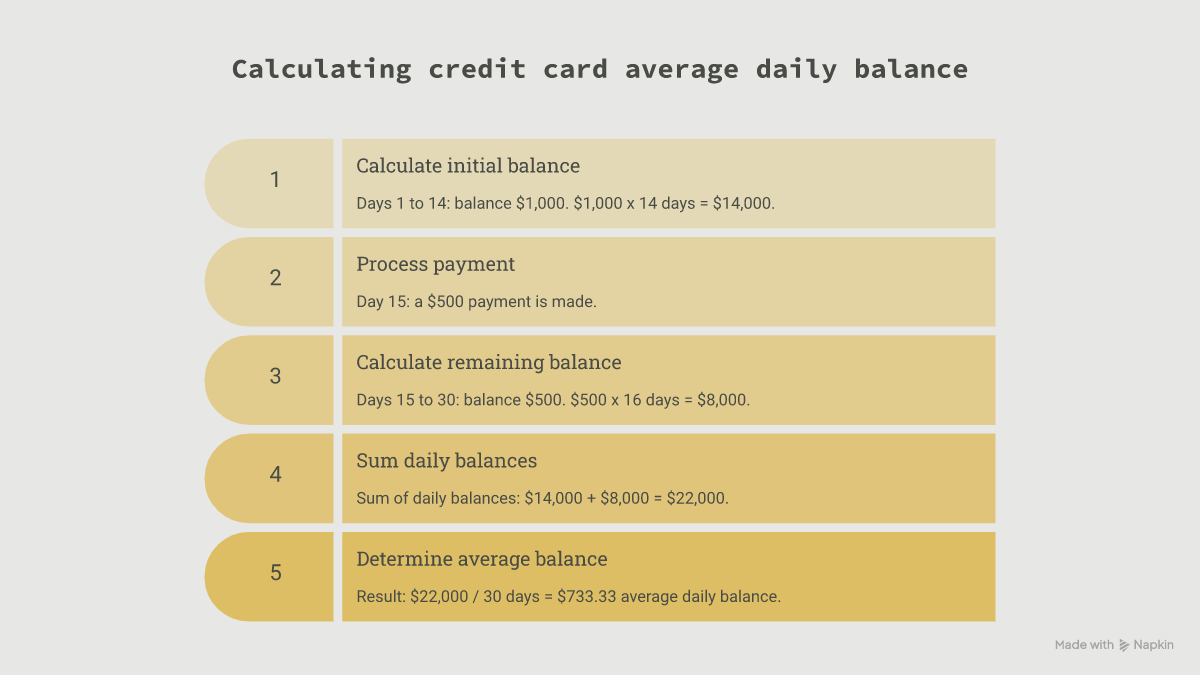
For example, if you start a 30% day billing cycle with a $1,000 balance and make a $500 payment on day 15, your balance is $1,000 for the first 14 days and $500 for the final 16 days. The calculation would be:
($1,000 * 14) + ($500 * 16) = $14,000 + $8,000 = $22,000
$22,000 / 30 days = $733.33 average daily balance.
Putting the Formula Together
Once the daily periodic rate and the average daily balance are known, the monthly interest charge is determined by multiplying these figures by the number of days in the billing cycle.
The general formula is:
(Average Daily Balance * Daily Periodic Rate) * Days in Billing Cycle = Monthly Interest Charge
Using our previous examples of a $733.33 average daily balance and a 25% APR (0.0006849 daily rate) over a 30% day cycle:
($733.33 * 0.0006849) * 30 = $15.07
This $15.07 is the finance charge that will appear on your statement. While this may seem like a small amount for one month, these charges accumulate and compound over time if the balance is not paid in full.
Step-by-Step Calculation Guide
If you want to manually verify the interest on your next statement, follow these steps.
How to Calculate Credit Card Interest
- 1
Locate your APR
Find the "Interest Charge Calculation" section on your statement to see your current APR for purchases. Note that cash advances or balance transfers may have different rates.
- 2
Calculate your daily periodic rate
Divide your APR by 365. Convert the percentage to a decimal first (e.g., 20% becomes 0.20) before dividing.
- 3
Determine your average daily balance
Look at your statement for the ADB, or calculate it by adding up your balance for each day of the month and dividing by the number of days in the cycle.
- 4
Multiply for the final charge
Multiply the ADB by the daily periodic rate, then multiply that result by the number of days in your billing period.
The Role of Daily Compounding
Most credit card issuers use daily compounding, which makes the cost of borrowing slightly higher than the APR suggests. Compounding means that the interest charged today is added to your balance tomorrow. Consequently, you end up paying interest on your interest.
When interest compounds daily, the issuer takes the previous day's balance, adds any new purchases, subtracts any payments, and then adds the interest earned that day. This new total becomes the starting balance for the next day. Over a month, the difference is usually measured in cents, but over a year or more, daily compounding significantly increases the total debt for those only making minimum payments.
Different APRs for Different Transactions
It is a common misconception that a credit card has only one APR. In reality, a single card often carries multiple rates depending on how the card is used.
Purchase APR
This is the standard rate applied to the things you buy at a store or online. It is the rate most people focus on when comparing cards.
Cash Advance APR
If you use your card to get cash from an ATM, you will likely be charged a much higher APR. Cash advances often have no grace period, meaning interest starts accruing the moment the cash is in your hand. Most cash advances also come with a separate flat fee.
Balance Transfer APR
This rate applies to debt moved from one card to another. Many cards offer a promotional 0% APR on balance transfers for a set period, such as 12 to 18 months. After that period ends, any remaining balance will typically accrue interest at the standard purchase APR. If you are comparing payoff strategies, start with our balance transfer card comparison.
Penalty APR
If you miss a payment or pay late, the issuer may increase your APR to a penalty rate, which can sometimes exceed 29%. This rate can remain in effect for several months or even indefinitely, depending on the card's terms.
The Grace Period: Avoiding the Calculation Entirely
The most effective way to manage credit card APR is to avoid it altogether. Most credit cards offer a grace period, which is the window of time between the end of a billing cycle and your payment due date.
If you pay your statement balance in full by the due date every month, the issuer does not charge interest on purchases. In this scenario, your APR is effectively 0% for that month. However, if you carry even a small balance into the next month, you typically lose the grace period for all new purchases. Interest then begins to accrue on everything you buy starting on the day you buy it.
Factors That Determine Your APR
Your APR is not a fixed number for everyone. It is determined by a combination of your personal credit history and the broader economy.
Creditworthiness
When you apply for a card, the issuer looks at your credit score and history. Borrowers with excellent credit scores typically qualify for the lowest advertised APRs. Those with fair or poor credit may only qualify for cards with rates at the higher end of the range.
The Prime Rate
Most credit cards have variable APRs. This means the rate is tied to a benchmark called the Prime Rate. When the benchmark moves, your credit card APR will likely change within one or two billing cycles.
Fixed vs. Variable Rates
While most cards are variable, some fixed-rate cards still exist. A fixed APR stays the same regardless of market changes. However, issuers can still change a fixed rate if they provide notice and follow specific federal regulations.
How to Compare APRs
When shopping for a new card, comparing rates side by side is essential. MoneyAtlas provides tools to evaluate cards based on their APR ranges, fees, and rewards.
For someone who plans to pay their balance in full every month, the APR may be less important than the rewards program or the annual fee. However, for someone who may need to carry a balance for a few months, a low-APR card or a card with a long 0% introductory period is often a better financial choice. If you are focused on short-term interest savings, take a look at 0% APR credit cards.
When comparing, look for:
- The range of APRs offered.
- The length of any 0% introductory periods.
- Whether the promotional rate applies to both purchases and balance transfers.
- The presence of a penalty APR.
Summary of APR Management
Managing the cost of credit requires a clear understanding of the mechanics. Knowing that interest is a daily calculation rather than a monthly one can change how you approach your payments.
- Pay early: Because of the average daily balance method, making payments as soon as you have the funds lowers the average balance and the resulting interest.
- Target high rates: If you have multiple cards, focusing extra payments on the card with the highest APR can save the most money over time.
- Use comparison tools: We provide detailed breakdowns of card terms so you can identify which cards offer the most competitive rates for your credit profile.
- Match the card to your spending: If you want rewards and no annual fee, browse no annual fee credit cards before you apply.
Understanding how is apr calculated credit card balances gives you the power to predict your monthly costs and make smarter borrowing decisions. Whether you are looking for a new card with a 0% introductory rate or trying to pay down existing debt, the math remains the same. If you want to compare reward-focused options next, check out the best cash back credit cards.
FAQ
Ready to pick a card?
Compare the cards our editors rate highest right now, side by side, with the fees and rewards that matter.
Compare the best credit cardsMoneyAtlas Staff
Articles and reviews from the MoneyAtlas editorial team — independent research on credit cards, banking, loans, insurance, and investing.
Related Articles

The Fed just raised rates. Which of your debts will cost more?
The Fed made its first rate hike since 2023 on September 16. See which debts go up, which stay locked, and what the hike costs you each month.

Your credit card APR is going up. Here's what to do before your next statement
Learn how to lower credit card APR with 5 proven strategies. From negotiating with issuers to 0% transfers, discover how to offset rising interest rates.

Does Credit Card APR Go Down? How to Lower Your Interest Rate
Does credit card APR go down? Learn how market shifts, improved credit, or negotiation can lower your rate and save you money on interest today.