Most credit card users want to know if the interest rate on their monthly statement can change without warning. The short answer is yes. In the US market, the vast majority of credit card annual percentage rates (APRs) are variable. This means the rate is tied to an underlying index that fluctuates based on broader economic conditions.
MoneyAtlas tracks these shifts across thousands of financial products to help cardholders understand how market moves impact their wallets. This post covers the mechanics of variable rates, why they change, and how they differ from the rare fixed-rate options still available. Understanding these terms is the first step toward comparing credit cards more effectively. While most cards share this variable structure, the margin added to the base rate can vary significantly based on individual creditworthiness.
If you want a broader starting point, begin with our best credit cards comparison to see how APRs, fees, and rewards vary across top offers.
What a Variable APR Means for Your Wallet
A variable APR is an interest rate that is not set in stone. Instead, it is linked to a benchmark interest rate, which is most commonly the US Prime Rate. When that benchmark moves up or down, the interest rate on a credit card typically follows suit. This adjustment usually happens automatically without the issuer needing to provide a specific 45-day notice, as long as the change is tied to the index mentioned in the cardholder agreement.
The most common benchmark is the Prime Rate. Most major banks in the US set their Prime Rate based on the federal funds rate, which is the interest rate set by the Federal Reserve. When the Federal Reserve adjusts rates to manage inflation or stimulate the economy, it creates a ripple effect that eventually reaches your credit card balance.
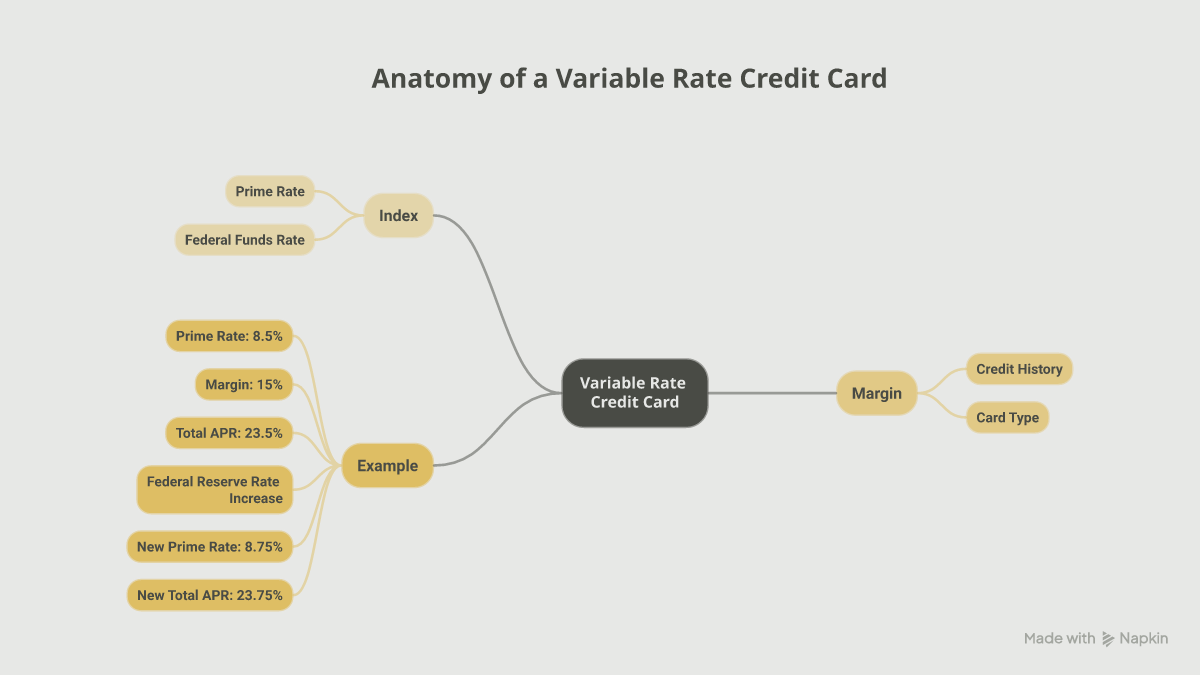
Your total interest rate is actually the sum of two different parts. Knowing these two components helps you understand why two people can have the same card but different interest rates.
The Index: This is the base rate, such as the Prime Rate. It is the same for every customer using that specific card.
The Margin: This is the additional percentage the bank adds to the index. The margin is determined by the bank based on your credit history and the specific card type.
For example, if the Prime Rate is 8.5% and your card has a margin of 15%, your total variable APR is 23.5%. If the Federal Reserve raises rates and the Prime Rate jumps to 8.75%, your APR will likely climb to 23.75% during the next billing cycle.
The two components behind every variable credit card APR
Why Variable Rates Are the Industry Standard
Fixed-rate credit cards were once more common, but they have largely disappeared from the catalogs of major national issuers. Variable rates allow banks to protect their profit margins. If the cost for the bank to borrow money increases, they can pass that cost along to the consumer automatically through the variable rate structure.
Fixed vs. Variable APRs: Key Differences
While variable rates are the norm, it is helpful to understand how they differ from fixed rates. A fixed APR remains the same over time regardless of what happens with the Federal Reserve or the Prime Rate.
The Mechanics of Fixed Rates
A fixed-rate card provides more predictability for someone who carries a balance month to month. However, "fixed" does not mean the rate can never change. Under the Credit CARD Act of 2009, issuers can still raise a fixed rate, but they must follow strict rules:
Advance Notice: The issuer must provide a written notice at least 45 days before the rate increase takes effect.
Application of Rates: In most cases, the higher rate can only be applied to new purchases made after the 45-day window. The old balance usually remains at the lower, original rate.
Comparison of Rate Types
Feature
Variable APR
Fixed APR
Connection to Index
Tied to Prime Rate or SOFR
Not tied to an index
Frequency of Change
Can change monthly or quarterly
Rarely changes
Notice Requirement
No notice for index moves
45-day notice required
Availability
Standard for most cards
Rare, mostly at credit unions
Market Sensitivity
High
Low
For those prioritizing stability, fixed-rate cards are worth looking for at smaller community banks or credit unions. However, these cards often lack the robust rewards programs found on variable-rate travel or cash back cards. MoneyAtlas makes it easier to compare these tradeoffs side by side when you are looking for a new account.
When inflation is high, the Federal Reserve often raises interest rates to cool the economy. This makes borrowing more expensive for banks, who then raise the Prime Rate. Conversely, during an economic slowdown, the Fed may lower rates to encourage spending.
The timeline for these changes is often swift. Many credit card agreements state that a change in the Prime Rate will be reflected on your statement within one or two billing cycles. This means that if the Fed announces a rate hike on Tuesday, you might see the impact on your interest charges by the following month.
While the index moves based on the economy, your specific margin or total APR can also change due to your financial behavior. These changes are separate from market fluctuations:
Late Payments: If you are more than 60 days late on a payment, the issuer may trigger a penalty APR. This rate is often significantly higher than your standard purchase APR, sometimes reaching 29.99%.
Credit Score Drops: If your credit score significantly decreases, an issuer may review your account and decide to increase your margin, though they must provide notice for this type of change.
Promotional Period Expiration: If you started with a 0% intro APR, that rate is temporary. Once the promotional period ends, the card reverts to the standard variable purchase APR.
It is a common misconception that a credit card has only one interest rate. In reality, a single card often has several different variable APRs depending on how you use the account. Each of these is typically tied to the same index but carries a different margin.
Purchase APR
This is the standard rate applied to the things you buy, like groceries or gas. If you pay your statement in full every month, you likely will not pay this interest at all due to the grace period. However, if you carry even a small balance, the purchase APR is the rate that determines your interest cost.
Balance Transfer APR
When you move debt from one card to another, the balance transfer APR applies. Many cards offer a promotional 0% APR on these transfers for 12 to 21 months. Once that offer expires, the remaining balance will be subject to a variable rate that is often similar to the purchase APR.
Using your credit card at an ATM to get cash usually triggers a cash advance APR. This rate is almost always variable and significantly higher than the purchase APR. Furthermore, cash advances usually do not have a grace period, meaning interest begins accruing the moment the cash is in your hand.
Penalty APR
As mentioned earlier, the penalty APR is the highest rate an issuer charges. It is triggered by severe late payments. This rate is also variable, meaning if the Prime Rate goes up while you are in "penalty status," your already high rate could climb even further.
How to Calculate Your Monthly Interest Charges
Because variable APRs are annual rates, they can feel abstract. To see the real-world cost of carrying a balance, you need to break the annual rate down into a daily cost. Most credit cards calculate interest daily based on your average daily balance.
How to Calculate Your Monthly Interest Charges
1
Find your daily periodic rate
Divide your current variable APR by 365. For a card with a 21.99% APR, the daily rate is 0.0602% (or 0.000602 as a decimal).
2
Determine your average daily balance
Add up your balance at the end of every day in the billing cycle and divide by the number of days in that cycle.
3
Calculate the daily interest charge
Multiply your average daily balance by the daily periodic rate.
4
Total the monthly cost
Multiply the daily interest charge by the number of days in your billing cycle, usually 30.
Example Scenario: If you carry a $3,000 balance on a card with a 25% variable APR:
Daily Rate: 25% / 365 = 0.0685%
Daily Interest: $3,000 x 0.000685 = $2.05
Monthly Interest: $2.05 x 30 = $61.50
Over a year, that interest adds up to hundreds of dollars. Because the rate is variable, if the index increases by 1%, that monthly cost would climb to roughly $64.00. Using comparison tools at MoneyAtlas can help you identify cards with lower margins, which reduces this daily cost.
Strategies for Managing Variable Rates
Since you cannot control the Federal Reserve or the Prime Rate, you must focus on the factors you can influence. Managing a variable APR involves protecting your credit score and utilizing the right financial products for your debt.
Improve Your Credit to Lower Your Margin
When you apply for a card, the bank assigns you a margin based on your creditworthiness. A card might advertise an APR range of 19% to 29%. Someone with an excellent credit score, typically 740+, is more likely to receive the 19% rate, while someone with fair credit might receive the 29% rate.
Monitor your score: Check for errors on your credit report that could be dragging your score down.
Reduce utilization: Keep your balances below 30% of your total credit limit.
Request a rate reduction: If your credit has improved significantly since you opened the card, you can call the issuer to ask for a lower margin. While not guaranteed, it is a common way for responsible cardholders to save money.
Utilize Balance Transfer Offers
If you are currently paying a high variable rate on a large balance, a balance transfer card is worth comparing. These cards often provide a 0% introductory period, effectively pausing the variable nature of your interest for a year or more. This allows every dollar of your payment to go toward the principal balance rather than interest charges.
Consider a Personal Loan
For those with significant high-interest credit card debt, a personal loan might offer a fixed-rate alternative. Personal loans typically have fixed interest rates and set repayment terms, making them more predictable than a variable-rate credit card. Comparing personal loan rates alongside credit card offers on our platform can clarify which path is more affordable for your specific situation.
If you are weighing debt payoff options, take a look at our personal loans comparison for a fixed-payment alternative.
How to Find Your Card's APR Details
You do not have to guess whether your card is variable or what the current rate is. This information is legally required to be accessible to you.
The Schumer Box: This is the standardized table included in your credit card agreement and on many monthly statements. It clearly lists the purchase APR, whether it is variable, and how the rate is calculated.
Monthly Statements: Your statement will show the APR currently being applied to your balance. Because rates are variable, this number may change from month to month.
Online Account Portal: Most major banks list your "Account Details" or "Card Benefits" section, where the current interest rates for purchases and cash advances are displayed.
MoneyAtlas makes it easier to compare these rates across 1,500+ products before you even apply. By looking at the APR ranges and the index used, you can get a better sense of what a card might cost you over the long term.
As long as the Federal Reserve uses interest rates as a primary tool for economic management, variable APRs will remain the standard for the credit card industry. Borrowers should expect their rates to fluctuate at least a few times per year.
Watching the news for Federal Reserve announcements can give you a head start on understanding when your card costs might rise. If the Fed indicates it will keep rates "higher for longer," it is a signal to prioritize paying down variable-rate debt. If they begin cutting rates, you may see some modest relief on your monthly statement.
Ultimately, the best way to "beat" a variable APR is to avoid it entirely by paying your balance in full every month. When you do that, the interest rate, whether it is 15% or 30%, becomes irrelevant because you never trigger the interest charge.
For readers looking for a deeper rewards strategy, our travel credit cards comparison can help you weigh perks against cost.
Learn how to lower credit card APR with 5 proven strategies. From negotiating with issuers to 0% transfers, discover how to offset rising interest rates.