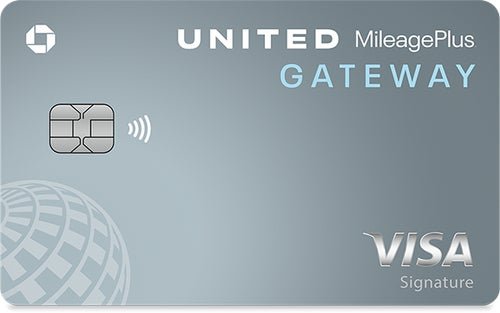
United Gateway℠ Card
The best no-annual-fee card for occasional United flyers
Updated June 2, 2026 · By the MoneyAtlas Editorial Team
Pros
$0 Annual Fee: The Gateway Card costs nothing to hold, so every mile earned is pure value with no annual break-even calculation.
5x Miles on United Flights: Earns the highest rate on United flights of any no-annual-fee card in the family.
No Foreign Transaction Fees: International purchases post at full earn rate with zero surcharge.
Cons
1x on Most Purchases: Outside of United flights, gas, and transit, you earn just one mile per dollar.
Checked Bag Requires $10K Annual Spend: Unlike the Explorer Card’s automatic first-bag benefit.
No Lounge Access or Club Passes: The Gateway Card includes no complimentary United Club passes or airport lounge access.
United Gateway Card Overview
The United Gateway℠ Card is Chase’s no-annual-fee entry into the MileagePlus credit card family. Issued by Chase and running on the Visa network, this card is designed for occasional United Airlines flyers who want to earn MileagePlus miles without paying a recurring fee. It earns strong rewards on United flights, includes no foreign transaction fees, and comes with a 0% intro APR offer rarely seen on airline cards.
For travelers who fly United a few times a year but aren’t ready to commit to a premium card with an annual fee, the Gateway Card fills the gap between a generic travel card and a full-featured United card. It sits at the base of the United co-branded card lineup, below the Explorer, Quest, Club Infinite, and Business cards.
MileagePlus Earning Rates
The United Gateway Card offers a tiered earning structure that rewards United loyalty and everyday spending. Here’s a full breakdown of how miles are earned:
The 5x rate on United flights stands out. The United Explorer Card — which charges a $95 annual fee — earns only 2x on United purchases. If your primary use case is booking United flights, the Gateway Card generates more miles per dollar spent on that category while costing nothing to hold. For a traveler spending $3,000/year on United flights, the Gateway earns 15,000 miles vs. the Explorer’s 6,000 miles from the same spend.
Welcome Bonus & Current Offer
New cardholders can earn 30,000 bonus miles after spending $1,000 on purchases within the first 3 months of account opening. The $1,000 spending requirement is among the lowest thresholds for a welcome bonus on a travel card — achievable in a single month of normal spending for most households.
United also offers an additional 10,000 bonus miles when you add an authorized user to your account within the same 3-month period. Combined, that’s up to 40,000 bonus miles for minimal action — one of the better all-in welcome offers available on a no-annual-fee airline card.
Based on a conservative valuation of United MileagePlus miles at approximately $0.013 per mile, 40,000 bonus miles represent roughly $520 in travel value toward United flights, seat upgrades, or partner redemptions. Actual redemption value varies based on routes, availability, and award pricing.
Travel Benefits
Despite its $0 annual fee, the United Gateway Card includes several meaningful travel benefits:
25% Back on Inflight Purchases: Receive a 25% statement credit on eligible in-flight purchases including food, beverages, and Wi-Fi on United-operated flights. The benefit also applies to United Club premium drinks when ordered onboard. If you spend $40 on Wi-Fi and snacks during a round trip, you’d receive $10 back as a statement credit.
No Foreign Transaction Fees: The Gateway Card charges no foreign transaction fees on international purchases. Most entry-level cards add a 3% surcharge on foreign purchases — the Gateway’s $0 fee makes it a capable travel companion overseas, earning miles with no extra cost.
0% Intro APR on Purchases: The card offers 0% introductory APR on purchases for 12 months from account opening, after which the regular variable APR (19.74%–28.24%) applies. A 0% intro APR is unusual on airline cards and can be valuable if you need to finance a large purchase — like airfare for a group trip — interest-free for a full year.
Checked Bag Benefit: [MANUAL: Verify current checked bag policy on Chase.com — reported as 2 free checked bags on United flights after spending $10,000 on the card in a calendar year. Confirm exact terms before publishing.]
United Perks & MileagePlus Benefits
As a United co-branded card, the Gateway Card integrates directly with MileagePlus in several ways that extend its value beyond the base earning rates:
Expanded Award Availability: Gateway cardholders gain access to expanded award availability on United flights, meaning more redemption seats are accessible compared to non-cardholders. This can make a meaningful difference when booking popular routes or holiday travel with miles.
Star Alliance Partner Redemptions: MileagePlus miles earned on the Gateway Card can be redeemed for flights on Star Alliance member carriers, including Lufthansa, ANA, Air Canada, Singapore Airlines, and 22 other airlines. This significantly expands the geographic utility of your miles beyond United’s own route map.
No Miles Expiration: MileagePlus miles do not expire as long as your account remains active with qualifying activity. Card spending naturally provides that qualifying activity, keeping your balance alive year over year without requiring separate redemptions.
Lifetime Miles Accumulation: Miles earned on the Gateway Card count toward MileagePlus Lifetime Miles — a running total that contributes toward lifetime status consideration and long-term loyalty recognition as it accumulates over years of card spending.
No Annual Fee Value Proposition
The $0 annual fee fundamentally changes the math on holding this card. With premium airline cards, you must calculate the break-even point — the level of spending at which benefits justify the fee. With the Gateway Card, there is no break-even. Any miles earned represent net value.
Consider a cardholder spending $4,000/year on United flights (5x = 20,000 miles), $3,000 at gas stations (2x = 6,000 miles), and $8,000 on general purchases (1x = 8,000 miles). The Gateway Card generates 34,000 miles annually at zero net cost. That same spending profile on the Explorer Card earns fewer total flight miles (2x on United vs. 5x on Gateway) and costs $95 to hold. For United-heavy spenders, the Gateway delivers better miles ROI on the flight category.
The Gateway Card also works well as a dedicated United-earning card within a broader Chase portfolio. Pairing it with the Chase Sapphire Preferred lets you earn 5x on United flights specifically while using the Sapphire for dining, Chase Travel bookings, and other bonus categories — each card handling the spending it earns best.
Basic Economy & the Gateway Card
One of the most-searched questions about the United Gateway Card is how it interacts with Basic Economy fares. Here’s a complete breakdown.
When you book a Basic Economy ticket on United using the Gateway Card, the 5x miles earning rate applies to the full ticket purchase, and the 25% inflight statement credit remains active during the flight. These benefits are tied to card membership and payment method, not fare class — they work regardless of which ticket type you buy.
However, the Gateway Card does not override Basic Economy’s restrictions. Basic Economy passengers may not bring a full-size carry-on to the overhead bin (unless they have elite status or pay an upgrade fee), cannot change or receive refunds on their ticket, and board in the last group. The Gateway Card’s spend-based bag benefit also does not waive Basic Economy’s carry-on restrictions — those rules are set by the fare type, not the card.
For Basic Economy travelers, the Gateway Card’s practical value lies in: earning 5x miles on the ticket purchase, receiving 25% back on in-flight Wi-Fi and snacks, and building a MileagePlus balance over time without paying an annual fee.
Compare United Gateway Card vs. Explorer Card
The most common upgrade question for Gateway cardholders: when does it make sense to move to the United Explorer Card? Here’s a direct side-by-side comparison of the two most popular cards in the United lineup:
The break-even for upgrading to the Explorer is straightforward: at $35 per checked bag each way, checking one bag on 2 round-trip United flights saves $140/year — more than covering the $95 annual fee. Add the 2 United Club passes (worth approximately $59 each at the door) and the Explorer easily out-values the Gateway for travelers who fly United at least twice per year with checked bags.
The Gateway Card wins when: you never check bags, you fly United primarily for the miles earning (5x beats Explorer’s 2x on United flights), you don’t value lounge passes, or you want a no-commitment card to hold alongside other rewards cards without annual fee drag.
Credit Score & Approval Requirements
The United Gateway Card targets applicants with good to excellent credit. The recommended credit score range is 670–850, with approval rates highest for scores above 700. Applicants in the 670–699 range may be considered but will face closer scrutiny on other factors including debt-to-income ratio, credit history length, and existing Chase relationships. The average credit limit for approved cardholders is approximately $12,700, though individual limits vary.
Chase 5/24 Rule: Chase applies its 5/24 policy to all United co-branded card applications. If you’ve opened 5 or more credit card accounts across any issuer in the past 24 months, Chase will typically decline your application regardless of credit score. Check your new-account count before applying if you’ve opened multiple cards recently.
Additional requirements include being at least 18 years old (19 in Alabama and Nebraska, 21 in Puerto Rico), having a valid US Social Security Number or Individual Taxpayer Identification Number, and not already holding an existing United Gateway Card account.
Who Should Apply for the United Gateway Card?
The United Gateway Card is the right choice for:
- Occasional United flyers who want MileagePlus miles without an annual fee commitment
- First-time travel card holders entering the airline rewards ecosystem at zero cost
- Chase ecosystem builders who want dedicated United earning alongside Sapphire or Freedom cards for broader reward categories
- International travelers who need a no-foreign-transaction-fee card and want airline miles on purchases abroad
- Basic Economy travelers who want the 5x miles on United ticket purchases and 25% inflight credit without needing elite benefits
Consider skipping the Gateway Card if you check bags on every United flight (the Explorer’s automatic bag benefit covers its $95 fee within 2 round trips), you want flexible travel rewards transferable to multiple programs (the Chase Sapphire Preferred earns transferable Ultimate Rewards points), or you want broad everyday bonus categories without airline restrictions (the Chase Freedom Unlimited offers 1.5% back on all purchases with no annual fee).