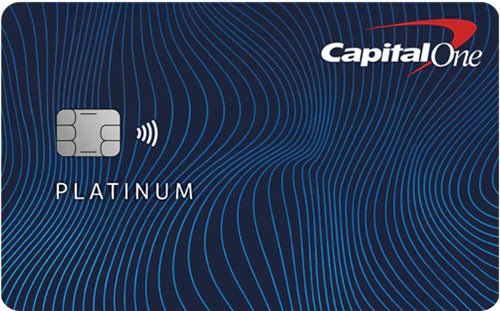
Capital One Platinum Secured Credit Card
Secured card with a path to an unsecured credit line
Updated October 2, 2026 · By the MoneyAtlas Editorial Team
Category Ratings
Pros
Low Minimum Deposit Potential: Option for a $49 or $99 deposit (for a $200 limit) makes it highly accessible for those with limited fund
$0 Annual Fee: No yearly cost to keep the card open
Reports to All 3 Bureaus: Essential for building a comprehensive credit history
Cons
High APR: The 29.74% variable APR is very high
No Rewards Program: Cardholders earn no cash back, points, or miles on their spending
Why we rate it 4.4/5
The cheapest way into a major-bank secured card when $200 is a stretch. It earns nothing, so full-deposit applicants should look elsewhere.
It earns no rewards at all. The sibling Quicksilver Secured pays 1.5% cash back, so this card only wins if you can't cover a $200 deposit.
There is no annual fee, so building credit costs nothing beyond a refundable deposit, unlike subprime cards that charge yearly and monthly fees.
No foreign transaction fees, CreditWise monitoring, reporting to all three bureaus and a built-in path to an unsecured card. Little else.
Nothing to activate or track, deposit tiers can start at $49, and Capital One reviews the account for upgrades without you applying again.
The Capital One Platinum Secured Credit Card is the most accessible secured card from a major bank. Its "killer feature" is its flexible deposit requirement: depending on your creditworthiness, you might secure a $200 credit limit with a deposit as low as $49 or $99, a rarity in a market that usually demands a dollar-for-dollar match. Its low barrier to entry and reliable graduation path to an unsecured card make it a top choice for rebuilding shattered credit.
At a Glance
- Welcome Offer: None
- Rewards Rate: 0% (This card does not earn rewards)
- Annual Fee:
- Security Deposit: Refundable; Minimum of $49, $99, or $200 (for a $200 initial credit line)
- Foreign Transaction Fee: None
- Credit Score:
- APR:
- Graduation: Automatic reviews to upgrade to an unsecured card and refund the deposit.
Overview
The Capital One Platinum Secured Credit Card is a rehabilitation tool. It is designed for people who have been rejected for traditional credit cards due to bankruptcy, defaults, or a lack of credit history. By requiring a security deposit, Capital One mitigates its risk, allowing it to give you a genuine Mastercard® that reports to all three major credit bureaus (Equifax, Experian, TransUnion).
Rewards & Benefits
- Credit Building: The primary benefit is access. Because it reports as a standard credit card (not "prepaid"), on-time payments will boost your score significantly over 6-12 months.
- Automatic Line Reviews: Capital One monitors your activity. In as little as 6 months, they may increase your credit limit without requiring an additional deposit, giving you more purchasing power and lowering your utilization ratio.
- Flexible Deposit Tiers: When you apply, Capital One determines your required deposit.
- Tier 1: $49 deposit = $200 limit
- Tier 2: $99 deposit = $200 limit
- Tier 3: $200 deposit = $200 limit
- Note: You can deposit more (up to $1,000) to get a higher limit, but the minimums are the selling point.
Fees & Requirements
- Annual Fee: .
- Foreign Transaction Fee: None.
- Bank Account Required: You generally need an authorized bank account to fund the security deposit.
- Credit Check: Yes, Capital One performs a hard inquiry. If you have an active bankruptcy that hasn't been discharged, you might be declined.
Borrower Experience
- Graduation: The goal of this card is to lose it. Capital One is proactive about "graduating" users. Once you prove you can pay on time, they will often automatically refund your deposit and convert the card to an unsecured Capital One Platinum.
- App Features: You get full access to the Capital One ecosystem, including CreditWise monitoring, virtual card numbers for safe online shopping, and instant payment options.
How the Capital One Secured Card Deposit and Limit Work
Capital One assigns your minimum deposit when it approves you: $49, $99 or $200. All three tiers open the same $200 starting credit line, so a $49 deposit gets you $151 of credit you haven't paid for up front. You don't pick the tier, and the issuer's terms don't say how it's chosen.
Want a higher limit from day one? You can deposit more than the minimum before you activate the card, up to a $1,000 maximum, and the extra money raises your starting line. That is the honest answer to the "$1,000 Capital One secured card" question: you fund it yourself.
After that, the line grows on Capital One's schedule. The issuer says you could be considered for a credit line increase in as little as six months. Separately, Capital One periodically reviews secured accounts for an upgrade to the unsecured Capital One Platinum Mastercard, and if you qualify it refunds your deposit and notifies you. There is no fixed timeline, so treat six months as the earliest case, not the norm.
The whole time, the account reports to Equifax, Experian and TransUnion. That reporting is the point of the card: a year of on-time payments on a $200 line does more for a thin file than the line itself.
Who It’s Best For
- The Cash-Strapped Rebuilder: If you need a credit card but can't afford to lock away $200 or $500, the possibility of a $49 deposit makes this the most affordable entry point into the credit world.
- Fee Haters: If you have bad credit but refuse to pay the monthly or annual fees charged by predatory "subprime" issuers, this is your safe haven.
- Travelers with Bad Credit: If you are rebuilding credit while living or studying abroad, the lack of foreign transaction fees is unmatched in the secured category.
Who Should Skip It
- Those Who Want Rewards: The Discover it® Secured is functionally better because it earns cash back. If you have the full $200 for a deposit, get the Discover card first. Only choose Capital One if you need the lower deposit requirement.
- Those With NO Bank Account: You need a bank account to fund the deposit. If you are unbanked, look at Firstcard or OpenSky.
- Active Bankruptcy: If your bankruptcy is still in progress, you may be denied. OpenSky® Secured Visa® is the better choice here, as it does not check credit.
Compare


Platinum Secured vs. Quicksilver Secured
Capital One sells a second secured card, the Quicksilver Secured, and the choice comes down to cash on hand. Quicksilver Secured earns unlimited 1.5% cash back but requires the full $200 deposit, and it upgrades to the unsecured Capital One Quicksilver. Platinum Secured earns nothing, yet can open with $49 down. If you can spare $200, take Quicksilver Secured. If you can't, Platinum Secured is the cheaper way in.
Bottom Line Verdict
The Capital One Platinum Secured Credit Card is the best "budget" secured card. While it doesn't offer the flash of cash-back rewards, its potential to secure a $49 security deposit is a financial lifeline for anyone trying to rebuild their credit on a tight budget. It is a stepping stone that costs you nothing to hold and paves the way to a healthy financial future.